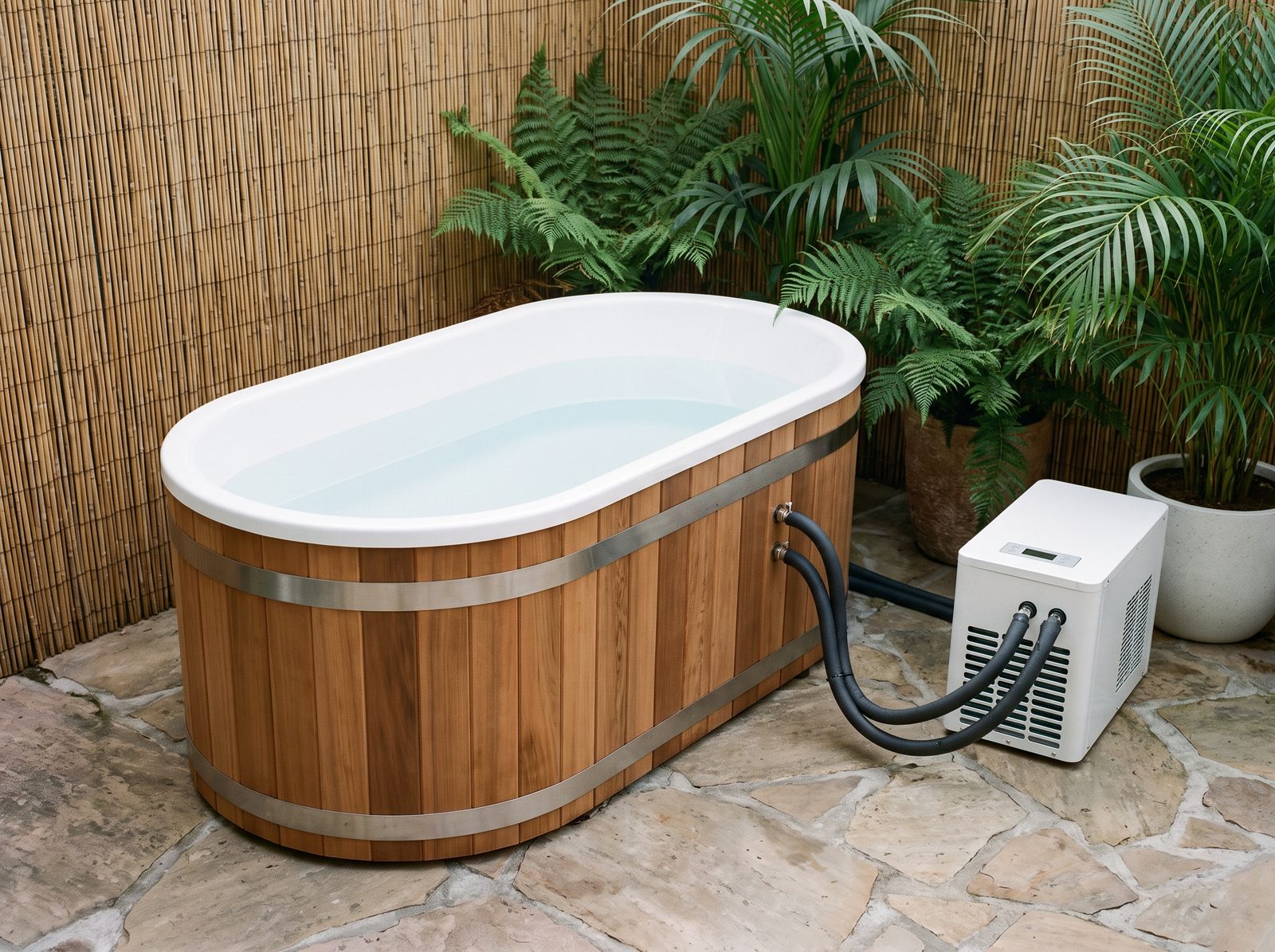
Ice bath3–12 °C, set and held
Chilled cold plunge
Set a temperature and it holds it — in thirty-degree ambient, through the dry season, without you buying a…
from IDR 68,000,000 ≈ USD 4,200
2 models · built on the island
Anyone can fill a tub with ice. Holding ten degrees on an island that never drops below twenty-four is the actual job.
3 years and 100+ builds across Lombok and the Gilis. Message us for photos of similar projects, or tap «Get a project quote» and a project manager will get back to you shortly.
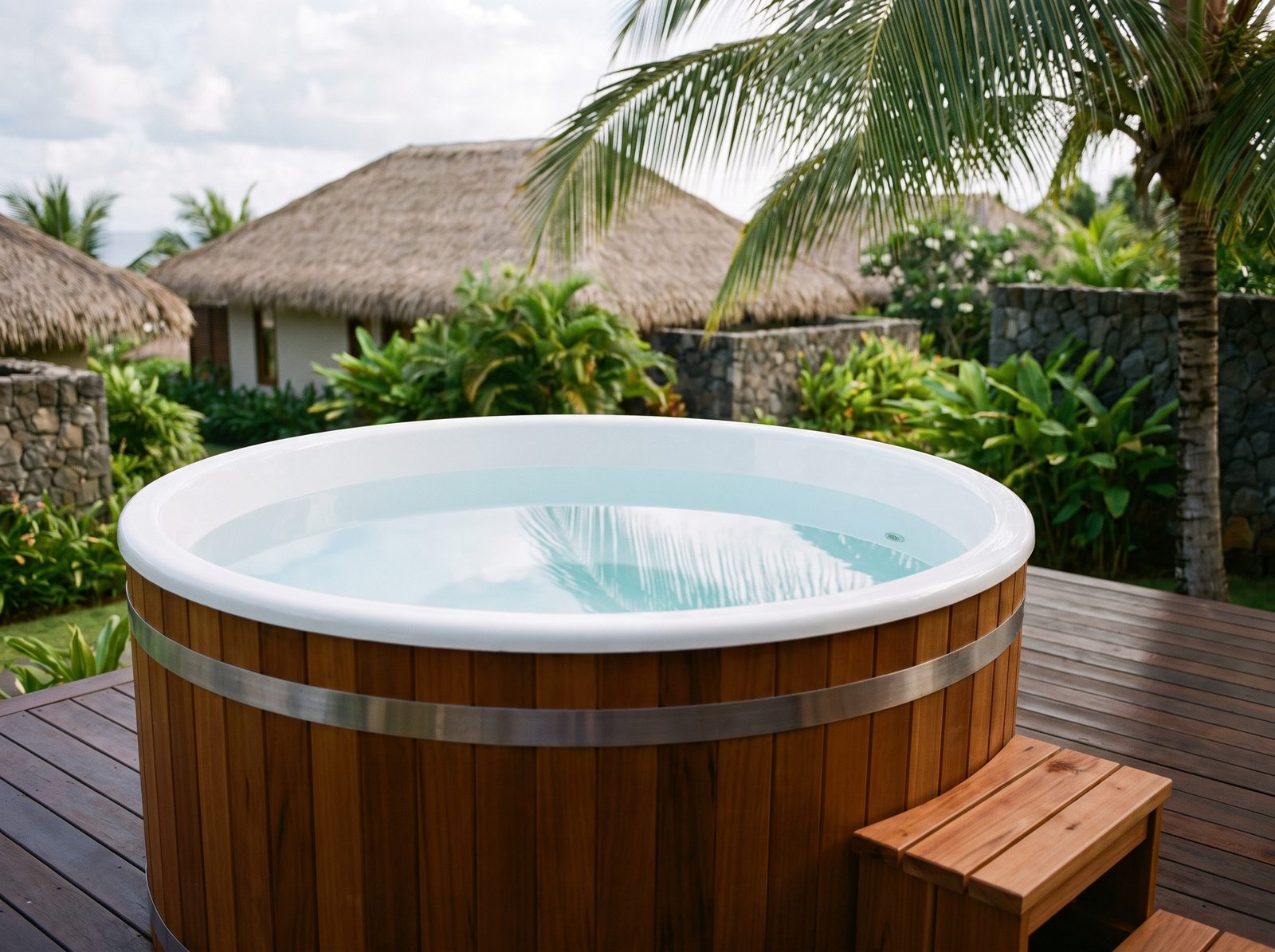
Ice bath3–12 °C, set and held
Set a temperature and it holds it — in thirty-degree ambient, through the dry season, without you buying a…
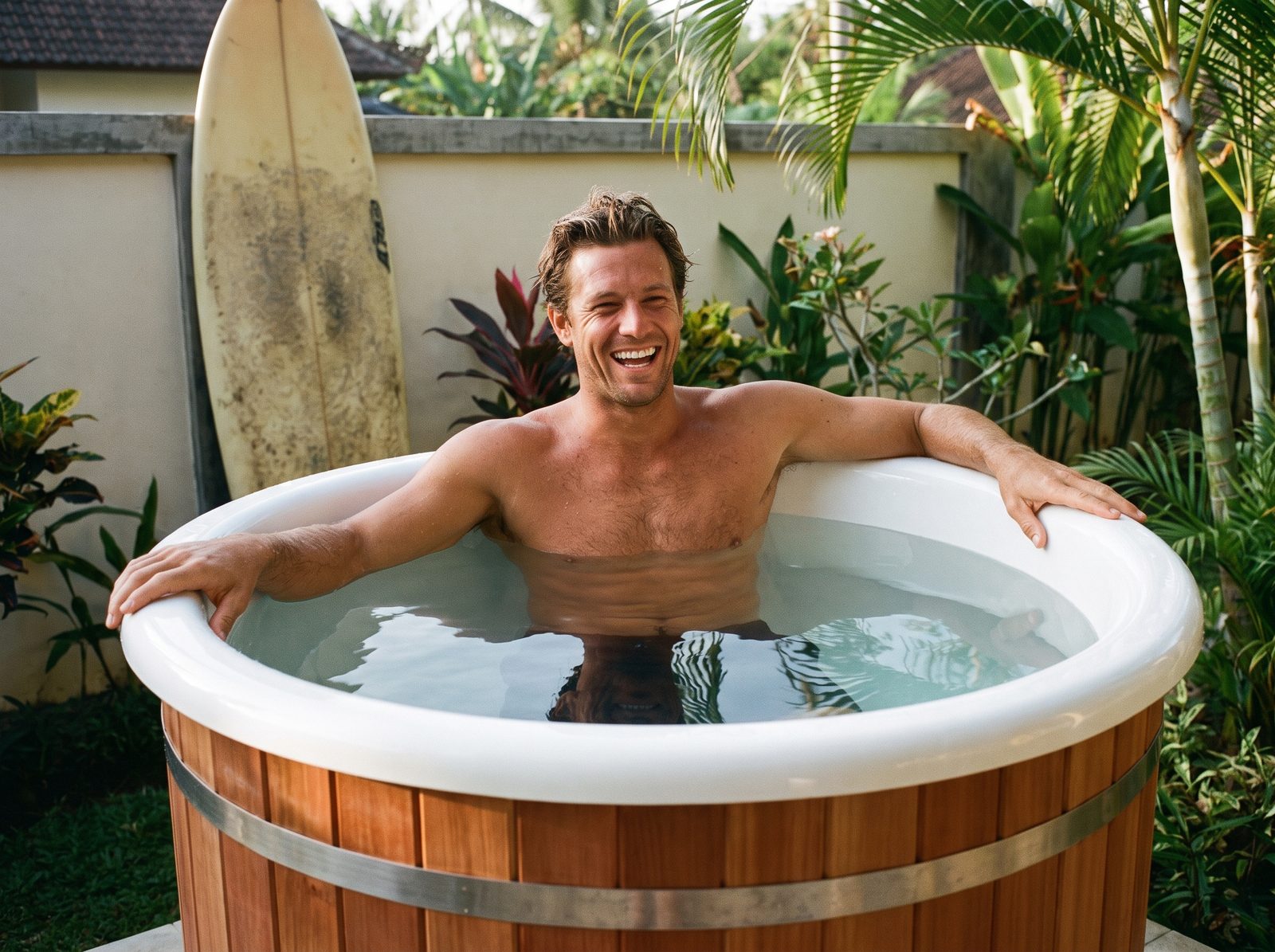
Ice bathIce-dependent, typ. 4–12 °C
The simple one. A hooped cedar tub, no plant, no power, no controller. You bring the ice — and we will tell…
The thinking
There are only two real questions. How often will you use it, and is there power at the spot?

Daily use plus a supply means a chilled plunge. The refrigeration replaces ice permanently, holds a stable setpoint, and pays for the difference within a couple of years — because at Lombok's 27 °C tap temperature you need 20–30 kg of ice per fill, and that adds up to roughly a tonne a month for a daily user.
Occasional use, no power, or a remote site means a cedar ice bath. Nothing to break, nothing to plug in, nothing to service. You just have to actually be honest about whether you will still be hauling ice in month six.
Either way the same physics applies: insulate the shell, fit the lid, put it in shade. Those three decide your outcome long before the chiller does — the full arithmetic is in sizing a chiller for the tropics. And whichever you buy, cold water is not self-sanitising: read water treatment before anyone else gets in it.
Price
An ice bath in Lombok costs from IDR 42,000,000 (≈ USD 2,600) for a hooped cedar tub you fill with ice, and from IDR 68,000,000 (≈ USD 4,200) for a chilled cold plunge that holds 3–12 °C by itself. Those are unit prices; freight to your address, a base rated for the filled weight, drainage and the electrical run are itemised separately once we have seen the site.
| Option | From (IDR) | Best for |
|---|---|---|
| Cedar ice bath | 42,000,000 | occasional use, no power at the spot, remote sites |
| Chilled cold plunge | 68,000,000 | daily use, villas, gyms, surf camps |
| Full wellness zone | 240,000,000 | sauna, plunge and rest built as one sequence |
The full list, including what island logistics add on top, is on the sauna and ice bath price list.
Where
Most of our cold plunges go into three kinds of site. Surf camps and guesthouses around Kuta and Mandalika, where the plunge is used by a rotating crowd after the evening session. Villas and dive resorts on the Gili Islands, where everything arrives by boat and the tub has to fit on a cart. Established resorts and mature gardens in Senggigi, and family homes in Mataram, where the grid is stronger and there is less salt in the air.

Each area changes something: freight and power on the Gilis, sand and shade in the south, older switchboards in town. We plan those at the survey, not at delivery.
Chiller or ice
Lombok tap water arrives at about 27 °C, so a 700-litre tub needs 20–30 kg of ice for every fill, and the water starts warming the moment you step out. For someone plunging daily that becomes roughly a tonne of ice a month — the point at which a chiller stops being a luxury. A chiller sized for tropical air, an insulated shell and a proper lid hold the setpoint through the dry season without a daily ice run.
The sizing arithmetic — heat load, horsepower per litre, and why insulation matters more than the compressor — is in ice bath chiller sizing for the tropics. If you are off-grid or on a small supply, the solar guide shows why the chiller is the easy half.
Buying from abroad
Many of our clients own a villa in Lombok but live in Australia, the UK or elsewhere. The process works remotely: send photos of the spot and your electrical board on WhatsApp, approve a layout and a fixed price, and we coordinate the build with your villa manager. You see progress photos at each stage, and the handover includes a test run on video if you cannot be there. Three years of island builds and more than 100 finished projects have taught us which questions to ask before anyone flies in.

Questions
Our recommended working range is 8–12 °C, with 15 °C a sensible entry point for beginners. Below 5 °C is specialist territory and should be supervised. Colder is not automatically better — time at temperature matters more than chasing a low number, and cold shock is a real risk. Never use an ice bath alone or after drinking alcohol.
Chilled if you use it daily and have power: it holds a stable temperature and stops you buying ice forever. Cedar if you use it occasionally, are off-grid, or want nothing mechanical to maintain. The break-even is roughly a couple of years of daily use, because a 700-litre tub needs 20–30 kg of ice per fill at Lombok's tap temperature.
Because ambient air at 28–32 °C is constantly pushing heat into the water, solar gain adds more, and a chiller's condenser rejects heat badly when it is sitting in hot air. A unit rated for a European garden never catches up here — it runs continuously, ices its evaporator and fails early. Budget roughly double the temperate-climate nameplate, and insulate first.
Yes — three to five metres from the sauna door is the sweet spot. Close enough that the walk is part of the ritual, far enough that the plunge is not sitting in the sauna's heat plume. It needs a base rated for the filled weight (1,000 litres is a tonne), drainage away from timber, and shade. Designing both together as a wellness zone is cheaper than retrofitting.
From IDR 42,000,000 (≈ USD 2,600) for a cedar ice bath and from IDR 68,000,000 (≈ USD 4,200) for a chilled cold plunge, unit only. Freight, base, drainage and electrical work are itemised after a site survey.
Yes. Tubs and chillers travel by boat and cidomo cart, so we size components to fit, plan the power supply in advance and quote freight as its own line.
Next step
Send a photo of the spot and rough dimensions. You get a layout, a heat-load calculation and a fixed price — usually within two working days.