Sauna
Outdoor cabin sauna
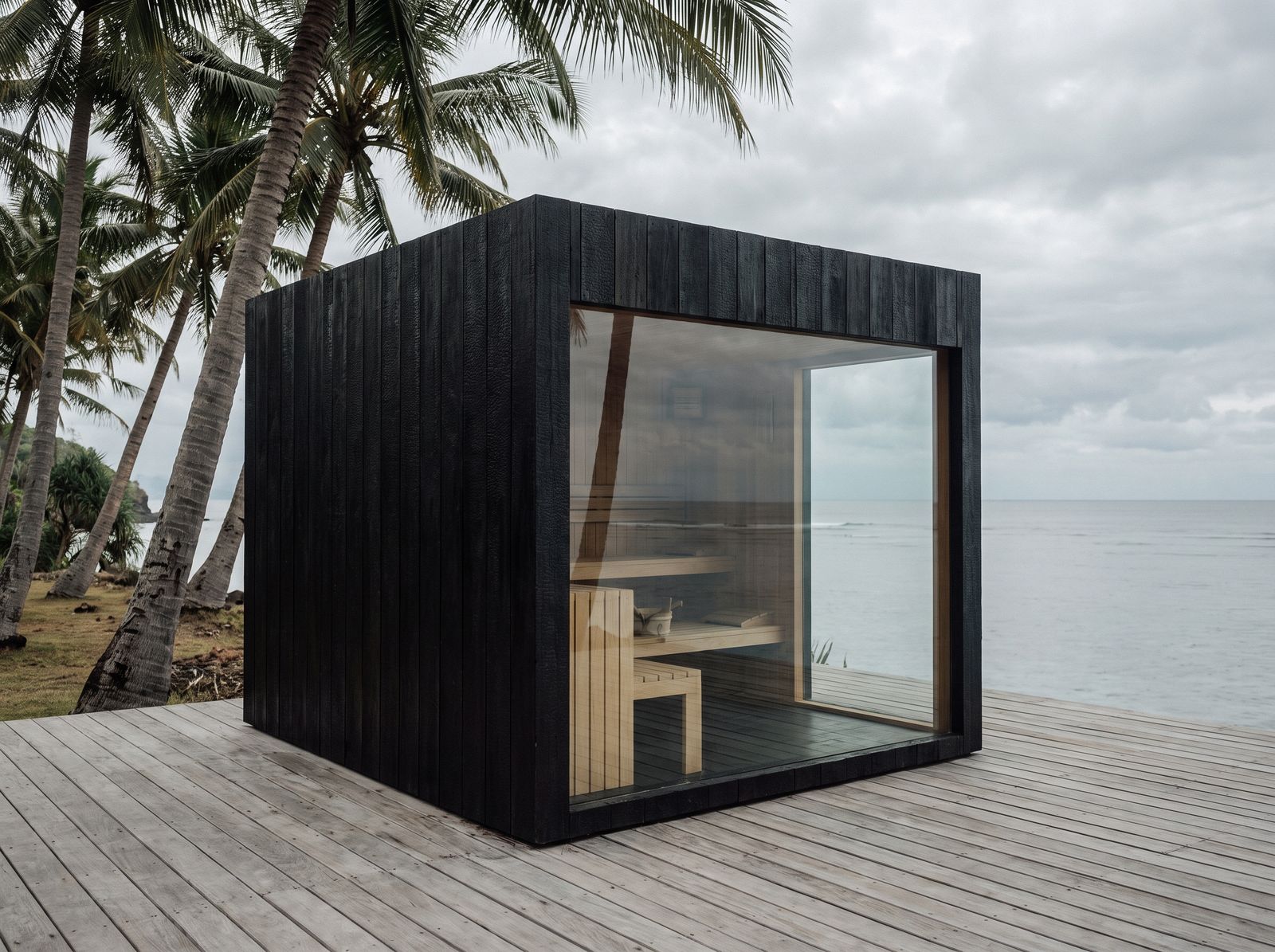
The proper one. Standing headroom, a two-tier bench, and as much glass as the heat-load calculation…
from IDR 125,000,000
Sauna · from IDR 78,000,000 (≈ USD 4,800)
The round one. Cheapest to heat, quickest to temperature, and the only shape on this list that laughs at monsoon rain.
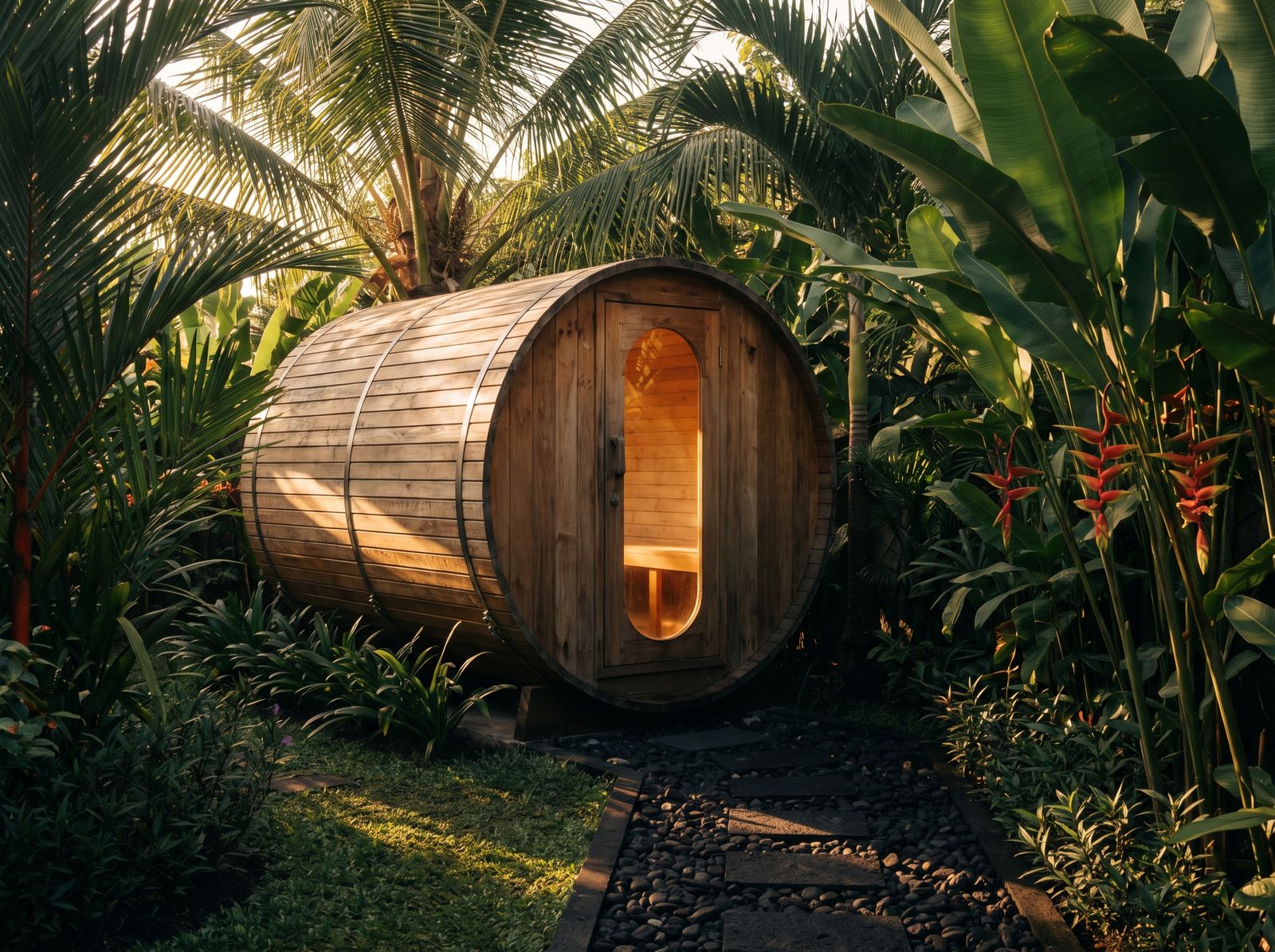
A barrel sauna is a cylinder lying on its side, and that geometry does three useful things at once. There is less air volume to heat than a square room of the same seat count, so it reaches 90 °C in about forty minutes on a 6 kW heater. The curved roof sheds rain instantly, which matters more here than it does in Finland. And the shape puts the ceiling close to your head, so the hot layer sits where you are rather than two metres above you.
It is also the model we most often talk people out of, so read the honest part below before you fall for the photographs.
Lombok's wet season is not drizzle. It is vertical water, for hours, and any flat or shallow roof detail eventually finds a way to hold some of it. A barrel has no flat surfaces and no roof-to-wall junction to fail — water hits the curve and leaves. Ten years of that is the difference between a structure you maintain and a structure you replace.
The staves are cedar, banded with A4/316 stainless rather than the A2 you will find on an imported kit. A2 is fine in a garden in Germany. Two hundred metres from the sea in Lombok it will streak rust down your cladding inside a year — which is one of the specific reasons we build on the island instead of importing flat-packs.
Cedar staves swell shut. A new barrel that shows daylight between the boards on day one is normal and will seal itself within two or three firings as the timber takes up moisture. Do not let anyone caulk it.
The curve that makes a barrel efficient also makes it awkward to sit in. A cylinder gives you a flat bench only where you cut one, so usable width is narrower than the outside diameter suggests, and the lower bench eats into foot room. Two people are comfortable. Four is a squeeze that works because everyone is facing the same way and nobody is moving.
Headroom is the other compromise. You cannot stand up in a barrel. For most people that is irrelevant — you sit down in a sauna — but if you want to do proper löyly with a whisk, or you are tall, the outdoor cabin sauna is the honest recommendation and we will tell you so.
Finally, glass. You can have a round window or a glass door, and that is roughly it. If the point of the build is a wall of glass facing the ocean, a barrel is the wrong shape — see designing a sauna around a view.
A 2.1 m × 2.4 m barrel is roughly 6 m³ of air, which puts it at a 6 kW electric heater on our usual rule of about 1 kW per cubic metre for an insulated room. That is the number that decides whether this project is simple or not, because 6 kW is exactly where a lot of Lombok villa supplies run out.
We check your board during the survey. If the supply will not carry it, you have three options: upgrade the PLN supply, drop to a smaller room, or go wood-fired and ignore the grid entirely. Wood is genuinely attractive here for its independence, and genuinely annoying in the wet season when nothing is dry. Both sides are laid out in electric versus wood-fired heaters and in the electrical requirements guide.
A barrel needs cradles, and the cradles need something level and drained to stand on. Directly on soil is not an option — that is a termite invitation and a rot clock. We stand barrels on treated bearers over a compacted base, or on a small concrete pad with a fall away from the door, and we make sure water leaving the plunge next to it has somewhere to go that is not underneath the sauna.
If a cold plunge is going in alongside it now or later, tell us at survey. Getting the drainage and the three-to-five metre gap right at the start costs nothing; retrofitting it means lifting the deck.
Questions
About 35 to 45 minutes to reach 90 °C at the upper bench with a 6 kW electric heater, from a cold start in Lombok's ambient temperature. That is noticeably faster than a cabin sauna of the same seat count, because there is less air volume and less surface area to lose heat through. Wood-fired takes longer to come up but holds heat well once the stones are charged.
It is the best shape for it. There are no flat surfaces and no roof-to-wall junctions, so monsoon rain hits the curve and runs straight off rather than pooling or finding a seam. Combined with cedar and A4/316 stainless banding, it is the lowest-maintenance outdoor sauna we build for a coastal Lombok site.
Two comfortably, four at a squeeze. The curved shell means the usable bench is narrower than the outside diameter suggests, and you cannot stand up inside. If you need room for four adults who are moving around, or you want a wall of glass, an outdoor cabin sauna is the better fit and we will say so.
No. It needs cradles on treated bearers over a compacted, drained base, or a small concrete pad with a fall away from the door. Timber in contact with Lombok soil is a termite and rot problem, not a maybe. Preparing the base properly is part of the quote and is itemised separately from the sauna itself.
Also consider
Prices are indicative starting points for the unit itself and are quoted in good faith, not as a fixed offer. Foundations, drainage, glass, electrical supply upgrades and island freight are itemised separately. Every firm price follows a site survey.
Sauna
The proper one. Standing headroom, a two-tier bench, and as much glass as the heat-load calculation…
Sauna
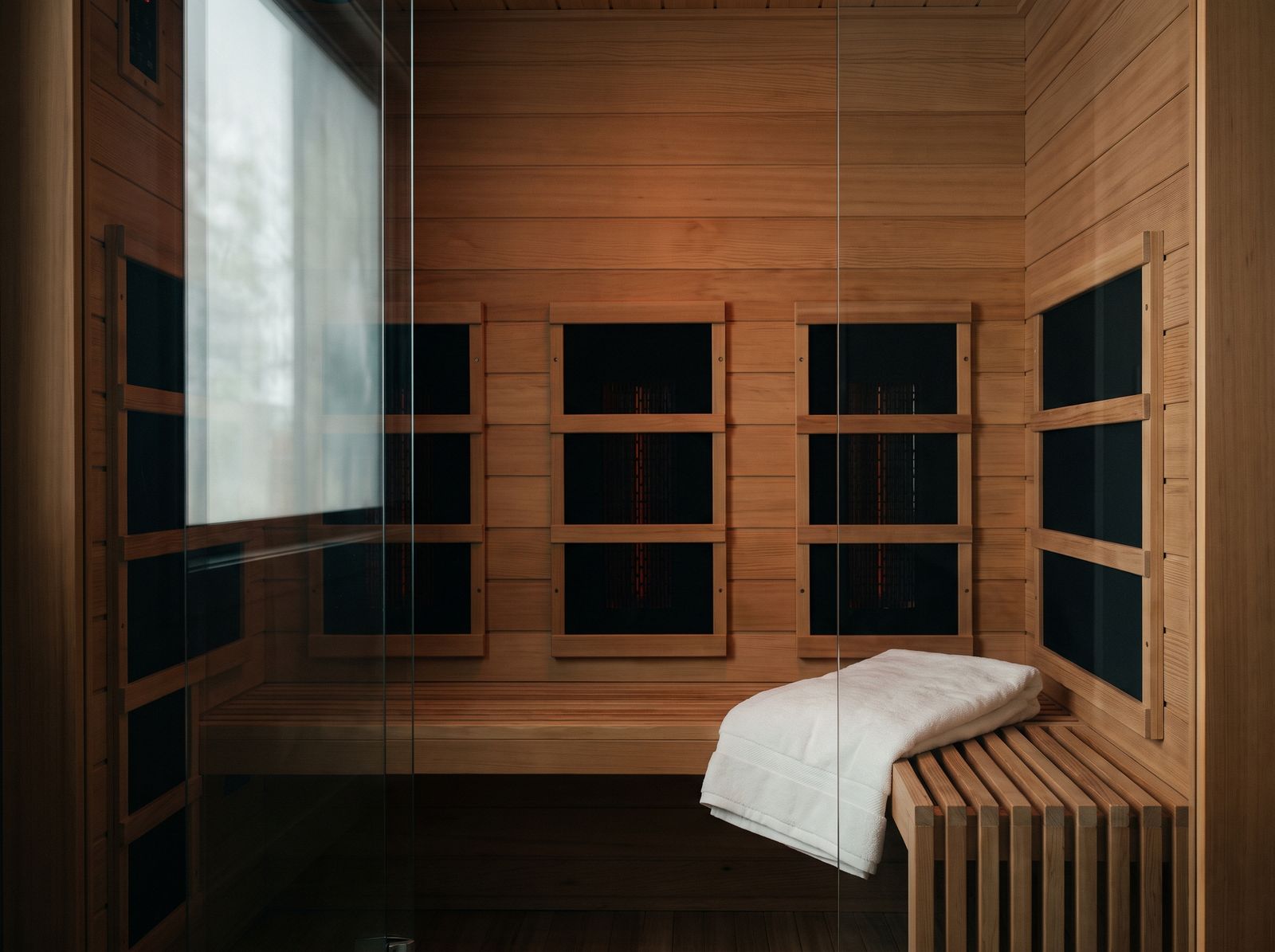
A different machine, not a lesser sauna. Lower temperature, longer sessions, and a power draw your…
Sauna
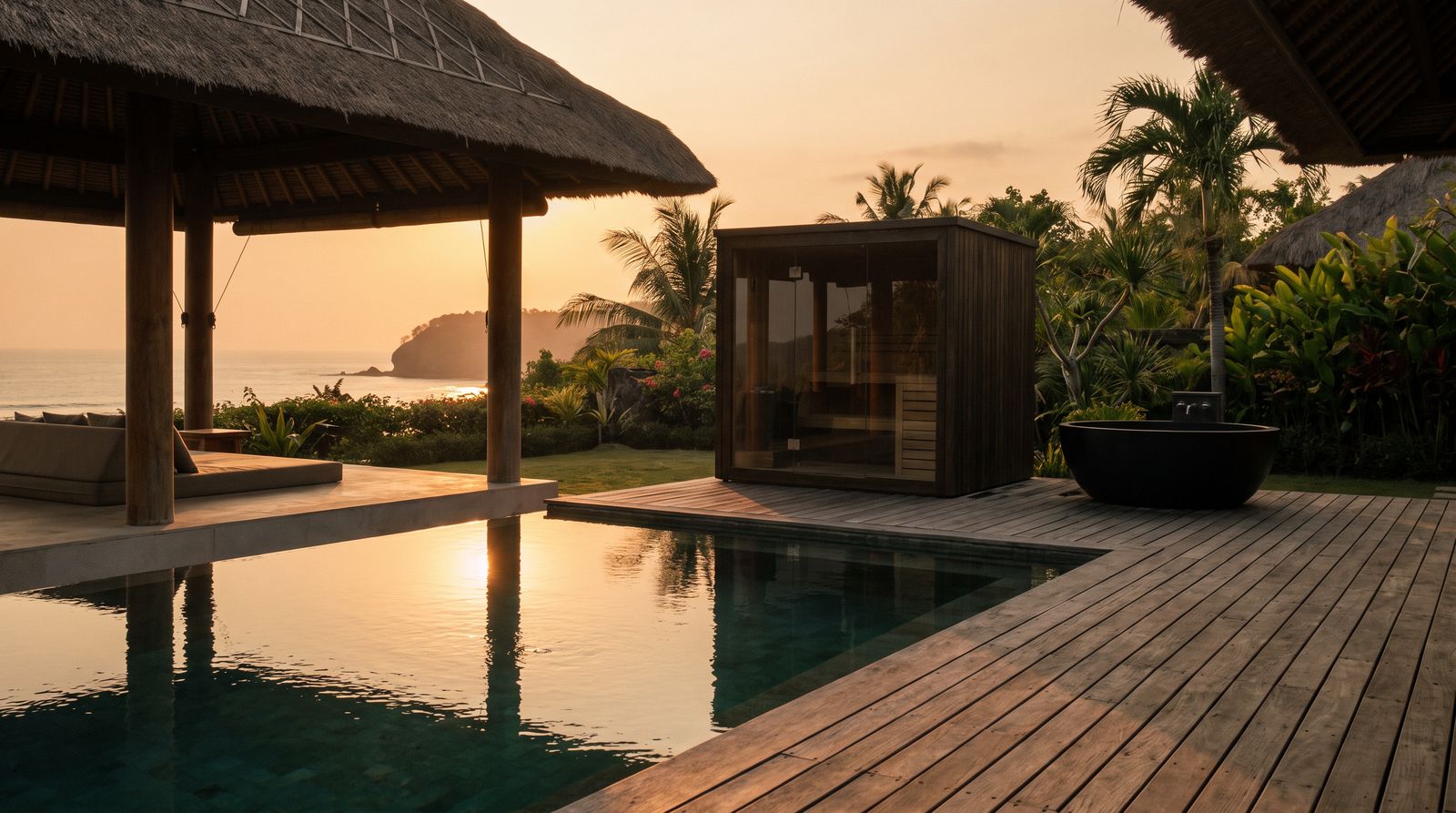
For the room you already have, the corner nothing standard fits, or the cliff edge that deserves…
Next step
Send a photo of the spot and rough dimensions. You get a layout, a heat-load calculation and a fixed price — usually within two working days.