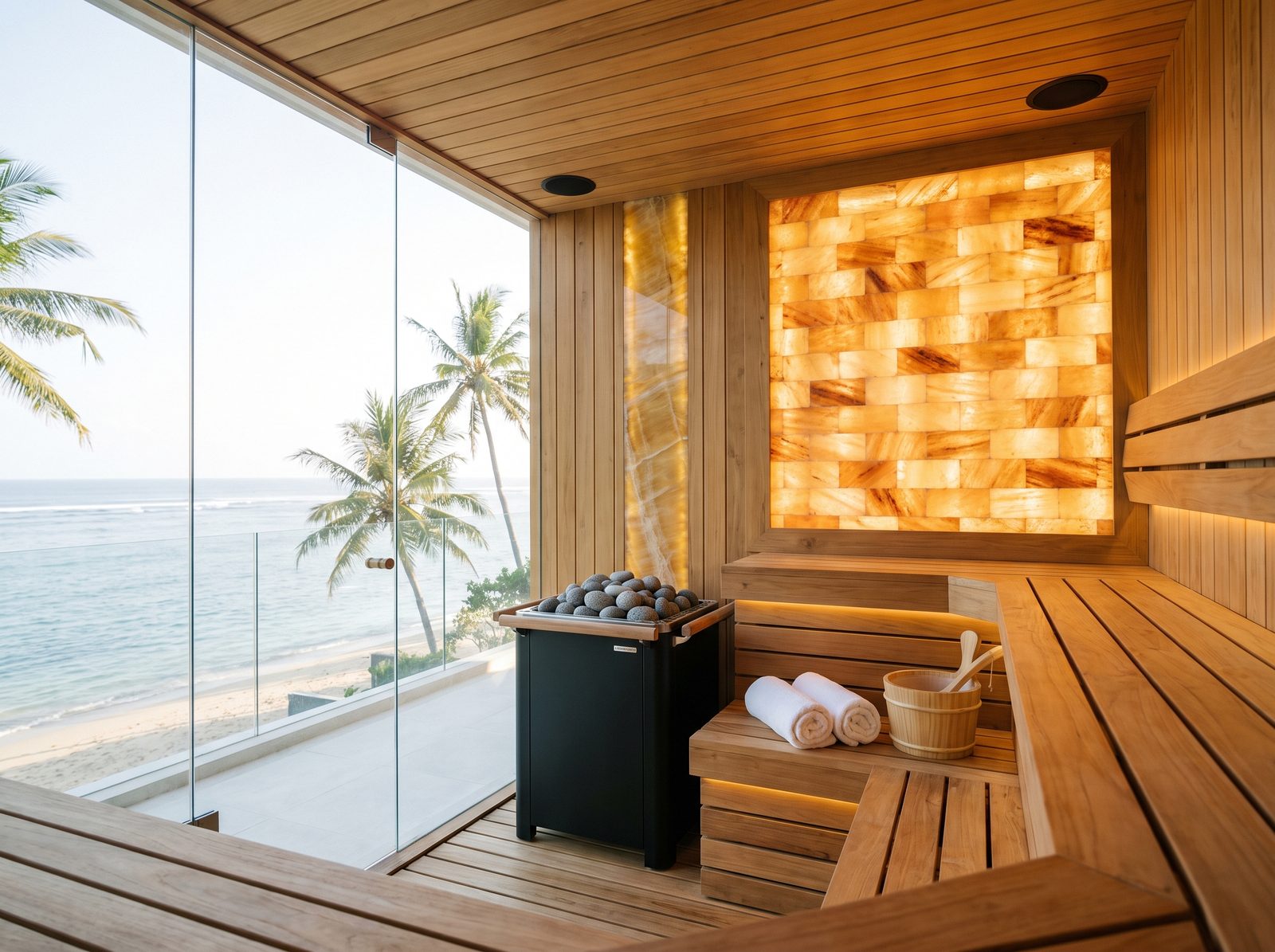
01 — Heat3 models
Saunas
Cabin, infrared or fully custom. Traditional rooms with proper stone heaters, sized against a real heat-load calculation rather than a catalogue guess.
from IDR 52,000,000 ≈ USD 3,200
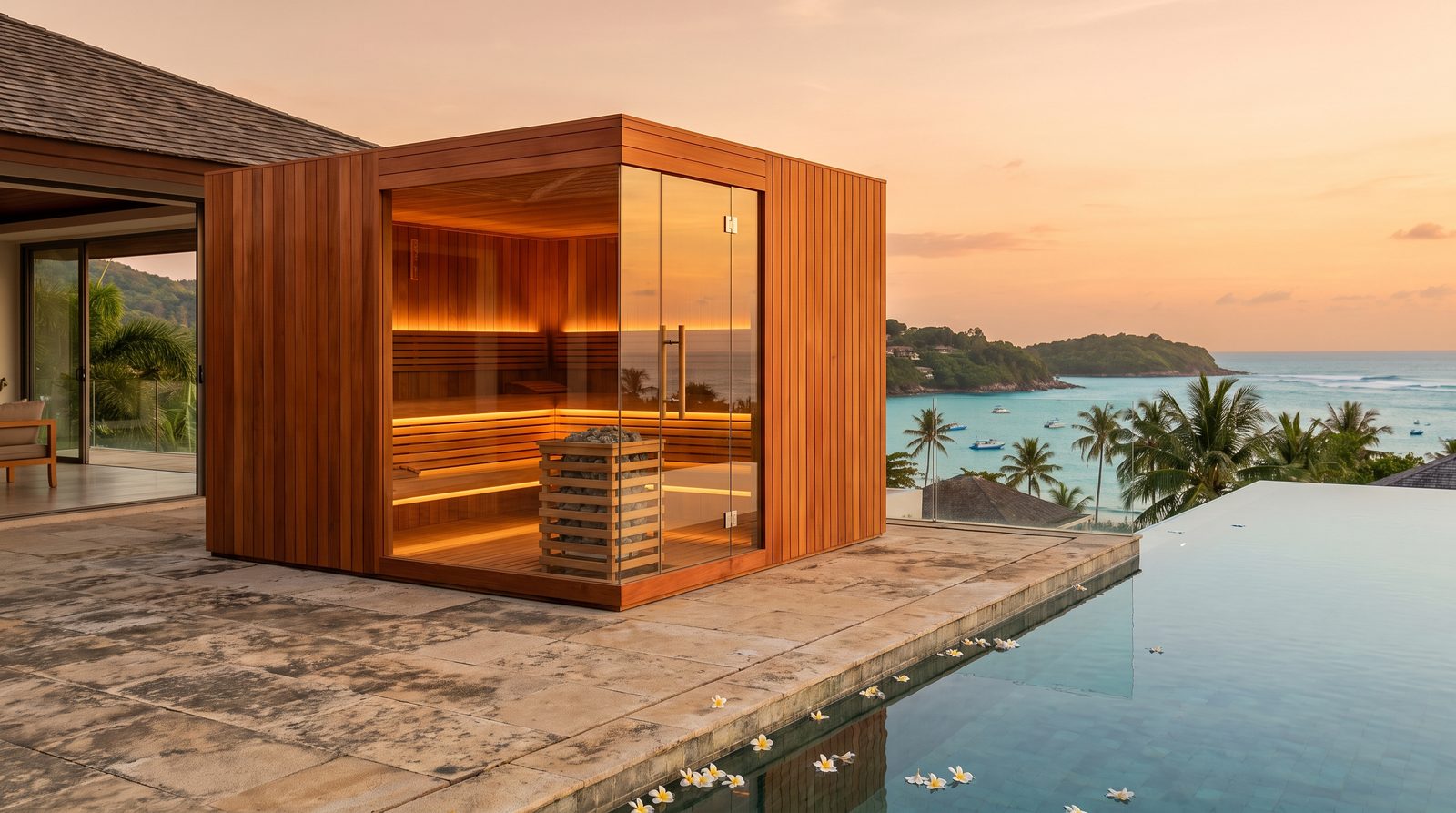
Ninety degrees.
Then three.
Saunas, ice baths and wellness zones for villas, surf camps and resorts from Kuta to the Gilis — engineered for thirty degrees in the shade and salt air. Three years of island builds and 100+ finished projects; a fixed price after survey and a 2-year structural warranty.
Message us on WhatsApp and we'll send photos of finished builds and the detailing behind them. Want numbers? Tap the second button — a project manager will get back to you shortly.
Looking for a sauna to visit? We build private ones for villas and homes, from IDR 52M — see ice bath Lombok options and saunas in Kuta Lombok.
90°C
Upper bench,
traditional room
3°C
Plunge floor,
held year-round
3–6wk
Survey to
first löyly
100%
Built on
the island
The principle
Heat opens you up. Cold shuts you down. The interesting part is the switch between them — which is exactly the part most installations get wrong, because they build one and bolt the other on later.
90°C
A traditional room, 80–100 °C at the upper bench, 10–20% humidity, and real löyly when water hits the stones. Not a warm cupboard.
3°C
A chilled plunge that holds temperature while the air outside sits at thirty. That is a refrigeration problem, and on this island it is the hard half of the job.
What we build
We are not a showroom. Every build starts with a survey of your actual spot — the power that reaches it, the way water leaves it, and where the afternoon sun lands.
01 — Heat3 models
Cabin, infrared or fully custom. Traditional rooms with proper stone heaters, sized against a real heat-load calculation rather than a catalogue guess.
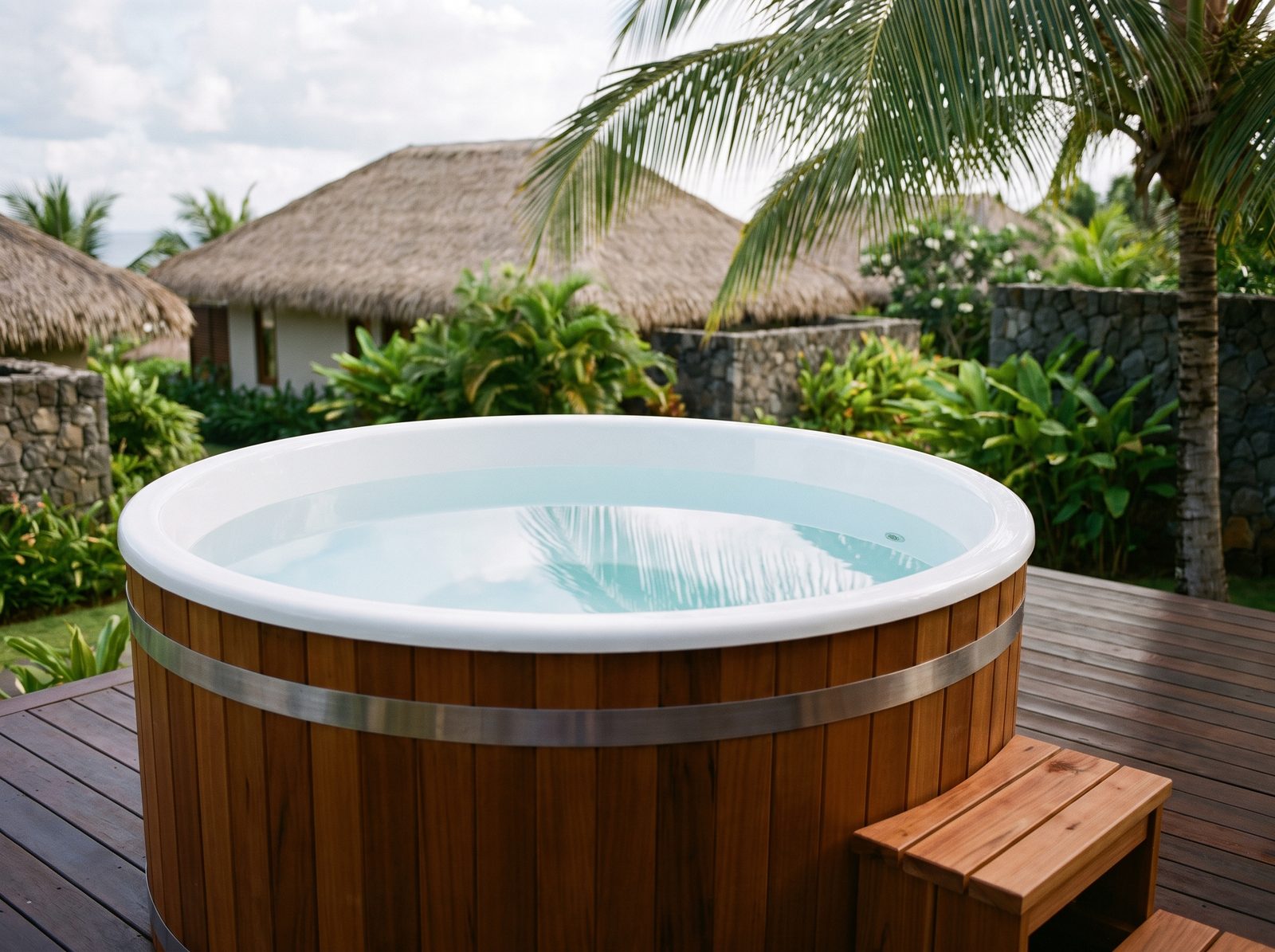
02 — Cold2 models
Cedar tubs and chilled plunges with the refrigeration actually sized for thirty-degree ambient — insulated, filtered, and holding temperature through the dry season.
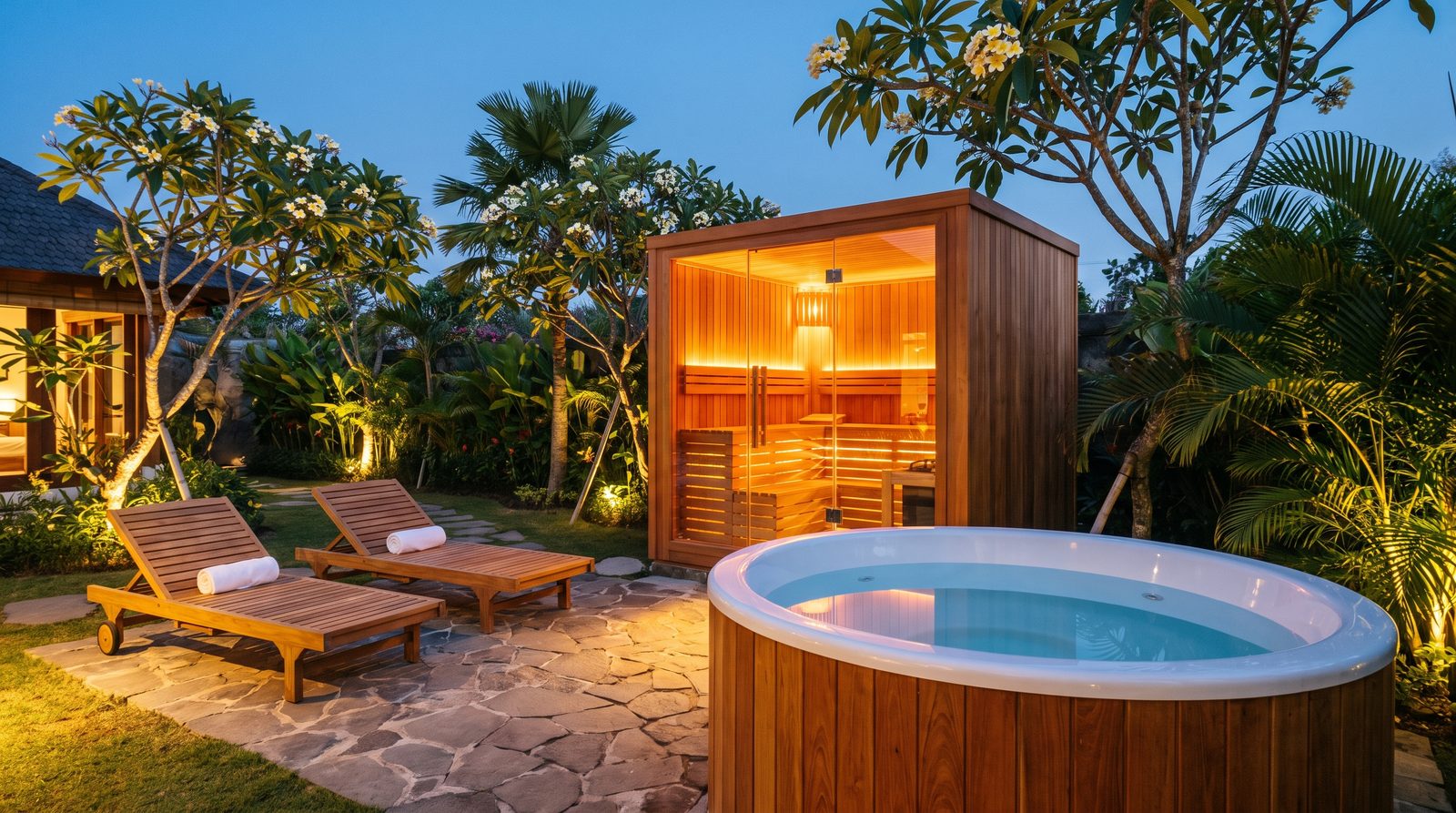
03 — BothDesign + build
The whole sequence: hot room, plunge, and a rest area that works in the tropics. Circulation, drainage, shade and privacy designed as one thing.
The catalogue · Heat
Three ways to get to ninety degrees. The right one depends on your site, your power supply and how many people sit down at once — not on which looks best in a photo.
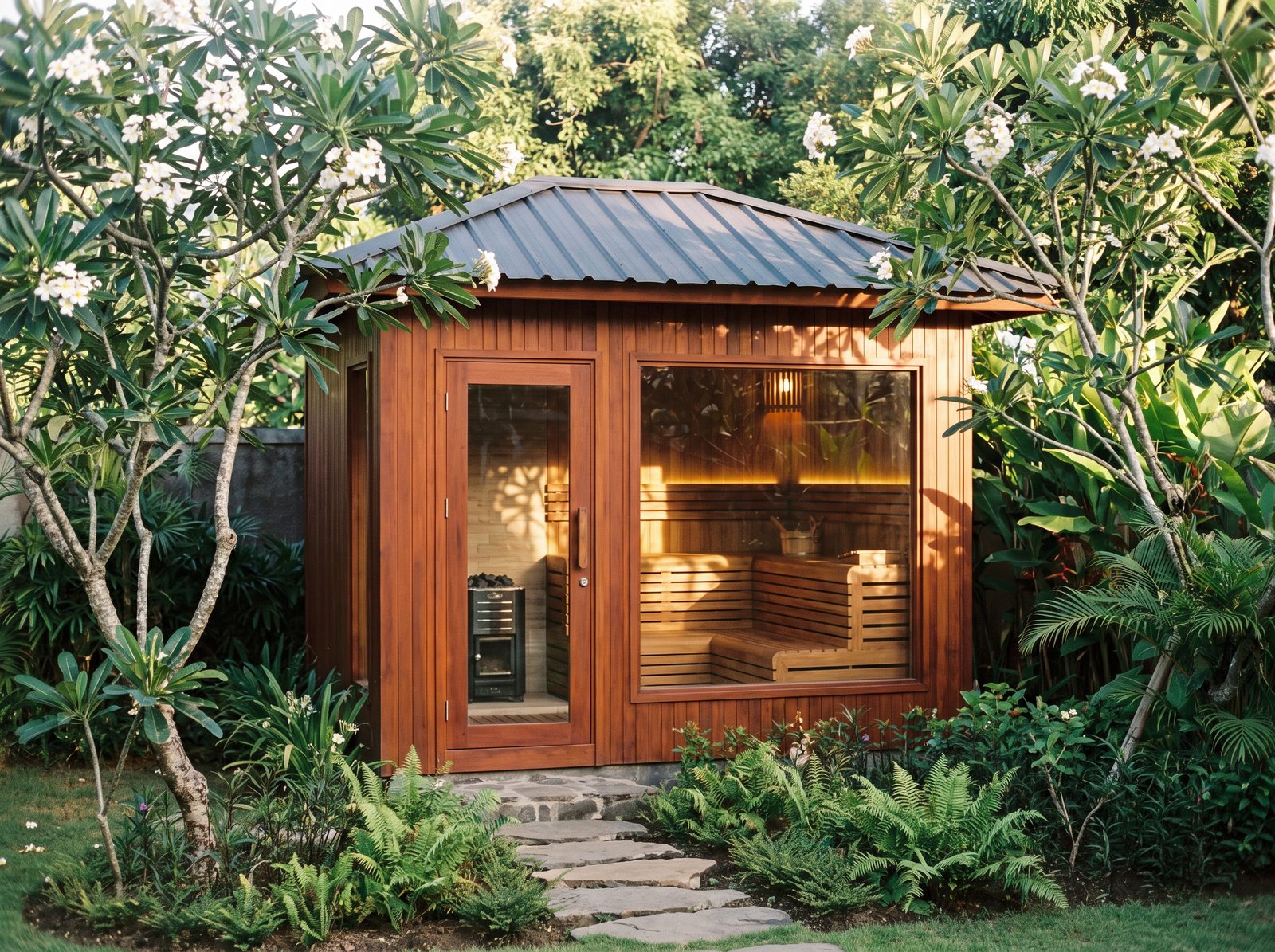
Cabin4–6 seats
Headroom, a proper two-tier bench, and as much glass as your heat-load calculation will allow.
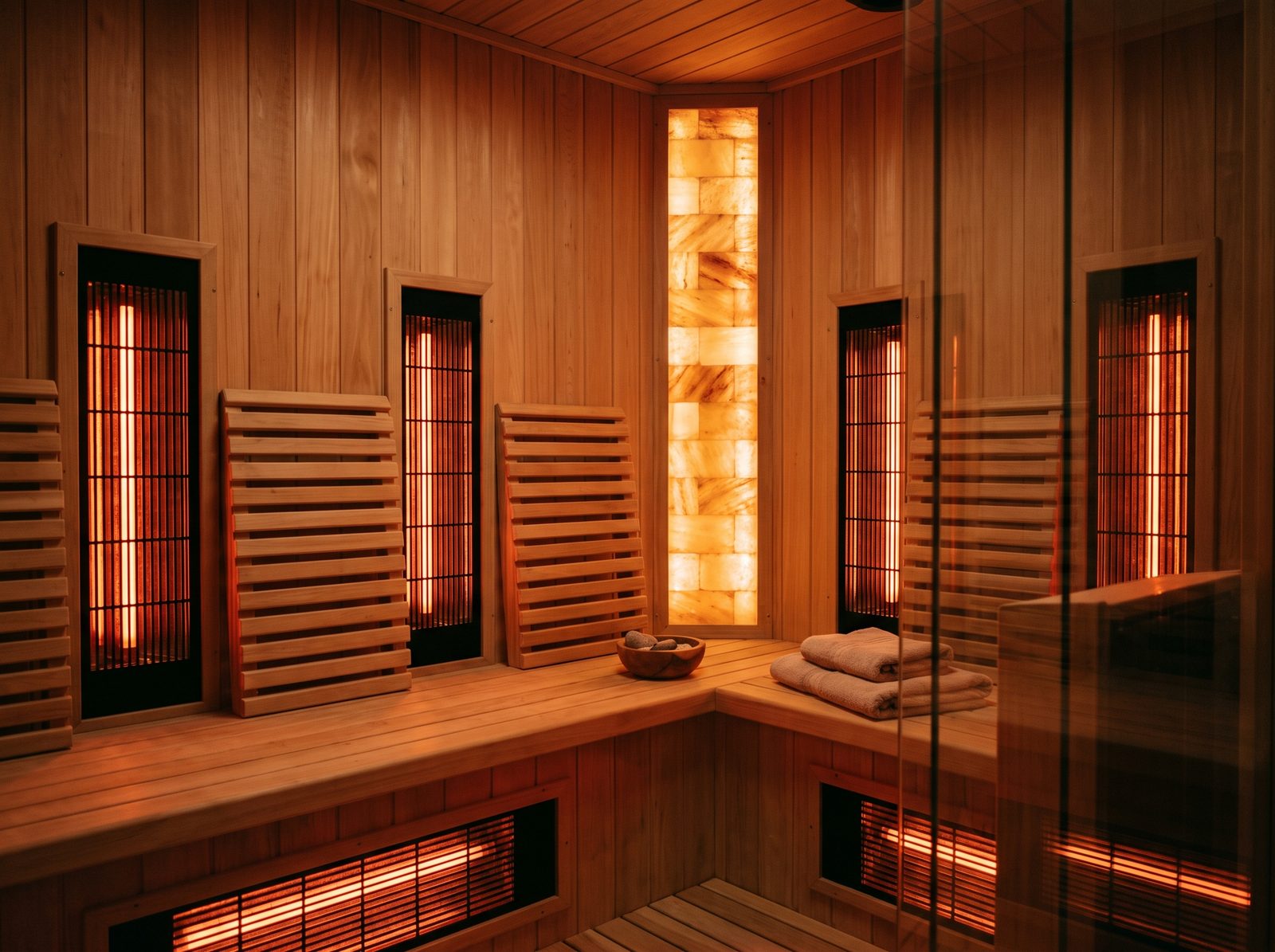
Infrared2–3 seats
A different machine: 45–60 °C, no steam, and a power draw a weak PLN supply can actually carry.
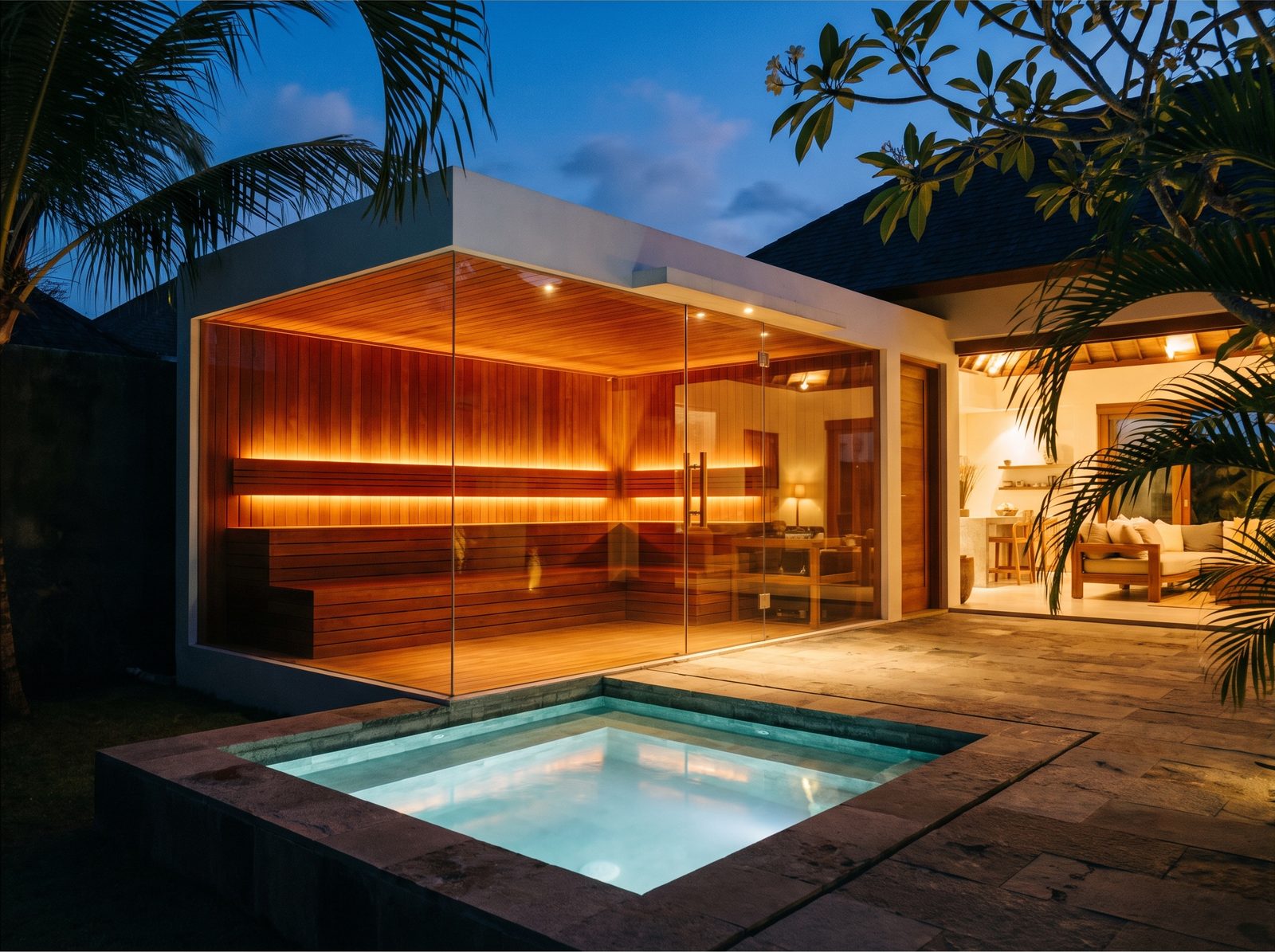
CustomAny size
Built into the villa fabric — a converted room, a cliff edge, an awkward corner. Drawn, then built.
The catalogue · Cold
Anyone can fill a tub with ice. Holding ten degrees in a place that never drops below twenty-four is the actual job — and it is decided by insulation long before it is decided by the chiller.
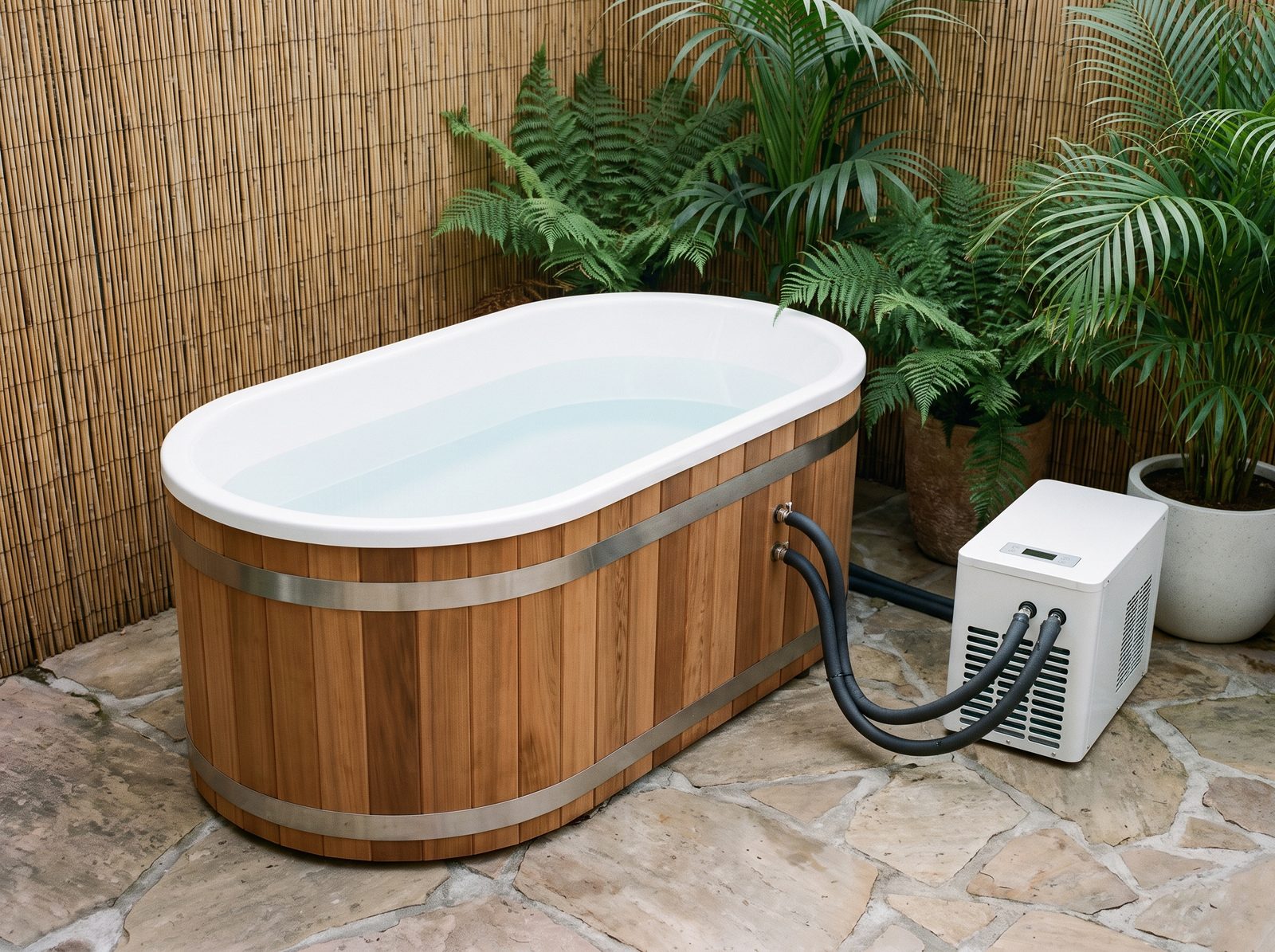
Chilled3–12 °C
Insulated shell, filtration, ozone, and a chiller sized against Lombok's ambient rather than a European catalogue. Set it and it holds.
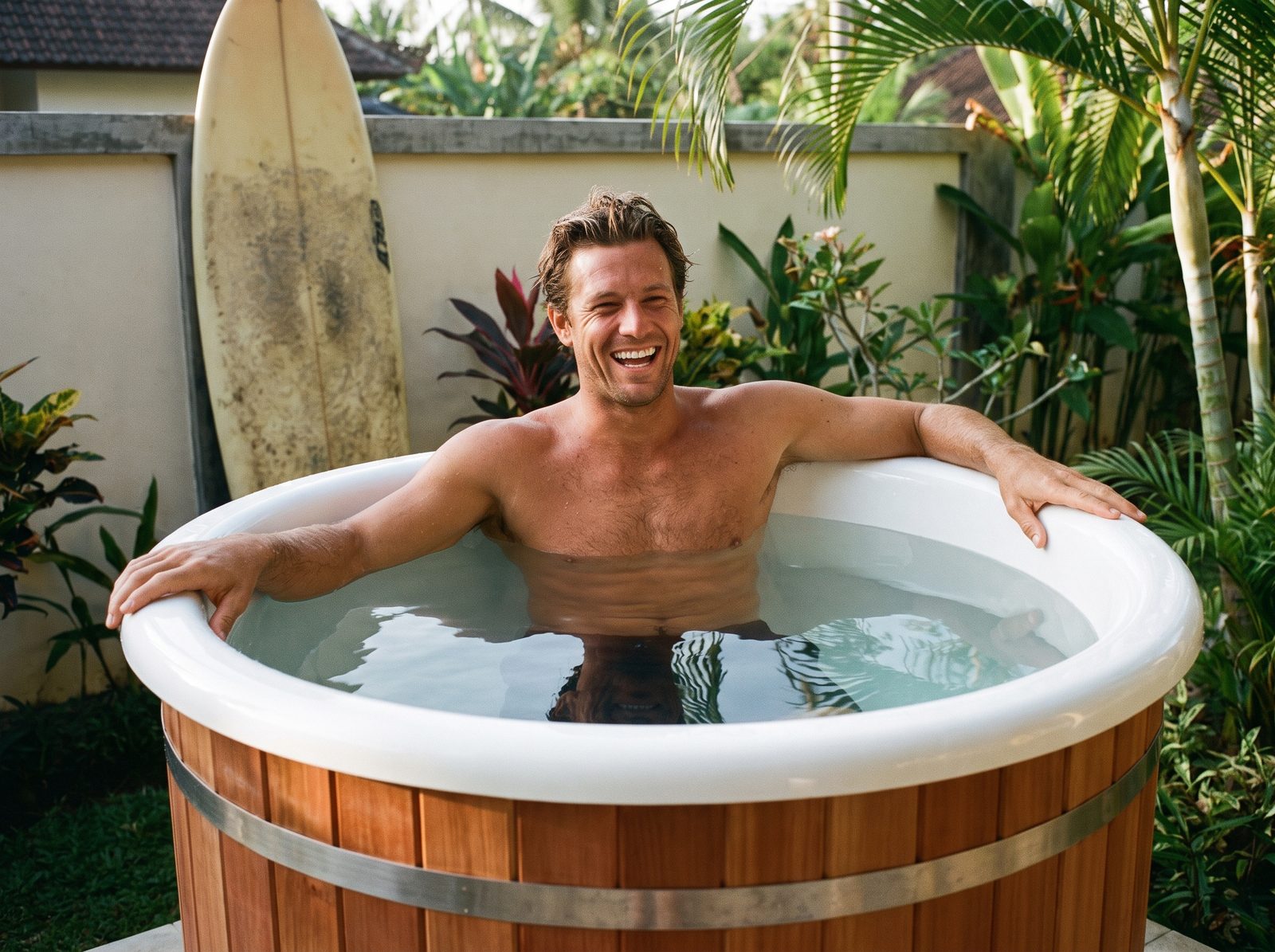
CedarIce-filled
The simple one. A hooped cedar tub, no plant room, no power. You bring the ice — and we will tell you honestly what that costs per year.
Why it is hard here
A plunge tub in Lombok is fighting three heat sources at once: air at 28–32 °C, direct solar gain on the shell, and the bather. A chiller rated for a European garden meets that load and never catches up — it runs continuously, ices its own evaporator, and dies inside two seasons.
So we start from the load, not the equipment. Insulate the shell and fit a lid and the chiller you need gets smaller and cheaper. Skip that and no amount of horsepower saves you.
The arithmetic, in full, is in our guide to sizing an ice bath chiller in the tropics — including why buying ice forever costs more than the machine.
The difference
On this coast the onshore breeze carries salt well past the beachfront and the air never truly dries. A sauna lasts here because every board, screw and finish was chosen for that — not because it was imported hopefully.
Every screw, hinge, band and bracket outside the hot room is A4/316 stainless. A2 looks identical on the counter and is bleeding rust down your cladding within a year of sea air — and at Kuta, Selong Belanak or Senggigi, sitting a couple of ridges back from the water does not exempt you.
Sea salt and UV work on wood as a pair: the sun breaks the surface down while the salt film holds moisture against it. So exteriors are charred timber or dense bengkirai under a penetrating oil that can be renewed — never a film varnish, which peels in this sun and traps salt beneath the failure. The species logic is in the timber guide.
At 85% ambient humidity a hot room cannot dump moisture to the outside the way it does in a dry climate. Ventilation gets designed — inlet low by the heater, outlet high and opposite — not left to a gap under the door. Details in our tropical sauna ventilation guide.
The supply that actually reaches your villa is the real constraint, not the room. We calculate heat load first, then tell you whether you need a supply upgrade — quoted as its own line, never buried.
Monsoon rain wants two answers. Above: deep eaves and a covered landing at the door, so water sheds clear of the cladding and the end grain. Below: falls, channels and a soakaway, drawn before the deck is. Standing water under a timber structure is how you lose it.
No untreated softwood touches the ground, anywhere. Structures stand on treated bearers or steel, and everything within reach of soil is a species that can defend itself.
Everything lands through Lembar or over the Padangbai ferry. Panel sizes, crate dimensions and the width of your access road are part of the drawing, not a surprise on delivery day.
For surf camps and resorts the hot room is infrastructure, not an ornament: at temperature when guests come up from the beach in the late afternoon, running again for the evening round, recovered in between. We size and schedule for that duty cycle — the arithmetic is in wellness for boutique hotels.
Commissioning is part of the build. We run the room to temperature, balance the ventilation, prove the RCD, and hand it over working — not left as a pile on your deck.
Selected work
Private villas, boutique resorts and surf camps across the island — garden saunas, resort courtyards, and recovery zones timed to be hot when the last group comes in from the break.
All projects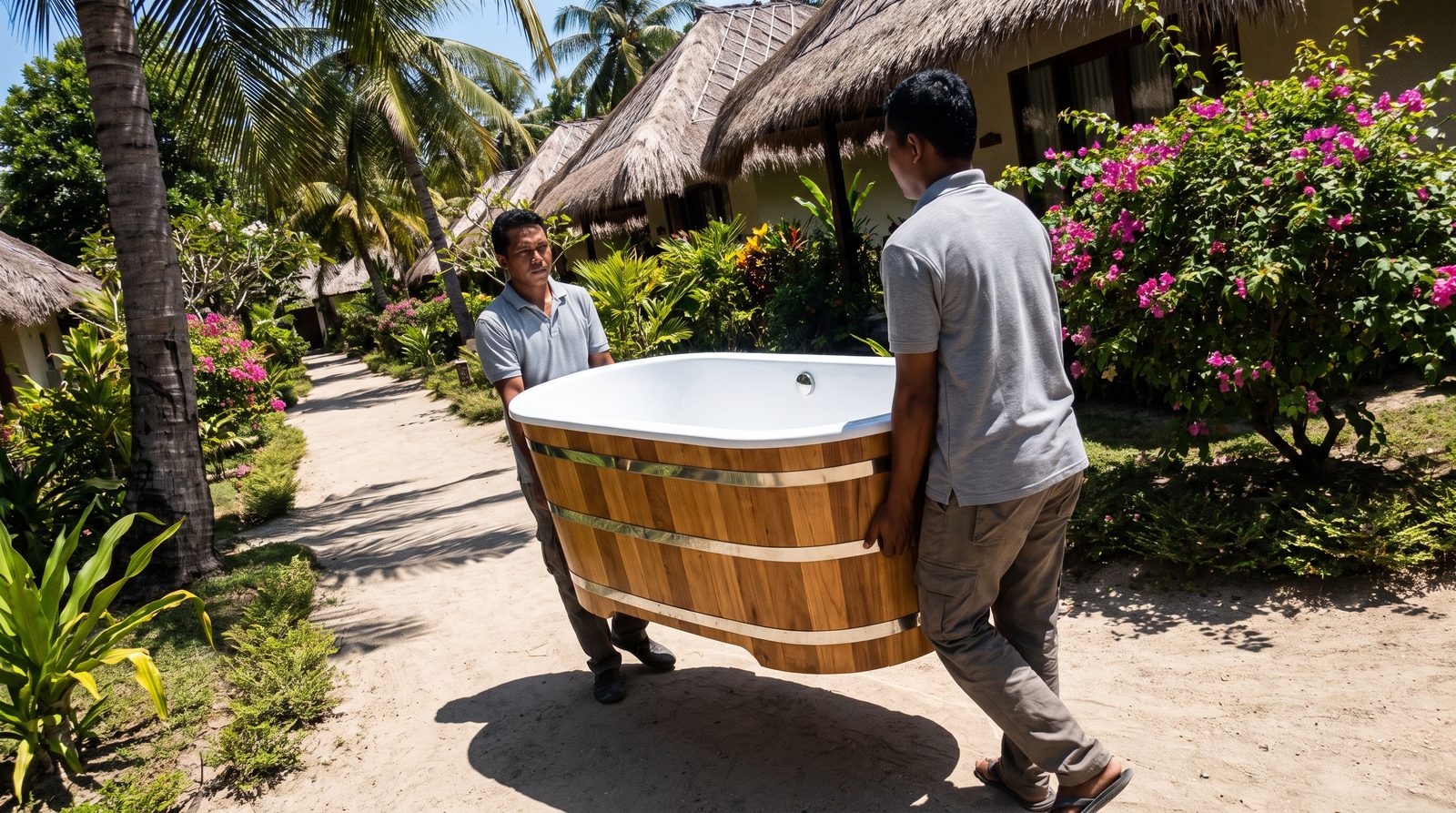
How it works
No deposit until you have seen a drawing and a fixed price. Nothing about the process should be a surprise.
01
We come to the spot — or you send photos and dimensions on WhatsApp if you are off-island. We measure, check the supply at the board, and look at where water goes.
02
A layout, a heat-load calculation, a specification and a fixed price. Usually two working days. Supply upgrades and groundworks are itemised separately, never hidden.
03
Cut, assembled and finished in the workshop, then installed on site. Three to six weeks for a standard cabin; eight to twelve for custom.
04
We run it to temperature, balance the ventilation, test every circuit, and walk you through it. You get the maintenance schedule in writing.
Questions
Anything else, message us. We answer the awkward ones too.
Indicative starting prices are IDR 52,000,000 (≈ USD 3,200) for an infrared cabin and IDR 125,000,000 (≈ USD 7,700) for an outdoor cabin sauna. Those cover the room and heater. The full installed cost also depends on foundations, drainage, glass and whether your electrical supply needs upgrading, which is why every quote follows a site survey.
Read the full Lombok sauna cost guide → — it itemises the roughly 40% of the bill that is not the cabin. Or see all pricing.
Three to six weeks from signed drawing to first use for a standard cabin sauna, and eight to twelve weeks for a custom built-in room. An ice bath is faster — usually two to three weeks, unless it needs a new deck or a power run. Lead time is driven mostly by freight to the island and by any electrical supply upgrade, both of which we confirm before you commit.
The full process, stage by stage, is on how we work.
Often, but not always. Many Lombok villas are on a single-phase PLN supply that comfortably runs a small infrared cabin but not a 6 kW-plus stone heater. We check the supply at your board during the survey and tell you plainly whether you need an upgrade or three-phase, and what that costs, before you order anything.
Read the guide to sauna electrical requirements in Lombok → for the heater-kW-to-supply table.
Yes, and we would rather build both together. The hot room and the cold plunge are one system — the distance between them, the drainage, and where you rest afterwards all matter. We build cedar ice baths and fully chilled cold plunges, with the refrigeration sized against Lombok's ambient temperature rather than a European rating.
Read sauna vs ice bath: what contrast therapy actually does →
Yes — recovery setups for surf camps and resorts are a large share of our work. The brief is different from a villa: the room has to be at temperature when guests come up from the beach in the late afternoon, run in bookable rounds through the evening, and recover between groups. That points to a compact, fast-recovering cabin, a plunge with filtration sized for daily shared use, and a rinse shower ahead of the door, because guests arrive carrying salt and sand.
Read sauna for surfers → — or the ROI framework for boutique hotels.
Our working range is 8–12 °C, with 15 °C a sensible entry point for beginners. Below 5 °C is specialist territory that should be supervised. Colder is not automatically better — time at temperature matters more than chasing a low number. Never use an ice bath alone or after drinking alcohol, and check with a doctor first if you have a cardiovascular condition, blood-pressure issues, or are pregnant.
You can build the box. What people get wrong is the parts you cannot see: the vapour barrier, the ventilation path, and the timber choice. Ventilation designed for a cold dry climate barely moves air at 85% humidity, so the room feels stale rather than hot and rot starts inside the wall. Resinous pine on a bench weeps sap and gets hot enough at the knots to burn. Electrical work must be done by a qualified electrician regardless.
If you want to try, we would rather you did it well — start with tropical sauna ventilation and choosing timber for a tropical sauna. Message us and we will tell you honestly whether your plan works.
Yes. We build across Lombok including Kuta, Senggigi, Mataram, Selong Belanak and Sire and Tanjung, and we install on Gili Trawangan, Gili Air and Gili Meno. Island delivery adds a boat transfer and constrains panel sizes, so we design around it from the start rather than discovering it on delivery day.
What that means in practice is on the Gili Islands page — there are no cars, so everything moves by cart.
Yes. Salt air and humidity mean a coastal sauna needs real maintenance, so every handover includes a written schedule. We offer servicing across the island — stone replacement, bench refinishing, seal and fixing checks, chiller service and water treatment. We also service systems we did not build, once we have inspected them.
Start from the bench: the seat should hold the view, which usually matters more than proximity to the house. Then check the practical layers — out of guest sightlines, close enough to the plunge and a rinse that the circuit feels natural, on ground that drains, and with the vent path set to work with the prevailing breeze. Most plots have one spot that satisfies all of it; finding that spot is what the survey visit is for, and photos with rough dimensions are enough to start.
A little, and it is predictable. The elevation facing the water takes the most salt and sun, so its oil finish is renewed more often than the sheltered faces, fittings on that side are checked at each service, and the view glass gets a fresh-water rinse rather than a scrape. None of this changes what the sauna costs to run day to day — it changes which face you look at first during the seasonal check, which is exactly how we write the handover schedule.
Where we build
Based in Kuta on the Mandalika coast, building everywhere from Senggigi to the Gilis. If your access road is one metre wide, tell us early and we will design around it.
Journal
Guides on heat, cold and the specific ways this climate breaks things, written by the people who build them. Start with how long a sauna build takes in Lombok and ice baths for villas, gyms and retreats.
Read the journalCold8 min
Ice bath temperature isn't a race to the lowest number. The 8–12°C working range, a 15°C beginner entry, and why below 5°C needs…
Technical8 min
Sauna electrical requirements in Lombok: PLN supply tiers, single vs three-phase, cable sizing, RCD earthing, and why 6 kW…
Wellness Zones8 min
Wellness zone design is a circulation problem: the order of hot room, plunge and rest, the distances between them, drainage falls…
Siting notes · October 2026
Most recent villa surveys turned on the same question: not which sauna, but where it should stand. Four notes from those visits, while the dry-season build window is still open. Send plot photos and your approximate footprint on WhatsApp this month and we can plan the survey visit around the first rains.
An ocean view is framed from the bench, not the doorway — so we set the glazing for a seated eye line and keep glass to the view face only, because every extra pane costs heat the stove has to buy back.
The door should open away from guest paths and the pool deck. A metre of planting or a screen wall reads calmer than a blind — and the walk from hot room to plunge stays out of sightlines.
The afternoon onshore breeze can drive the vent path if inlet and outlet are set with it rather than against it. A door facing the prevailing gust slams, drains heat, and carries spray closer than you think.
Whichever elevation looks at the water weathers fastest. That face gets its renewable oil finish checked first each season and fresh water over the glass — the full routine is in the salt-air maintenance schedule.
Next step
Send a photo of the spot and rough dimensions. You get a layout, a heat-load calculation and a fixed price — usually within two working days.