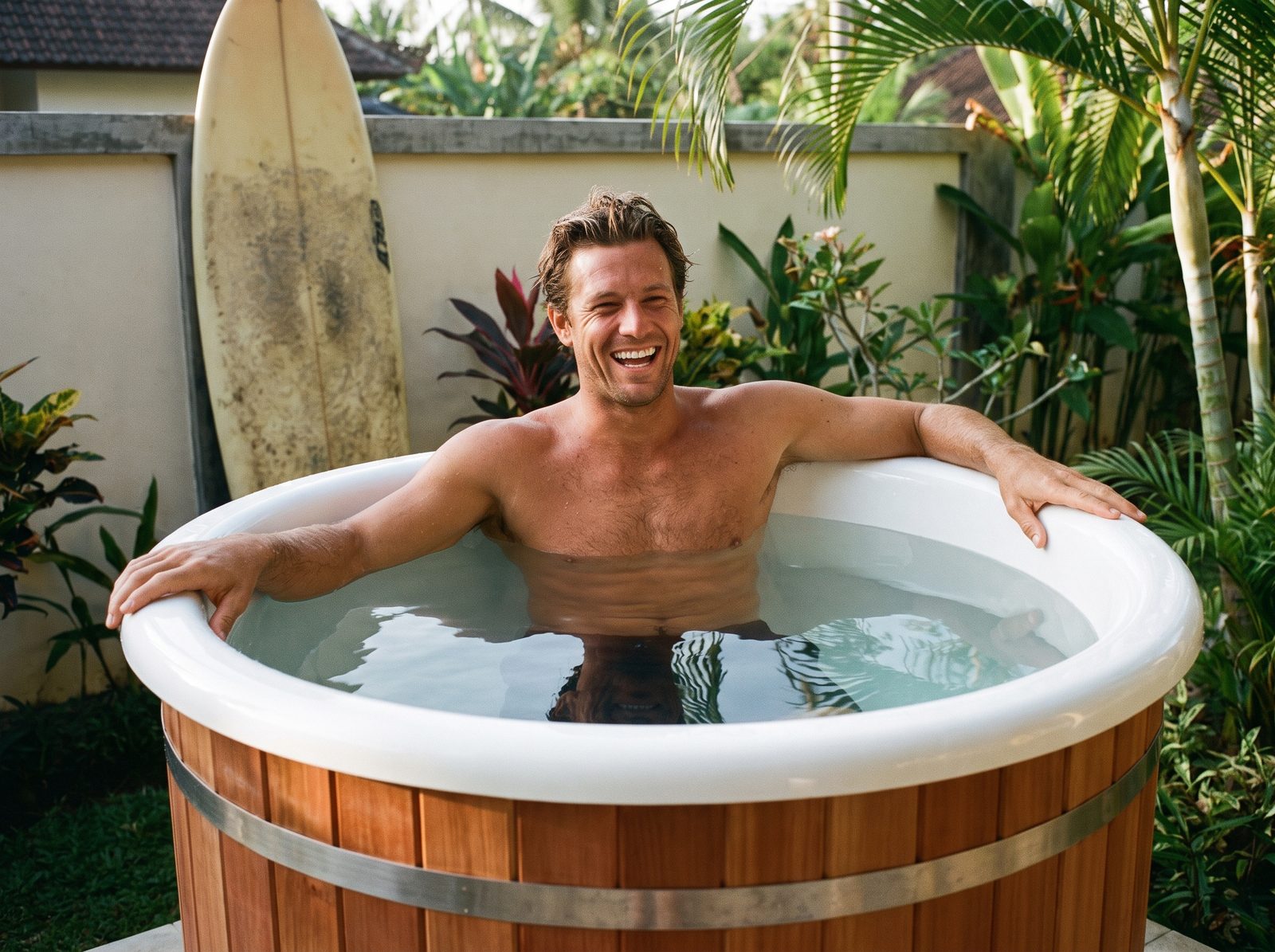
Ice bath
Cedar ice bath
The simple one. A hooped cedar tub, no plant, no power, no controller. You bring the ice — and we…
from IDR 42,000,000
Ice bath · from IDR 68,000,000 (≈ USD 4,200)
Set a temperature and it holds it — in thirty-degree ambient, through the dry season, without you buying a single bag of ice.
3 years and 100+ builds across Lombok and the Gilis. Message us for photos of similar projects, or tap «Get a project quote» and a project manager will get back to you shortly.
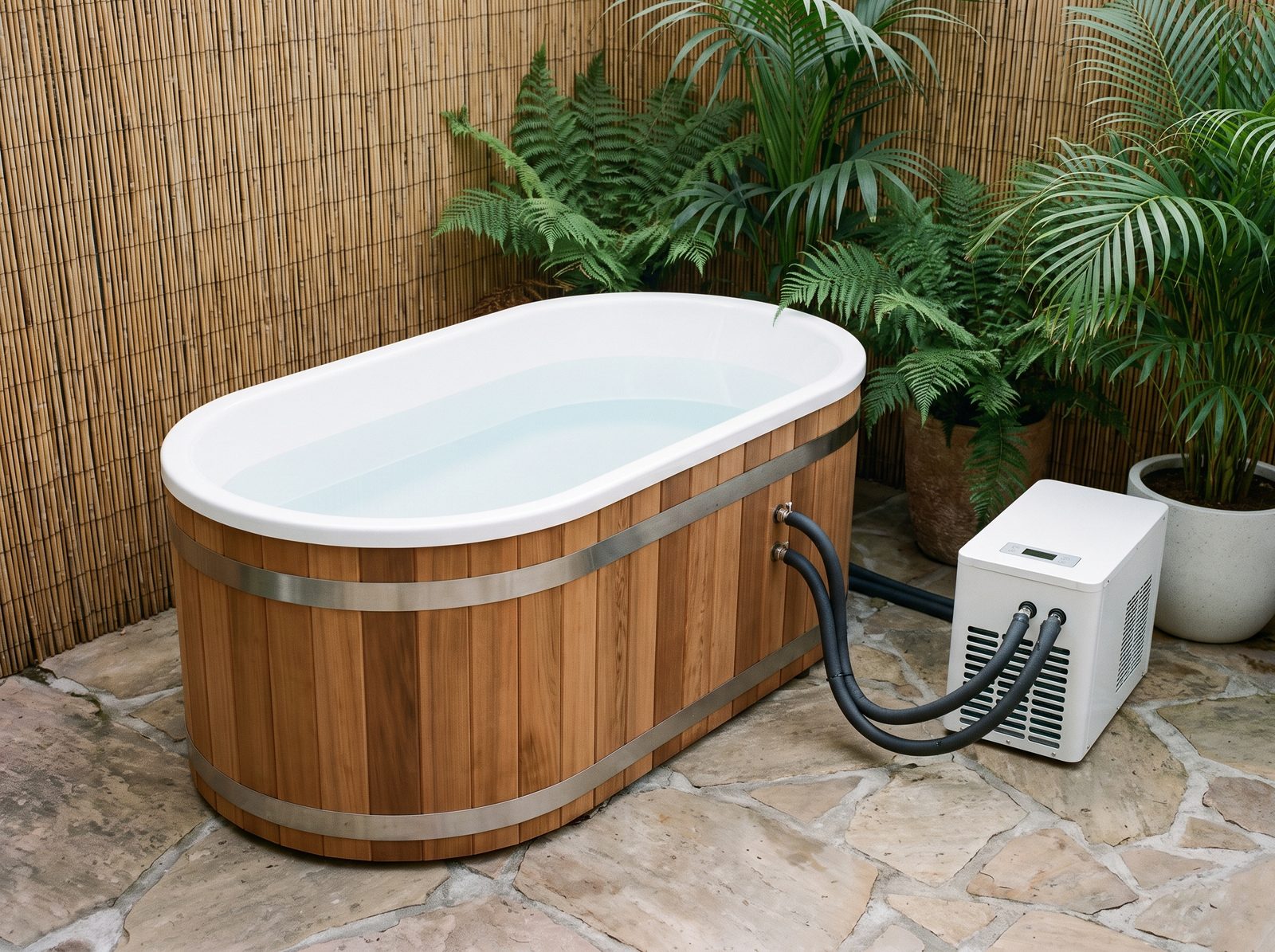
This is the engineered one. An insulated shell, a circulation loop, filtration, sanitation, and a chiller sized against the heat load your site actually imposes rather than the one a European catalogue assumes. You set 8 °C on the controller and it is 8 °C when you walk out at 6am.
It is also the product where we most often argue with the client's initial spec, because almost everyone wants to talk about chiller horsepower and almost nobody wants to talk about insulation — and insulation is what decides the outcome.
Your plunge is fighting three heat sources simultaneously. Ambient air at 28–32 °C, conducting through every surface. Solar gain, if any part of it sees sun. And you — a body at 37 °C dumping heat into 700 litres of water for three minutes at a time.
A chiller rated in Europe assumes an ambient in the teens. Bring the same unit here and it never catches up: it runs continuously, its condenser sits in hot air so it rejects heat badly, it ices its own evaporator, and it fails inside two seasons. This is the single most common failure we are called out to fix, and it is always the same story.
Our starting point is roughly 1 to 1.5 HP per 1,000 litres to hold around 10 °C here, but that is a starting point, not an answer. The real number comes from the shell, the lid and the shade. The full arithmetic is in sizing an ice bath chiller in the tropics.
Every watt you keep out is a watt the chiller does not have to remove. An uninsulated tub in the sun is a solar collector with a refrigerator strapped to it, and no amount of horsepower fixes that — you are just paying PLN to lose the argument more expensively.
So the shell is fully insulated with closed-cell foam, the plumbing runs are insulated, and it comes with an insulated lid that is part of the specification rather than an accessory. The lid is not a nicety. On a tub sitting in Lombok sun, the lid is doing more work than the chiller.
Spend the money in this order: insulation, then lid, then shade, then chiller. Reverse that order and you will buy the chiller twice.
Cold water does not sanitise itself. That belief is common and it is wrong — cold slows biological activity, it does not stop it, and a plunge that four sweaty people used yesterday is a problem today. So there is a circulation pump, cartridge filtration, and ozone as standard, with UV as an option for commercial installations.
Chlorine behaves differently at 10 °C than at 30 °C and dosing habits from a swimming pool do not transfer. The practical version — turnover rates, when to actually drain it, and why a shower-before-entry rule does more than any equipment you can buy — is in cold plunge water treatment.
Three to five metres from the sauna door. Close enough that the walk between them is part of the ritual rather than a hike; far enough that the plunge is not sitting in the sauna's heat plume and the chiller is not fighting it.
It needs a level base rated for the filled weight — 1,000 litres of water is a tonne before anyone gets in — a dedicated RCD-protected circuit, drainage that takes splash away from timber, and shade. If it is going in alongside a hot room, we would rather design both at once as a wellness zone. Retrofitting drainage under an existing deck is the expensive way to learn this.
Questions
It will hold anywhere from 3 to 12 °C, set on the controller, year-round. Our recommended working range is 8–12 °C, with 15 °C a sensible entry point for beginners. Below 5 °C is specialist territory that should be supervised. The limiting factor is not the chiller's minimum but whether the shell is insulated well enough to hold the setpoint against 30 °C ambient.
Start from roughly 1 to 1.5 HP per 1,000 litres to hold about 10 °C in Lombok's ambient — roughly double what the same tub would need in a temperate climate, because the condenser is rejecting heat into hot air. But the honest answer is that insulation, a lid and shade decide the real number. Fix those first and the chiller gets smaller and cheaper.
No. That is the entire point of a chilled plunge — the refrigeration replaces the ice permanently. Over a couple of years the chiller typically costs less than continuously buying and hauling ice, and it holds a stable temperature instead of drifting from 4 °C to 15 °C over a morning. If you would rather not run any plant, the cedar ice bath is the ice-filled alternative.
Yes. Cold slows biological activity, it does not stop it — a plunge is not self-cleaning, and this is a common and genuinely unsafe assumption. Every plunge we build includes a circulation pump, cartridge filtration and ozone as standard, with UV available for commercial use. A strict shower-before-entry rule does more good than any equipment you can add.
Also consider
Prices are indicative starting points for the unit itself and are quoted in good faith, not as a fixed offer. Foundations, drainage, glass, electrical supply upgrades and island freight are itemised separately. Every firm price follows a site survey.
Ice bath
The simple one. A hooped cedar tub, no plant, no power, no controller. You bring the ice — and we…
Next step
Send a photo of the spot and rough dimensions. You get a layout, a heat-load calculation and a fixed price — usually within two working days.