Sauna
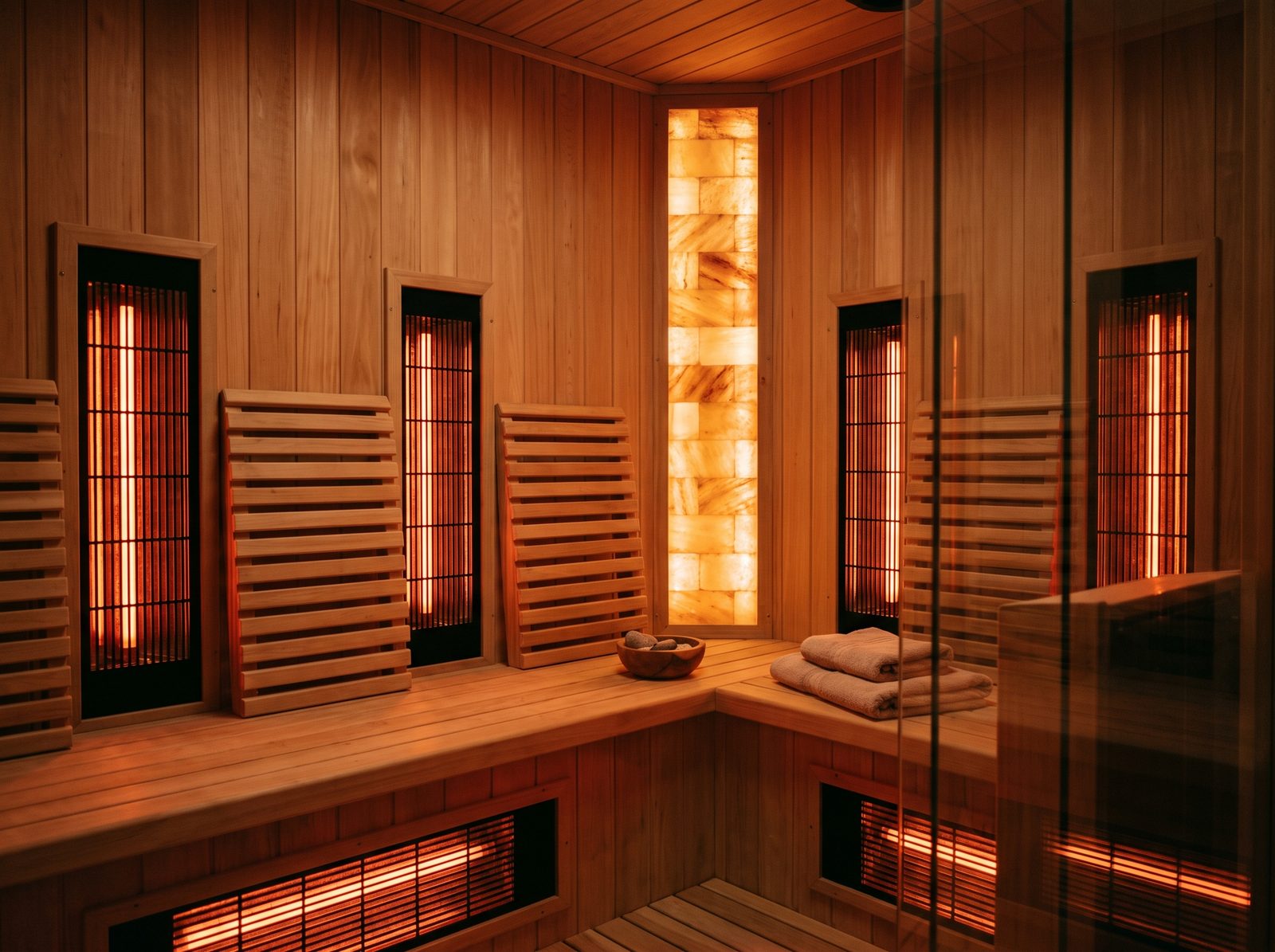
Infrared sauna
A different machine, not a lesser sauna. Lower temperature, longer sessions, and a power draw your…
from IDR 52,000,000
Sauna · from IDR 125,000,000 (≈ USD 7,700)
The proper one. Standing headroom, a two-tier bench, and as much glass as the heat-load calculation will let you have.
3 years and 100+ builds across Lombok and the Gilis. Message us for photos of similar projects, or tap «Get a project quote» and a project manager will get back to you shortly.
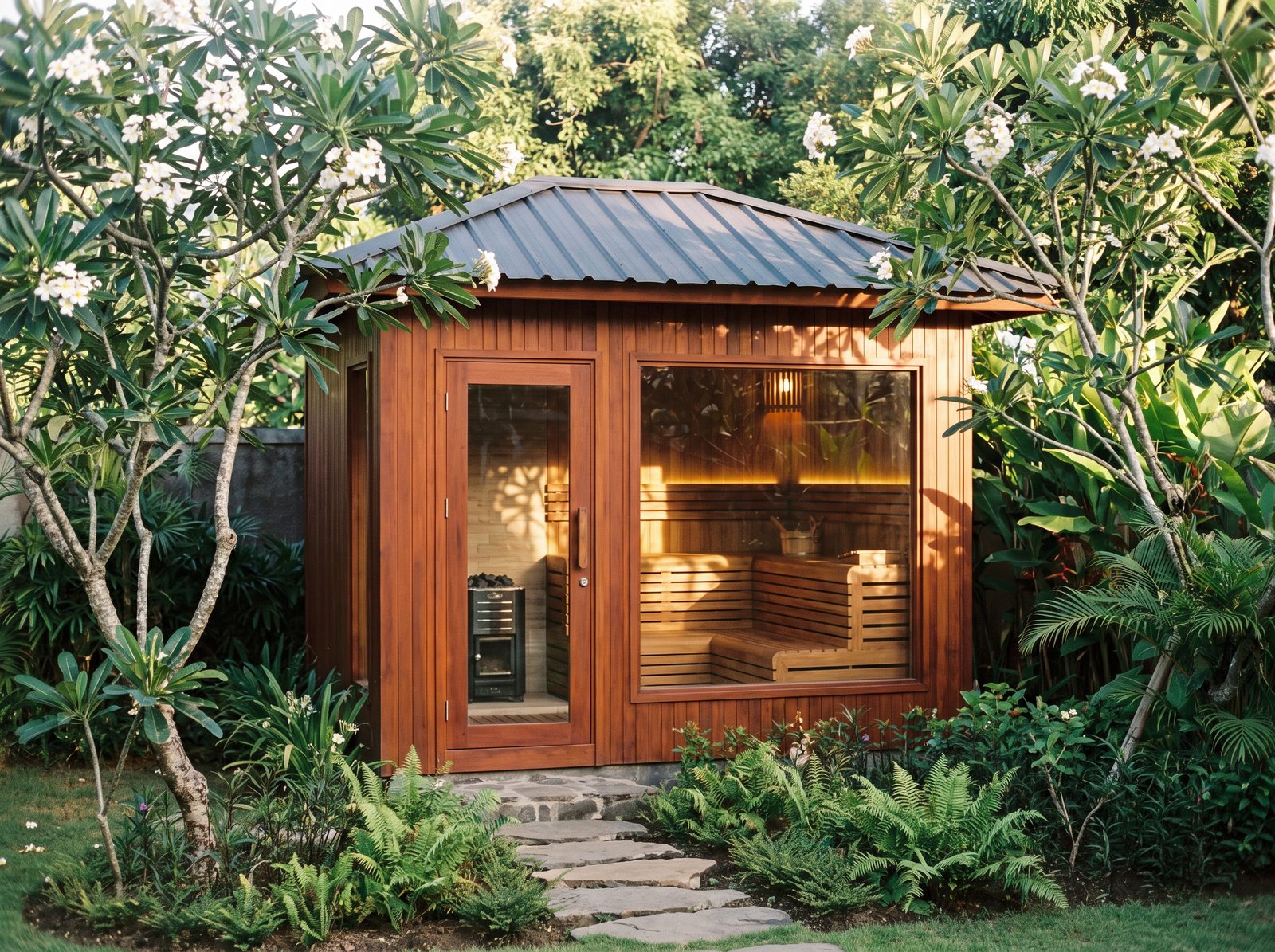
A cabin is a rectangular room, which sounds obvious until you have tried to fit four adults and a heater into a cylinder. Square walls give you a real two-tier bench, so you can choose your temperature by choosing your height — there is roughly ten degrees between the lower and upper bench, and that difference is most of what makes a session pleasant rather than an endurance test.
It is also the only model that takes a serious wall of glass, which on this island is usually the entire point.
Heat stratifies. In a properly built room the air at upper-bench height sits around 90 °C while the lower bench is closer to 80 °C, and the floor is somewhere you could comfortably stand barefoot. That gradient is the feature. Beginners and children sit low, everyone else sits high, and nobody has to leave because the room only has one temperature.
The benches are thermally-modified aspen. Not pine — never pine on a bench. Resinous softwood at 90 °C weeps sap and gets hot enough at the knots to burn skin. The full reasoning is in choosing timber for a tropical sauna.
Upper bench height should sit level with the top of the heater stones. Below that line the löyly rolls over you; above it, you are sitting in the ceiling's dead air. It is a detail nobody notices when it is right and everybody feels when it is wrong.
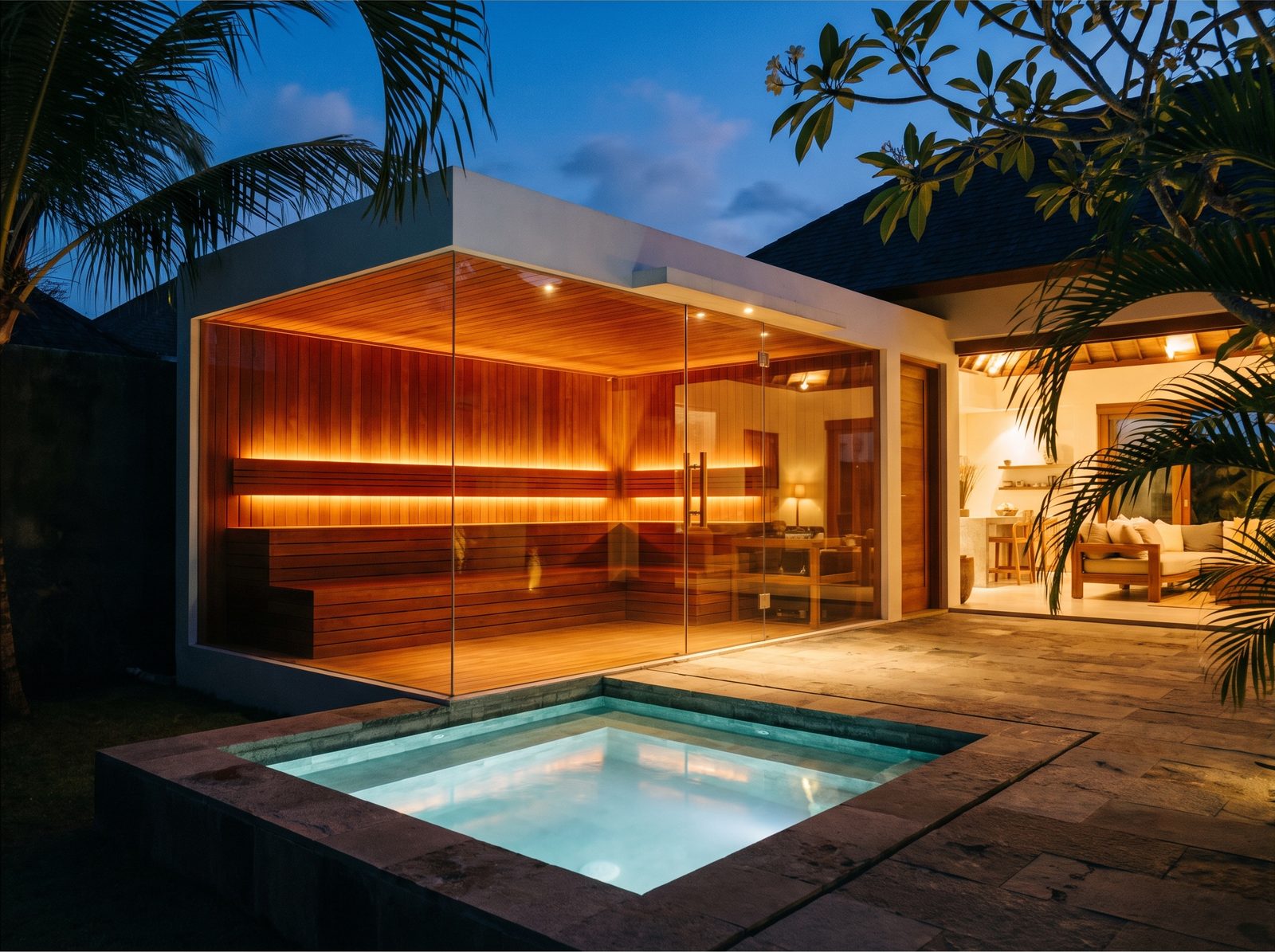
Every client wants the ocean wall, and we build a lot of them. The honest trade-off is that glass is the worst-insulating part of the room. Our working figure is about 1.5 kW of extra heater capacity per square metre of glazing, which is why a heavily-glazed cabin can need a 12 kW heater where a solid one of the same size needs 8 kW — and that difference can be the difference between your existing PLN supply and an upgrade.
All of it is toughened, all of it is in a frame that allows for movement, and orientation gets decided at survey. West-facing gives you the sunset and three hours of afternoon thermal gain. East-facing gives you a cooler room and a sunrise nobody is awake for. There is no free lunch; there is just a decision made with the numbers in front of you. See the full guide to sauna glass and orientation.
This is where most tropical saunas fail, and it is invisible until you sit in one. A hot room in Finland dumps heat and moisture into cold dry outside air. A hot room in Lombok is trying to push 90 °C air into 30 °C air at 85% humidity, and the pressure difference driving that exchange is a fraction of what the design assumed.
So we design the airflow rather than leaving it to a gap under the door: inlet low next to the heater, outlet high on the opposite wall, adjustable, sized for the room. Get it right and the room feels alive and dries itself between sessions. Get it wrong and you have stratified dead air, a stale room that never feels properly hot, and rot starting somewhere you cannot see. The detail is in tropical sauna ventilation.
On this coast the enemy is not rain on its own. It is the salt film the onshore breeze lays on every surface it reaches — at Kuta, Selong Belanak, Senggigi and out on the Gilis, that means well back from the sand — working in tandem with UV that breaks down any finish which cannot be renewed. Salt holds a damp layer against the timber long after the sky has cleared, which is precisely the condition wood tolerates worst.
So the cladding is one of two things. Charred timber, where the burnt skin is a sacrificial, mineralised layer that salt and insects find little to work on. Or bengkirai, the local yellow balau dense enough to shrug this climate off for decades. Both are fed with a penetrating oil that soaks in and can be renewed for the life of the building. Film finishes — varnish, lacquer, paint systems — blister under tropical sun and then trap salt and moisture beneath the failure, so we use them nowhere.
The roof earns its keep too: deep eaves and a covered landing at the door throw monsoon rain clear of the walls and the end grain, which is where water actually enters timber. And every hinge, band, bracket and screw outside the hot room is A4/316 stainless — A2 looks identical in the shop and is streaking rust down the boards within a year of sea air. The renewal cycle for all of it is in the salt-air maintenance guide.
A growing share of these cabins go to surf camps and resorts around Kuta and the south coast, where the cabin is not a spa flourish — it is recovery infrastructure with a timetable set by the ocean. Guests come up from the beach in the late afternoon, salty and tired, and the room has to be at ninety when they do, then run in bookable rounds through the evening.
That duty cycle shapes the specification more than any aesthetic choice. A compact room on a well-matched heater recovers between groups far faster than an oversized hall. The layout wants a rinse shower ahead of the door, because salt and sand belong outside the hot room, and a lit, covered path, because half the sessions happen after dark. We size for the schedule, not the seat count — the thinking is in sauna for surfers, and the commercial arithmetic in wellness for boutique hotels.
Questions
Around 2.0 × 2.4 m internally, with 2.1 m headroom and a two-tier bench, is comfortable for four adults. That is roughly 10 m³, which puts it at an 8 kW heater for a well-insulated room — more if you want a large glass wall. Six people needs about 2.4 × 3.6 m. We size it against your actual site and power supply at survey.
Yes, and we build them, but it costs heater capacity. Budget roughly 1.5 kW of extra heater per square metre of glazing, because glass is the worst-insulating part of the room. On a weak PLN supply that can push you into an electrical upgrade, so we run the heat-load calculation and show you the trade-off before you decide how much glass you want.
About ten degrees. Heat stratifies, so the upper bench sits near 90 °C while the lower is closer to 80 °C. That gradient is deliberate and useful — beginners and children sit low, experienced users sit high, and everyone shares the same room. Upper bench height should be level with the top of the heater stones.
Never directly on soil — that is a termite invitation and a rot clock. We stand cabins on treated bearers over a compacted, drained base, or on a small concrete pad with a fall away from the door, and we make sure water from a plunge next door has somewhere to go that is not underneath the sauna. The base is itemised on the quote after survey.
Four decisions, made at the drawing stage. Cladding in charred timber or bengkirai rather than a softwood that needs sealing. A penetrating oil that can be renewed, instead of varnish that peels under UV and traps salt beneath it. A4/316 stainless for every external fixing, hinge and band. And deep eaves with a covered door landing, so rain and spray shed clear of the end grain. After that, upkeep is a rinse and a re-oil on schedule — not a rebuild.
Also consider
Prices are indicative starting points for the unit itself and are quoted in good faith, not as a fixed offer. Foundations, drainage, glass, electrical supply upgrades and island freight are itemised separately. Every firm price follows a site survey.
Sauna
A different machine, not a lesser sauna. Lower temperature, longer sessions, and a power draw your…
Sauna
For the room you already have, the corner nothing standard fits, or the cliff edge that deserves…
Next step
Send a photo of the spot and rough dimensions. You get a layout, a heat-load calculation and a fixed price — usually within two working days.