
Cold6 min
Ice bath vs cold shower: why immersion wins
Ice bath vs cold shower isn't close once you factor in surface area, and in Lombok, where tap water runs…
Cold
An ice bath chiller rated for Europe runs far harder in Lombok's heat. The real sizing math — heat load, HP per litre, and why insulation wins.
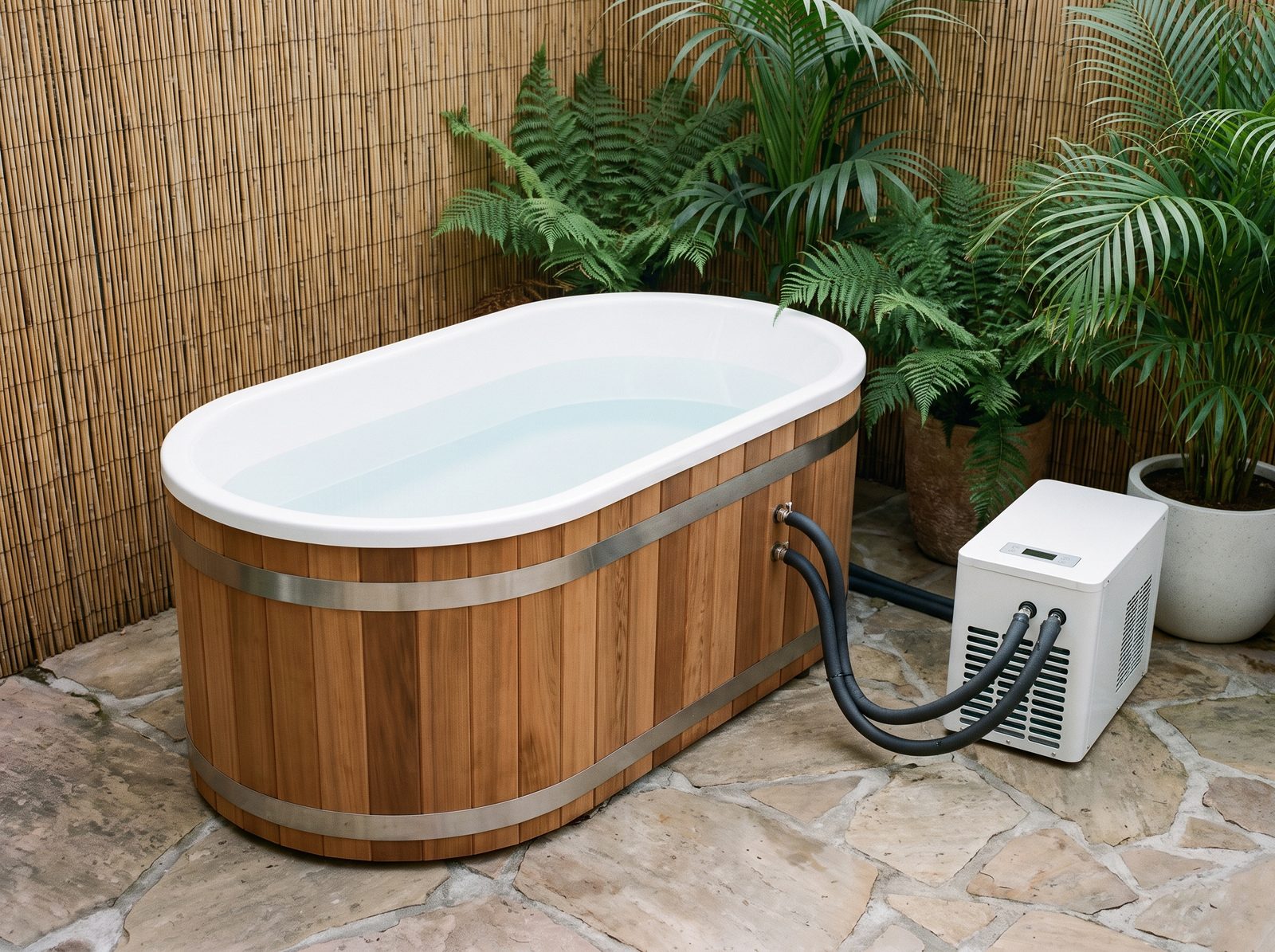
An ice bath chiller rated to hold 10°C in a European basement will not hold 10°C on a Lombok deck, and the gap isn't small. Ambient air here runs 28–32°C year-round, the sun adds direct radiant load to any tub that isn't fully shaded, and every bather who gets in adds a further heat dump the moment they sit down. Budget roughly double the nameplate cooling capacity you'd spec for the same tub in a temperate climate, and treat that as a starting point, not a safety margin.
This is the technical centre of our ice bath work, and it's where most tropical installs we're called out to fix actually failed — not the chiller unit itself, but the assumption that a spec sheet written for a cooler country would translate directly. Below is how we size a chiller for this climate: the heat loads involved, a starting-point sizing table, and why insulation and a lid do more work than most buyers expect.
Chiller nameplates are rated against a specific ambient temperature and a specific target — usually a cool room and a modest temperature drop. Move the same unit to a Lombok villa sitting in 30°C ambient air and ask it to hold 10°C, and the unit is now fighting a 20°C gap instead of the smaller one it was rated against, running near-constantly rather than cycling on and off.
The result of under-sizing is predictable, and it's the complaint we hear most often: the tub reads a comfortable 10°C first thing in the morning and has drifted to 14–16°C by mid-afternoon, because the chiller simply cannot remove heat faster than the tropical day is adding it. A unit that looks adequate on a spec sheet written for a temperate climate is frequently 40–50% undersized for the same job here.
We've re-specced several plunge installs that arrived with a chiller sized from a supplier catalog rather than this climate. All of them held temperature fine overnight and lost the fight by 2 p.m., which is the classic signature of an undersized unit rather than a broken one.
A chiller here isn't fighting one heat source, it's fighting three at once, and sizing that ignores any of them will drift in the afternoon regardless of horsepower.
Ambient air load is constant and predictable; it's the baseline the chiller is sized against. Solar gain is the one most buyers under-count because it depends entirely on siting and shade, not on the chiller at all. Bather load is the smallest of the three for a single-person home tub, but it matters for a villa or hotel plunge seeing back-to-back guests. Which of those usage patterns applies to your site — private villa, gym floor or retreat schedule — is mapped out in our guide to ice bath setups for Lombok villas, gyms and retreats.
~1 HP per 1,000 L of tub volume is our starting point for holding around 10°C in Lombok conditions, before adjusting for shade, insulation, and expected use pattern. Treat the table below as the first pass in a sizing conversation, not a final spec — a fully shaded, well-insulated, lidded tub can run lighter than this; an exposed, uninsulated one needs to run heavier.
| Tub volume | Starting-point chiller | Typical use case |
|---|---|---|
| 300–500 L | 0.5–0.75 HP | Single-person home plunge, shaded |
| 800–1,000 L | 1 HP | Standard villa plunge, partial shade |
| 1,200–1,500 L | 1.5 HP | Larger villa or small hotel plunge |
| 2,000 L+ | 2 HP+ | Hotel or wellness-zone shared plunge |
These figures assume a reasonably insulated tub with a lid used when the plunge is idle. Strip either of those away — an uninsulated shell, no lid, full sun for six hours a day — and the same volume can need the next size up to hold a stable 8–12°C through the afternoon.
A bigger chiller is the expensive way to fix a problem that insulation and a lid solve more cheaply. Every degree of heat that doesn't get into the tub in the first place is a degree the chiller never has to remove, and a well-insulated, lidded tub can hold its target with a genuinely smaller unit than an exposed one twice its size in chiller capacity.
The lid matters most during idle hours. A plunge sits uncovered and idle far more than it's occupied, and an open water surface under direct sun is a constant heat-gain path — closing that path when nobody's using the tub is the single highest-value change available on most sites we visit.
Insulation and a lid decide whether a chiller holds temperature or loses ground every afternoon — the horsepower number on the unit is the second decision, not the first.
Wall insulation matters continuously rather than only when idle. A double-wall tub with a genuine insulating cavity — rather than a single skin of timber or fibreglass over ambient air — cuts the constant ambient heat load significantly and is worth specifying before the chiller size is even discussed.
Flow rate determines how evenly a chiller's cooling gets distributed through the tub, not how much total heat gets removed — and it's commonly confused with the fix for a temperature problem that's actually about heat load, not circulation. A pump that's too small leaves cold water pooling near the chiller return and a warmer layer near the surface and edges, so the tub reads inconsistently depending on where you check it.
The practical target is turning the full tub volume over often enough that the whole body of water tracks the chiller's set point within a degree or so, rather than showing a stable core with a warm skin layer on top. This is a plumbing and pump-sizing question that sits alongside chiller capacity, not a substitute for it — doubling flow rate on an undersized chiller will even out the temperature faster without changing what that temperature settles at.
Get flow rate right and the readout on the chiller controller actually reflects what a bather feels getting in. Get it wrong and you can have an accurate, well-sized chiller and a tub that still feels inconsistent from one session to the next.
Buying ice to chill a tub looks like the cheap option on day one and becomes the expensive one within a few months of regular use. A single top-up for a mid-size tub needs a meaningful quantity of ice delivered or bought locally, repeated every session or every few days depending on use, indefinitely, for as long as the tub stays in service.
A chiller is a larger upfront cost with a running electricity bill behind it, but that cost is fixed and predictable, and it doesn't require a supply run every time someone wants to use the plunge. Run the comparison over a year rather than a week and the crossover point arrives faster than most first-time buyers expect, especially for a plunge used several times weekly rather than occasionally.
Ice also cannot hold a steady number the way a thermostatically controlled chiller can. A tub cooled by ice runs coldest right after the top-up and drifts warmer until the next one, which works for an occasional plunge and works poorly for daily use, or for a hotel plunge where guests expect a consistent 10°C regardless of what time they show up.
A chiller is a continuous electrical load, and that has to be planned into the villa's supply rather than discovered afterward. PLN's standard single-phase connection handles a small chiller without issue; a larger unit on a bigger shared plunge can push a villa's total load high enough that it's worth checking headroom alongside any sauna heater on the same property, since the two are often specified together in a wellness zone build.
Running cost scales with how hard the unit works, which loops back to everything above — a shaded, insulated, lidded tub asks its chiller to run a smaller fraction of the day than an exposed one, and that difference shows up directly on the electricity bill, not just on the thermometer. Sizing generously at the insulation and shade stage is what keeps ongoing running cost reasonable, not sizing the chiller itself larger.
Where the connection is already tight — an older villa on a modest PLN supply, for instance — that's a conversation to have before the chiller is chosen, not after it's installed and tripping breakers.
Every figure in this guide is a starting point, and the actual number depends on your tub's shade, exposure, insulation, and how often it will be used — which is exactly why we size chillers against a site visit rather than a volume number alone. Two tubs of identical size on the same street can need different chillers if one sits under a roof overhang and the other sits in full afternoon sun.
We build both routes: a cedar ice bath for lighter, ice-assisted use, and a fully chiller-fed cold plunge from IDR 68,000,000 (≈ USD 4,200) indicative, for daily use where holding a steady number matters. Our guide to ice bath temperature covers what number to target once the equipment side is settled.
If you're planning a plunge and want the chiller matched to your actual roof line, shade, and power supply rather than a catalog default, get in touch to arrange a site survey.
Read next: Solar power for saunas and ice-bath chillers in Lombok: hybrid and off-grid setups.
Common questions
Start at roughly 1 HP per 1,000 L of tub volume for holding around 10°C in Lombok's ambient heat, then adjust for shade, insulation, and a lid. A fully shaded, well-insulated, lidded tub can run a smaller unit than that starting point; an exposed, uninsulated tub needs to run larger. Site-specific factors decide the final number.
European nameplate ratings assume a cooler ambient temperature and a smaller gap to the target. In 28–32°C Lombok air, the same unit fights a much larger temperature difference and runs far closer to constantly. Budgeting roughly double the temperate-climate nameplate rating is a sensible starting point before adjusting for shade and insulation.
Only in the very short term. Ice needs buying and delivering every session or every few days indefinitely, and it can't hold a steady temperature the way a thermostatic chiller can. Over a year of regular use, a chiller's higher upfront cost is usually offset by not needing a constant ice supply.
Yes, more than the chiller size itself in most cases. Every degree of heat kept out by insulation and a lid is heat the chiller never has to remove, and a well-insulated, lidded tub can hold its target with a smaller unit than an exposed tub of the same volume needs.
Enough to turn the full tub volume over often enough that the whole body of water tracks the chiller's set point within about a degree, rather than showing cold water near the return and a warmer layer at the surface. Flow rate evens out temperature; it does not add cooling capacity on its own.
Keep reading
More from the journal on heat, cold and the specific ways this climate breaks things.
All 19 guidesCold6 min
Ice bath vs cold shower isn't close once you factor in surface area, and in Lombok, where tap water runs…
Cold8 min
Ice bath temperature isn't a race to the lowest number. The 8–12°C working range, a 15°C beginner entry, and…
Cold8 min
Cold plunge water treatment matters even though the water is cold. Filtration, ozone, UV, chlorine at 10°C,…
Next step
Send a photo of the spot and rough dimensions. You get a layout, a heat-load calculation and a fixed price — usually within two working days.