Cold8 min
Ice bath temperature: why colder is not better
Ice bath temperature isn't a race to the lowest number. The 8–12°C working range, a 15°C beginner entry, and…
Design
A sauna with a view means more heater capacity, toughened glass and a real maintenance routine. The honest engineering trade-off, and how to do it right.
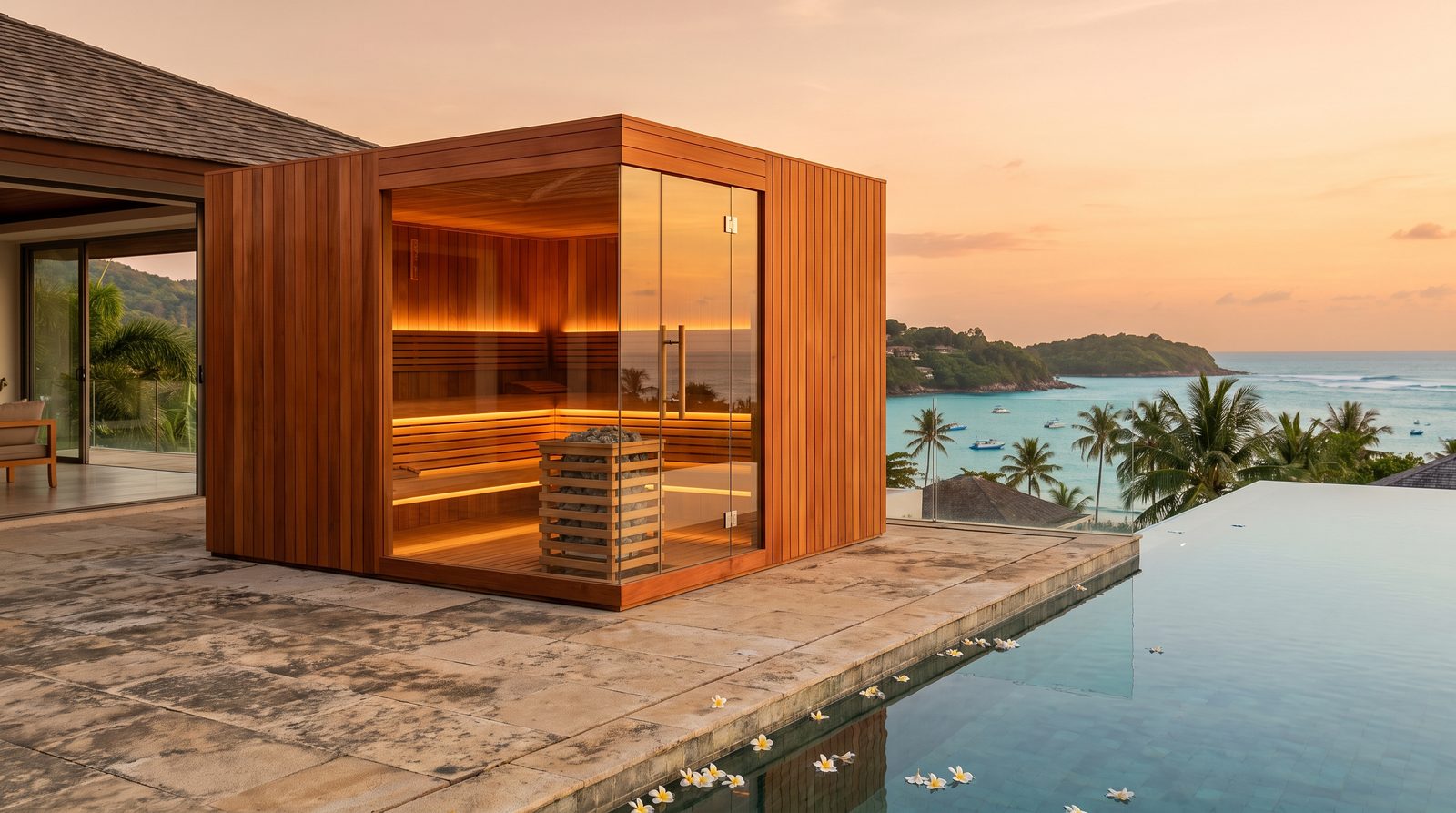
Everyone wants the glass wall facing the ocean, and the search term proves it: sauna with a view is one of the most common things people ask us for before they have specified anything else about the room. The honest answer is that glass is the worst-insulating material you can put in a hot room wall, so a sauna glass wall is not a free upgrade. It is a trade you make deliberately, with the numbers in front of you, or a trade that gets made badly by default and discovered later.
Done properly, a full ocean-facing glass wall is one of the best rooms we build on this island. Done without understanding what it costs in heater capacity, glass specification and ongoing maintenance, it is a beautiful room that never quite gets hot enough, cracks a pane within a couple of seasons, or looks permanently dulled by salt within a year.
A wall of glass turns a sauna from a box you sit in in the dark into a room with a horizon — sunset over the water, or the surf line visible from the upper bench. On a cliff site, or anywhere with genuine ocean frontage, it is the single upgrade clients ask for before anything else, including before they ask what it actually costs to run.
The catch is physics, not opinion, and it does not go away because the view is worth it. Insulated timber walls hold heat inside the room; glass does not, regardless of how expensive or well-installed it is. Every square metre of glazing you add is a square metre that is actively losing heat back outside while the heater tries to hold 80–100°C on the other side of it. None of this is an argument against the glass. It is an argument for sizing the heater for the glass you actually specified, rather than for the room's volume alone and hoping the view does not change the maths.
Insulated timber walls hold heat in because the insulation layer traps still air, and still air is a poor conductor of heat. Glass has no equivalent layer, so heat moves through a single pane far more readily in both directions — into the room from the tropical sun during the day, and straight back out of it once the heater is running. That is the entire physical reason a glazed wall changes heater sizing. It is not a mysterious property of glass; it simply conducts heat efficiently, and an insulated timber wall does not.
Our working figure, consistent across every glazed cabin we build, is roughly 1.5 kW of additional heater capacity per square metre of uninsulated glass. A standard cabin that would need an 8 kW heater as a solid-walled room can need 12 kW once a substantial ocean-facing wall goes in, and that jump is not trivial — it can be the difference between running comfortably on an existing villa supply and needing a PLN upgrade or a three-phase connection.
| Room | Solid walls | With a full glass wall |
|---|---|---|
| Typical 4–6 seat cabin | 8 kW | 12 kW |
| Supply implication | Usually fine on single-phase | Often needs a supply check or upgrade |
This is exactly why we calculate heat load from the actual glazing area at survey, rather than quoting a heater size from the footprint alone. The full method for sizing supply against a heavier heater is in our guide to sauna electrical requirements.
Every pane in a hot room wall has to be toughened safety glass, without exception. Ordinary float glass can fail under thermal stress — the temperature difference between the hot inner face and the cooler outer face, in a way regular glass was never designed to handle — and when float glass fails, it fails in large, sharp shards. Toughened glass is heat-treated specifically to survive that stress and, on the rare occasion it does fail, breaks into small, largely harmless pieces instead.
The same toughened specification applies to a small porthole window on a compact garden cabin as to a full ocean-facing wall on a custom build. Glass is glass at 90°C — size is not a safety factor.
This is one of the few places in a sauna build where there is no acceptable cheaper option, and it applies to every pane regardless of size: a full wall, a single vision panel in a door, or a round porthole window. We specify toughened glass rated for sustained heat on every hot-room opening we build, and would not build it any other way.
Timber and glass expand and contract at different rates as a room cycles from ambient temperature to 90°C and back, several times a day, in a climate that is already swinging between a monsoon downpour and hard afternoon sun on the same wall. A frame that holds glass rigidly, with no allowance for that movement, eventually cracks the glass, the seal, or both — usually well before the pane itself would otherwise have any reason to fail.
The fix is a floating frame detail: glazing seated in a frame designed to allow for expansion and contraction, with gaskets rather than rigid sealant doing the work of absorbing movement. It is a detail that costs very little to get right at the design stage and is genuinely difficult and expensive to retrofit once a rigid frame has already cracked a pane in service.
Anywhere within reach of sea air, salt settles on glass as a fine film long before it is visible to the eye. Left to dry repeatedly without being rinsed off, that film etches the surface over time — a slow, physical abrasion rather than a chemical stain, and one that leaves glass permanently duller no matter how hard you scrub it afterwards once the etching has actually happened.
The practical answer is not a special coating on the glass; it is a rinse routine, applied consistently rather than occasionally. Fresh water across the glass on a fixed schedule — weekly on an exposed cliff or beachfront site, less often set back from the coast — stops salt film from ever sitting long enough to do damage in the first place. It is the same underlying logic that applies to every piece of hardware on the build, and our salt-air maintenance guide covers the fixings and cladding side of it in full.
Which way the glass wall faces decides two different things, and it is worth choosing deliberately rather than defaulting to whichever wall already had the view. West-facing glass gives you sunset from the bench and roughly three extra hours of afternoon solar gain heating the room from outside — which sounds like a free bonus until you are trying to hold a precise temperature on a heater that was sized without accounting for it, particularly during the hottest part of the dry season.
East-facing glass gives you a cooler, more predictable room and a sunrise that, realistically, nobody is booking a 6 a.m. sauna session to watch. A north or south aspect sits somewhere between the two, with less dramatic solar gain either way and a more even temperature through the day. Neither orientation is wrong. The point is that orientation is a decision made with the heat-load numbers in front of you at survey, not something discovered afterwards when the room runs hotter, or cooler, than the heater was sized for.
None of the above is an argument against building a glass-walled sauna facing the ocean — it is an argument for specifying it properly, in this order:
Get these five right and a glass wall is one of the best rooms we build on this island. Skip any one of them and you get a beautiful photograph of a sauna that runs cold on the hottest afternoons, cracks a pane in its second year, or looks salt-dulled within a single season.
A glass wall facing the ocean is worth building. It is not worth guessing at. Send us the site, the direction it faces, and roughly how much glass you are picturing, and a survey gives you the actual heat-load number, the electrical supply check, and a fixed indicative price for the room before any decision is locked in.
Most of our glazed cabins are built as part of a standard outdoor cabin sauna, and where the glazing is larger or the site is unusual, the build moves into a custom build instead. Either way, cliff and coastal sites around Selong Belanak and similar bays are exactly where we build this most often, and exactly where getting the glass, the frame and the orientation right matters most. Send through the site and we will tell you honestly what the view will cost you in heater capacity, not just what it will look like.
Common questions
Not if the heater is sized for it. Glass loses heat far faster than an insulated timber wall, so a heavily-glazed cabin needs meaningfully more heater capacity — roughly 1.5 kW more per square metre of glass — to hold the same 80–100°C as a solid-walled room. Sized correctly, a glazed cabin performs exactly like any other.
Our working figure is about 1.5 kW per square metre of uninsulated glass, on top of what the room would need with solid walls. In practice this often means an 8 kW room becomes a 12 kW room once a substantial ocean-facing wall is added, which can affect whether your existing electrical supply is sufficient.
Over time, yes. Salt settles on glass as a fine film, and left to dry repeatedly without being rinsed, it slowly etches the surface — a physical abrasion rather than a stain, and one that leaves glass permanently duller. A simple, consistent fresh-water rinse schedule prevents this from ever becoming a problem.
West-facing gives you sunset views and extra afternoon solar heat gain, which needs to be accounted for in the heater sizing. East-facing gives a cooler, more predictable room and a sunrise view instead. Neither is wrong — the right choice depends on when you will actually use the room and what the heat-load numbers say.
Sometimes, but it usually means reworking the heater sizing and checking the electrical supply again, since the original heater was likely sized for solid walls. It is generally more cost-effective to plan glazing into a new build than to retrofit a wall of toughened glass into an existing structure.
Keep reading
More from the journal on heat, cold and the specific ways this climate breaks things.
All 19 guidesCold8 min
Ice bath temperature isn't a race to the lowest number. The 8–12°C working range, a 15°C beginner entry, and…
Technical8 min
Sauna electrical requirements in Lombok: PLN supply tiers, single vs three-phase, cable sizing, RCD earthing,…
Wellness Zones8 min
Wellness zone design is a circulation problem: the order of hot room, plunge and rest, the distances between…
Next step
Send a photo of the spot and rough dimensions. You get a layout, a heat-load calculation and a fixed price — usually within two working days.