Cold8 min
Ice bath temperature: why colder is not better
Ice bath temperature isn't a race to the lowest number. The 8–12°C working range, a 15°C beginner entry, and…
Materials
Best wood for sauna in the tropics: western red cedar inside, bengkirai outside, why pine fails, and the oil-not-varnish rule for salt spray and UV.
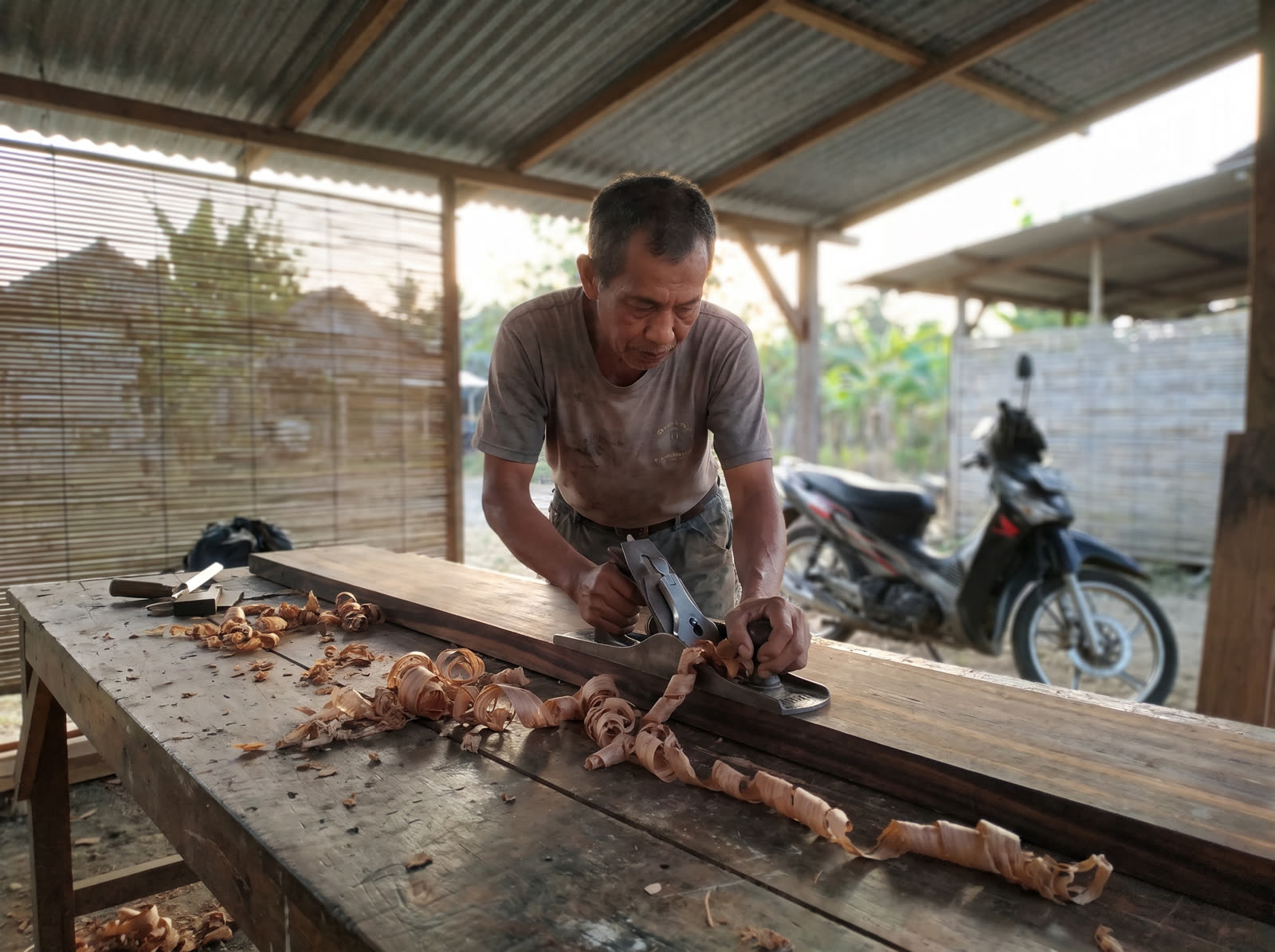
The best wood for sauna depends on which side of the wall you are standing on. Inside a hot room running at 90°C, bare skin touches the bench directly, so the timber needs to stay cool to the touch, resist resin bleed, and never splinter. Outside, the island stacks its attacks: 85% ambient humidity, monsoon rain, termite pressure — and on the coasts where most of these cabins actually stand, from Kuta and Selong Belanak round to Senggigi and the Gilis, a salt film off the sea breeze working in tandem with equatorial UV. A bench species put on that duty would rot or warp within a couple of seasons; the exterior needs an entirely different specification.
Treat interior and exterior timber as two separate specifications, not one material choice, and most of the decisions below become straightforward.
A sauna interior has to satisfy three things at once: low thermal conductivity, so a bench at 90°C does not burn the skin sitting on it; low or no resin, since resin softens and can bleed at hot-room temperatures; and dimensional stability under repeated heating and cooling cycles, so boards do not cup, crack or work their fixings loose over a few years of use.
Exterior timber around the same cabin — decking, cladding, structural framing exposed to weather — faces a completely different set of demands.
A species that excels at one job can be a poor choice for the other, which is the mistake behind most bad sauna timber decisions.
Interior and exterior timber are not one decision. Specify them as two separate materials and most of the mistakes on this list disappear by themselves.
Western red cedar is the reference point for hot-room interiors for good reason. It is low-density, so it conducts heat slowly and stays comfortable to the touch even when the room around it is at 90°C. Its natural resin content is low, and what little it has does not liquefy and bleed the way pine's does. It is also naturally stable, moving less than most alternatives as the room cycles between ambient and full heat.
The trade-off in Lombok is that cedar is not a local species — it arrives as imported timber, typically through Lembar port or over the Padangbai ferry route, which adds freight cost and lead time to a build. That cost is the reason thermally modified alternatives, covered next, have become a serious competitor rather than a downgrade.
Send us your PLN capacity (a photo of the meter or board is enough) and a photo of the spot — we will size the heater, wiring and ventilation for it and reply with a fixed price.
Thermal modification heats timber in a controlled, low-oxygen process that drives out sugars and reduces the wood's capacity to absorb moisture, without adding any chemical treatment. The result is a more dimensionally stable board with improved rot resistance compared with the same species untreated — a meaningful upgrade for aspen and alder, both of which are naturally low in resin to begin with.
For interior benching, thermally modified aspen or alder is a genuine alternative to cedar: comparable comfort at bench height, similar stability, and often a lower landed cost once freight is factored in. Neither is a downgrade — they are a different route to the same set of requirements, and the choice between them is often decided by supply and budget rather than performance.
Pine's resin content is the specific reason it has no place on a sauna bench. Resin softens and can liquefy well below sauna operating temperature, so a pine bench at 90°C bleeds sticky resin onto exactly the surface bare skin sits on. Knots are worse than clear timber — they concentrate resin and can weep or even blister under sustained heat.
This is not a finish problem that a coating solves. It is the timber itself, and no amount of sanding or sealing changes what happens to resin at hot-room temperature. If a quote includes an unspecified "pine" bench, treat that as a red flag and ask what species is actually being installed.
Outside the hot room, the priorities flip entirely: rot resistance, termite resistance, and tolerance of direct weather matter far more than thermal conductivity. Bengkirai, also known as yellow balau, is a dense hardwood with naturally high oil and silica content that gives it strong resistance to both rot and termite attack — it is a standard, well-proven choice for decking across this region for exactly that reason.
Teak offers similar durability with a tighter grain and a more refined finish, at a higher price point, and is a common choice for external cladding as well as decking. Both species handle the wet-dry cycling of a monsoon climate without the swelling and splitting that would affect a less durable species used the same way. Neither belongs on a hot-room bench — their strengths are entirely about surviving weather and pests outdoors, not comfort against bare skin.
On a coastal site the exterior specification goes one step further, because salt spray and UV attack the surface faster than rain alone ever would. Weather-exposed timber gets a penetrating oil that can be renewed, not a film finish that peels under this sun and then traps salt and moisture beneath the failure — and everything fixing it in place is A4/316 stainless, since cladding outlasting its own screws is not hypothetical on this coast. Deep eaves that keep rain and spray off the end grain do more for service life than anything sold in a tin; the renewal routine itself is in the salt-air maintenance guide.
All timber moves with humidity, and a sauna forces two different moisture cycles onto the same structure: the interior swings from ambient humidity to a near-dry 90°C room and back, session after session, while the exterior tracks Lombok's own seasonal swing between monsoon saturation and dry-season heat. Fixing schedules and gaps between boards need to allow for that movement, or boards cup, crack, or work their fasteners loose within a couple of years.
This is why hot-room boards are never installed edge-to-edge. A deliberate gap, or a sprung, floating fixing method that lets each board move independently, absorbs the swelling from a humid day without adjacent boards bowing against each other or working loose from the wall. Skip the gap to save a few millimetres of visual tightness at handover, and the first full wet-to-dry cycle makes the argument for you, usually as a row of cupped boards along one wall.
Metal fixings inside a hot room deserve their own thought. Exposed steel screw heads or nail heads on a bench surface conduct heat efficiently and can become hot enough to burn skin on contact, even though the surrounding timber stays comfortable. Countersunk, concealed fixings solve the burn; specifying them in A4/316 stainless solves the quieter problem, because on a salt coast an A2 screw is corroding inside the timber years before anything looks wrong from outside.
Exposed metal screw heads on a bench surface get hot enough to burn, even though the timber around them stays comfortable. Countersunk, concealed, non-corroding fixings are not a cosmetic upgrade — they are how you avoid a very specific, very avoidable burn.
Termites are a real pressure on this island for any untreated softwood in ground contact or structural framing, but a well-ventilated hot-room interior running at 90°C is a poor environment for termites, which need sustained moisture. The real termite exposure sits outdoors and in framing — which is exactly where bengkirai, teak, or properly treated structural timber earn their cost.
A hot-room interior should be left unfinished, or treated with only a very limited, sauna-appropriate oil where the supplier specifically approves it for that use. Varnish, lacquer and polyurethane are not designed for skin contact at 90°C, and heat accelerates whatever solvent or resin off-gassing they are capable of, in a small, enclosed room you are sitting inside.
There is a second reason beyond off-gassing: sealed timber cannot breathe, and a sauna interior needs to dry out between sessions as much as it needs to look good. Sealing the wood traps the moisture that ventilation and material choice are both working to remove, which is exactly the rot risk covered in our guide to tropical sauna ventilation. Bare, breathable timber is not an unfinished corner cut — it is the correct spec.
Four materials turn up in sauna quotes often enough that they deserve a direct answer, and each fails for a distinct, physical reason rather than general low quality.
None of these is a finish problem or a workmanship problem. Each is the wrong material for a room that runs hot, goes fully humid between sessions, and sits within reach of bare skin — and no amount of careful installation changes what the material itself does under those conditions.
Put together, the specification for a typical build looks like this:
| Species | Use | Why |
|---|---|---|
| Western red cedar | Interior benches, wall lining | Low conductivity, low resin, stable, imported |
| Thermally modified aspen/alder | Interior benches, wall lining | Comparable comfort and stability, often lower landed cost |
| Resinous pine | Never on a bench | Resin liquefies and bleeds at hot-room temperature |
| Bengkirai (yellow balau) | Decking, external cladding | High oil and silica content, rot and termite resistant |
| Teak | Decking, external cladding | Similar durability, tighter grain, higher cost |
We spec timber by application on every custom build, and it is built into the standard outdoor cabin sauna and infrared cabin ranges as well — cedar or thermally modified timber inside, bengkirai or teak outside, never the reverse. If you already have a heater type in mind, our comparison of electric and wood-fired heaters covers the other half of the build. For a species and finish spec matched to your site, get in touch with your rough dimensions.
Common questions
Western red cedar is the benchmark: low thermal conductivity, low resin, and dimensionally stable under repeated heat cycles. Thermally modified aspen or alder is a close, often lower-cost alternative with comparable comfort and stability. Both are correct choices — the decision usually comes down to budget and supply.
No. Pine's resin softens and can liquefy well below sauna operating temperature, so a pine bench bleeds sticky resin onto the exact surface bare skin sits on, and knots are worse than clear timber. No finish or sealant changes this — it is a property of the timber itself.
Bengkirai (yellow balau) or teak. Both are dense hardwoods with naturally high oil and silica content that resist rot and termite attack, and both tolerate the wet-dry cycling of a monsoon climate without the swelling and splitting a less durable species would suffer in the same conditions.
No. A hot-room interior should be left unfinished or treated with only a limited, sauna-appropriate oil where specifically approved. Varnish and polyurethane are not designed for skin contact at 90°C, heat accelerates their off-gassing, and sealing the timber traps the moisture the room needs to dry out between sessions.
Not much — termites need sustained moisture, and a hot-room interior running at 90°C is a poor environment for them. The real termite exposure is outdoors and in structural framing, which is why decking and cladding use naturally durable species like bengkirai or teak, or properly treated timber.
Keep reading
More from the journal on heat, cold and the specific ways this climate breaks things.
All 19 guidesCold8 min
Ice bath temperature isn't a race to the lowest number. The 8–12°C working range, a 15°C beginner entry, and…
Technical8 min
Sauna electrical requirements in Lombok: PLN supply tiers, single vs three-phase, cable sizing, RCD earthing,…
Wellness Zones8 min
Wellness zone design is a circulation problem: the order of hot room, plunge and rest, the distances between…
Next step
Send a photo of the spot and rough dimensions. You get a layout, a heat-load calculation and a fixed price — usually within two working days.