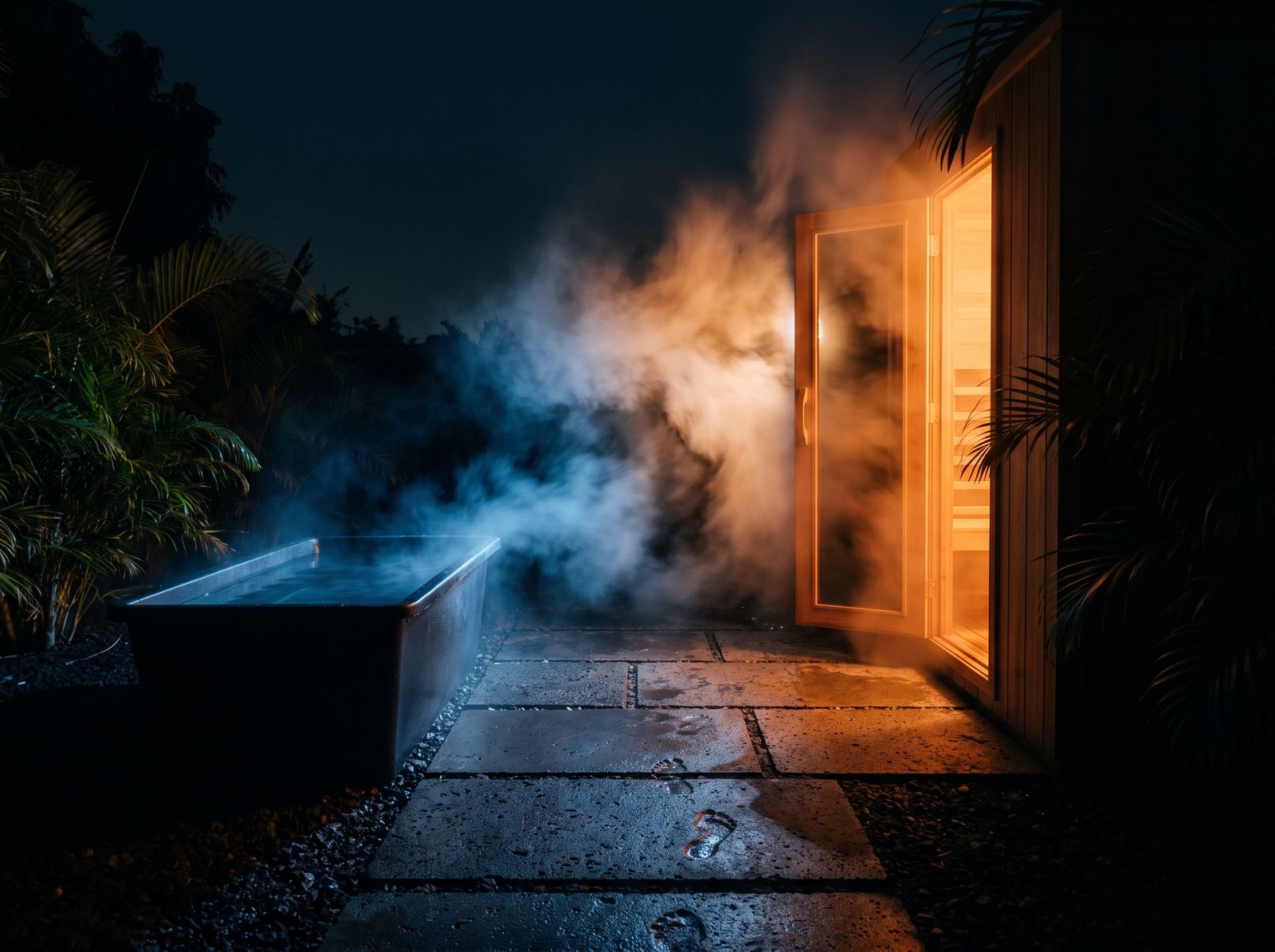
Contrast Therapy8 min
Sauna vs ice bath: why the sequence matters
Sauna vs ice bath isn't a competition — it's a sequence. See what heat does, what cold actually does, and how…
Contrast Therapy
The Nordic cycle assumes cold outdoor air for its rest phase. At 30°C and 85% humidity in Lombok that fails, so we rebuild the cycle to actually work.
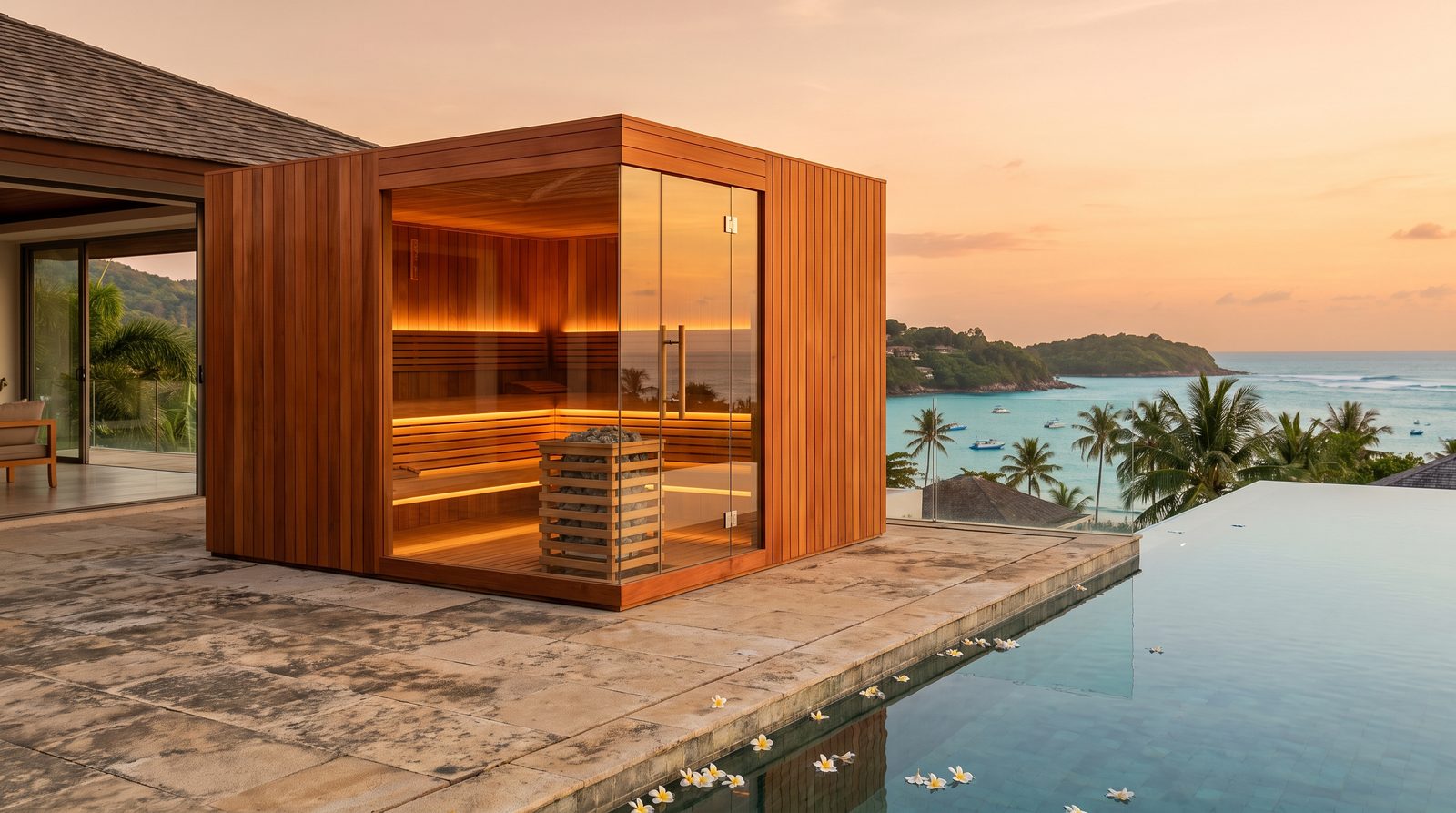
The Nordic cycle — löyly, cold, rest, repeat — was designed around a climate where the rest phase takes care of itself. Step outside a Finnish sauna in winter and the air alone finishes the job the cold plunge started: it is at or below 0°C, dry, and often moving. In Lombok, air at rest sits at 28–32°C with 80–90% relative humidity. The rest phase does not just work less well here — it actively fights the rest of the cycle, which means the Nordic cycle has to be re-engineered, not just relocated, to work on a tropical site.
This article covers what specifically breaks and what we build instead: a shaded, airflow-managed rest zone, a colder and longer plunge than the Nordic original calls for, and water and site details tuned to actual Lombok conditions rather than imported wholesale from Finland.
The traditional pattern is simple: löyly (steam thrown from water onto hot stones) in a wood-fired sauna, a plunge into cold water or a roll in snow, then rest outdoors before starting again. Two or three rounds is typical. It is old, consistent across the Nordic countries, and it was never designed as an isolated hot-cold trick — the surrounding climate is doing part of the work.
In Finland, "rest" means standing or sitting outside in air that is at or below freezing for a large part of the year, often with genuine wind. That air keeps pulling heat off wet skin well after the plunge itself has ended, and it does this without any deliberate design — the climate supplies it for free.
Copy the hot-plunge-rest structure onto a Lombok site without touching anything else and you keep the two active steps but lose the free part entirely. That is the actual problem this article solves.
Heat dilates, cold constricts, and most explanations of contrast therapy stop there. But the Nordic rest phase is doing a third thing: continued evaporative and convective cooling on skin that is still wet from the plunge, in air cold and dry enough to keep pulling heat away. That extends the vascular response instead of just switching it off.
Rest outdoors in a genuinely cold climate also drops heart rate and settles breathing faster than resting somewhere neutral would, because the body is still actively working to conserve core heat. The nervous-system "settle" that people associate with the Nordic cycle is partly a product of that ongoing cold-air exposure, not just a passive pause between rounds.
This is easy to miss because the rest phase looks like the boring part of the cycle. It is not filler — it is the phase that was quietly doing extra physiological work in the original climate, which is exactly what disappears first when the cycle moves to the tropics.
At 28–32°C ambient and 80–90% relative humidity, standing outside wet from a plunge does not cool you further. High humidity means the air is already close to saturated, so sweat and residual plunge water barely evaporate, and air this warm has little capacity to pull heat away by convection either — if anything, it adds heat back.
The practical result: "rest" in an unmodified Nordic layout becomes standing around hot, damp, and increasingly uncomfortable rather than settling. Guests either cut the rest phase short and go straight back to heat — collapsing the whole cycle into two shocks with no recovery — or they end the session early out of simple discomfort, well before the intended number of rounds.
We have watched this exact failure on unmodified layouts: the rest area gets skipped after round one because standing in 90% humidity at 30°C feels worse than either the heat or the cold. The fix is not willpower — it is redesigning the rest zone itself.
Import the hot-cold steps and ignore the rest zone, and you have not built a Nordic cycle in the tropics — you have built two shocks with an uncomfortable pause between them.
If the rest phase can no longer contribute passive cooling, the cold step has to do more of the work on its own. In practice that means running the plunge toward the colder end of the working range — 8–10°C rather than 12°C — and holding it a little longer than the Nordic original typically calls for, to bank more of the vascular effect before rest begins.
This is a direct trade against comfort, and we say so plainly to clients: a colder, longer plunge is a harder session. It is the correct engineering response to losing the free cooling the rest phase used to provide, not an arbitrary intensity increase. Our contrast therapy protocols guide has exact durations by experience level, and the tropical adjustment sits on top of those baselines rather than replacing them.
A colder, longer plunge is a bigger cardiovascular stress, not a bigger reward. Anyone with a cardiovascular condition, blood pressure issues, or who is pregnant should check with a doctor before running this version of the cycle, and nobody should do it alone or after drinking alcohol.
The heat step also needs a harder stop. Because the rest phase will not finish cooling the body down, we favour slightly shorter heat rounds in a Lombok Nordic layout than the same protocol would use in a cold climate, shifting a little more of the cycle's total time toward cold and rest.
Since the air itself will not cool a resting guest, the rest zone has to manufacture the conditions Finland provides for free: shade, moving air, and a surface that does not radiate stored heat back at the person sitting on it.
A misting element aimed across the rest area, not at the guest directly, can add a further evaporative edge in the driest part of the day, though it earns its keep more in dry season than during the wet months when ambient humidity is already high.
None of this is exotic engineering. It is the same logic as any tropical outdoor living space, applied specifically to the ten minutes right after a cold plunge, which is exactly the window where the Nordic cycle needs it most.
Ambient water on the island starts warm, often close to 27–30°C straight from the supply, which means a chiller here fights a far bigger gap than the same unit would face in a Nordic or even a temperate setup. Budget roughly double the nameplate cooling capacity you would use in a cooler climate, with tub insulation carrying a large share of the real performance.
Our chiller cold plunge page covers sizing in detail. The number that matters for a Nordic-cycle installation specifically is recovery time between rounds — the chiller needs enough headroom to pull the tub back to 8–10°C between guests or rounds, not just reach it once and hold a static temperature with nobody testing it.
Power is the other local constraint. PLN's single-phase supply at most villas needs an upgrade path once heater and chiller loads are combined, and that is a conversation worth having at the design stage rather than after a plunge is already plumbed in.
A tropical Nordic cycle is a genuinely different design brief from either a standalone sauna or a standalone ice bath. It needs a heater sized for slightly shorter, hotter rounds, a chiller sized to run colder with fast recovery, and a rest zone doing active engineering work rather than sitting as leftover space between the two. And because the hot rounds here run shorter but hotter, the fundamentals from our plain-terms guide to sauna safety — hydration, sensible timing, never mixing heat with alcohol — carry extra weight on a tropical site.
Get any one piece wrong and the cycle collapses back into what we described above — two shocks and no real rest, which is a worse experience than either a sauna or an ice bath used on its own. Get all three right and the cycle we build actually resembles what the Nordic original intended, just achieved by different means.
This is also why we treat it as one wellness zone design rather than three separate purchases: the heater, the chiller, and the rest area's shade and airflow all have to be sized against each other, on the same site survey, at the same time.
Every element above — plunge temperature, heat round length, rest zone orientation, chiller headroom — depends on your specific plot: which direction it faces, what shade already exists, and what power supply is already on site. There is no catalog version of a tropical Nordic cycle that fits every villa or retreat centre.
We survey the site, work out where the rest zone can actually catch a breeze, and size the heater and chiller against real numbers rather than European defaults. Contact us to start with a site visit, or look at our completed projects to see how the rest-zone problem has been solved on other Lombok sites.
Common questions
The traditional pattern of löyly (steam in a hot sauna), a cold plunge or roll in snow, and a rest period outdoors, repeated for two or three rounds. It developed in Finland and assumes a cold outdoor climate handles part of the cooling during rest.
The rest phase relies on cold, dry outdoor air to keep cooling wet skin after the plunge. At 28–32°C and 80–90% humidity, that air can't evaporate sweat or pull heat away, so rest stops working and the cycle collapses into two shocks with no recovery in between.
We build toward the colder end of the working range, 8–10°C, rather than the 12°C some temperate versions use, because the rest phase can no longer contribute extra cooling. The plunge has to do more of the work on its own.
Not fully, but they recover most of the function that matters: keeping a resting guest from re-heating. Shade stops direct radiant heat, and directed airflow restores some evaporative cooling that still tropical air at high humidity cannot provide on its own.
Yes, at a scaled-down version of the beginner contrast protocol, but the usual cautions apply: anyone with a cardiovascular condition, blood pressure issues, or who is pregnant should check with a doctor first, and nobody should run the cycle alone or after drinking alcohol.
Keep reading
More from the journal on heat, cold and the specific ways this climate breaks things.
All 19 guidesContrast Therapy8 min
Sauna vs ice bath isn't a competition — it's a sequence. See what heat does, what cold actually does, and how…
Contrast Therapy7 min
A contrast therapy protocol is just heat, cold, rest, and rounds. Real beginner, intermediate, and advanced…
Cold8 min
Ice bath temperature isn't a race to the lowest number. The 8–12°C working range, a 15°C beginner entry, and…
Next step
Send a photo of the spot and rough dimensions. You get a layout, a heat-load calculation and a fixed price — usually within two working days.