Contrast Therapy7 min
Contrast therapy protocol: beginner to advanced
A contrast therapy protocol is just heat, cold, rest, and rounds. Real beginner, intermediate, and advanced…
Contrast Therapy
Sauna vs ice bath isn't a competition — it's a sequence. See what heat does, what cold actually does, and how Lombok villas combine both safely.
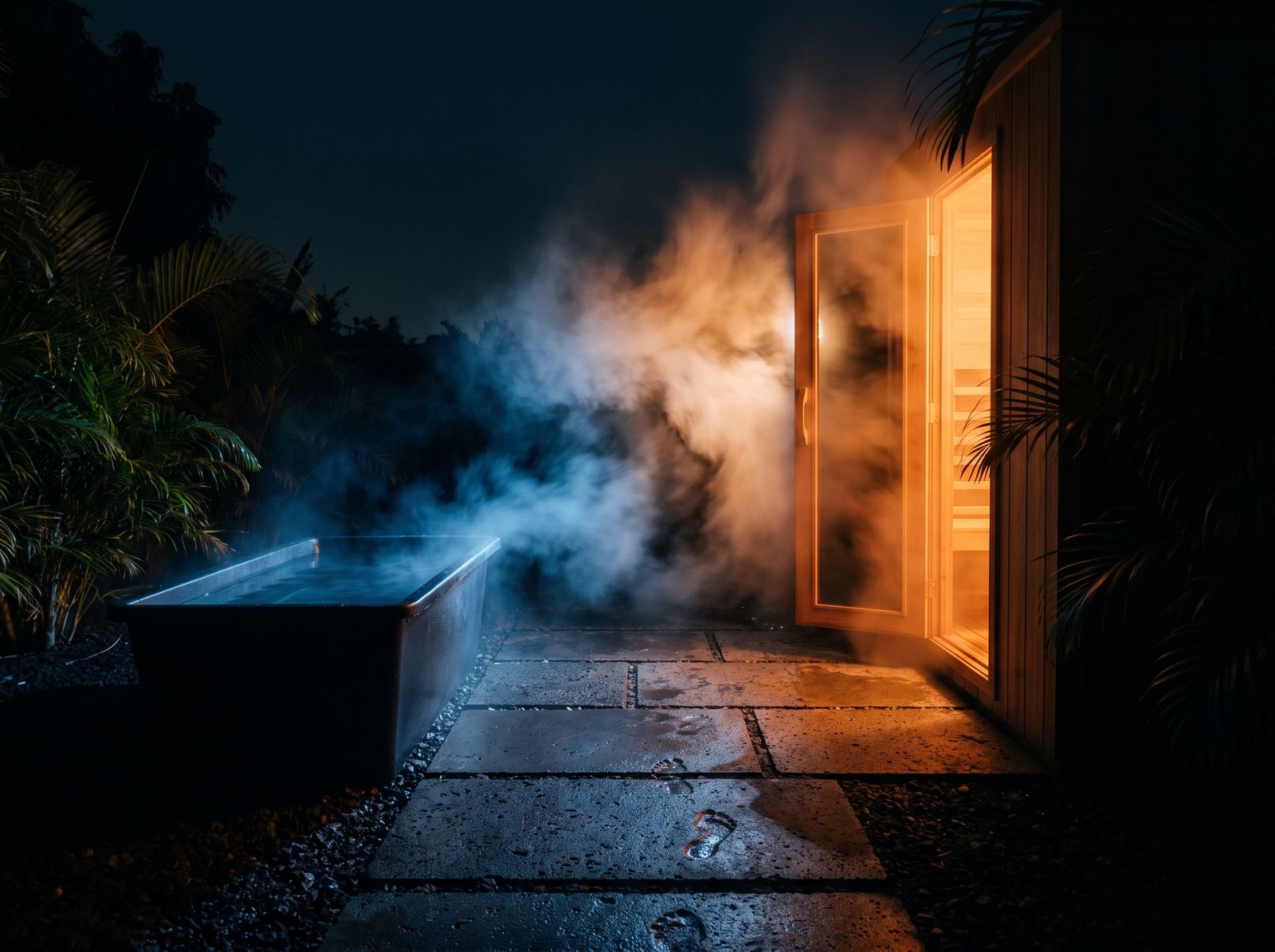
Sauna vs ice bath is usually asked like a choice between two competing products. It isn't one. A sauna heats the body's core and skin to the point of heavy sweating; an ice bath drops skin temperature fast enough to trigger a strong vascular reflex. They do different jobs, and most of what people actually want — better recovery, easier sleep, a reset after a hard week — comes from doing both, in sequence, rather than picking a winner.
That said, not everyone needs both. If you are building a single wellness feature for a villa or a surf camp, the honest answer depends on your guests, your climate, and your budget. This article covers what each does on its own, why the hot-to-cold sequence is the part that actually matters, and when one without the other is the right call.
Heat is the easier half to explain because the physics are direct. Air at 80–100°C forces the body to shed heat fast: blood vessels near the skin dilate, heart rate rises the way it would on a brisk walk, and sweating ramps up to cool the skin surface. None of this is mysterious — it is the same thermoregulation the body uses on a hot day, concentrated into fifteen or twenty minutes.
Sit at upper bench height in one of our outdoor cabin saunas and you are in roughly 90–100°C air; drop to the lower bench and it can be 10°C cooler. That gap is not a design flaw — it is how a sauna lets a first-timer and a regular each find their own seat. Core temperature moves more slowly than skin temperature, typically climbing by under 1.5°C over a 15–20 minute sit, which is enough to feel the effect without overwhelming the person inside.
Guests who go straight to the top bench on their first visit almost always leave early. We tell first-time villa guests to start low, stay ten minutes, and move up only on a second or third session.
What guests actually feel — loosened shoulders, a lighter head, a better night's sleep that sometimes follows — is commonly associated with this heat load combined with the simple effect of sitting still and hot for a fixed block of time. None of it is a medical treatment, and we do not sell it as one. It is a physical stress the body handles well in small, repeated doses.
Cold water at 8–12°C produces the opposite reflex: blood vessels in the skin and limbs constrict hard, breathing goes shallow and fast for the first 20–30 seconds, and heart rate typically spikes before settling. That reflex is real and immediate. What it is not is a fat-burning shortcut, a toxin flush, or a cure for inflammation — claims that circulate constantly around cold plunging and do not hold up to plain physiology.
An ice bath at working range reliably does two things: it produces a sharp alertness spike that most people describe as a mental reset, and it is commonly associated with reduced perceived muscle soreness in the day or two after hard exercise. Both are worth having. Neither is a guarantee, and cold exposure on its own does not replace sleep, hydration, or an actual training plan.
The other thing cold does not do well on its own, in a hot climate, is provide contrast. Stepping from 32°C Lombok air into a plunge and back out into 32°C air is a cold shock followed by a slow return to baseline, not the sharp swing that makes contrast work — which is one reason a standalone ice bath and a true contrast setup are different projects.
Cold does not "flush toxins" and it does not out-perform rest for recovery. Treat it as a strong, short physiological jolt, not a substitute for sleep or a training programme.
Heat alone dilates. Cold alone constricts. Put them back to back and the body's vessels do both in quick succession — a pumping action through the skin and superficial muscle that neither temperature produces by itself. This is the actual mechanism behind "contrast therapy," and it is why the order and the swing between temperatures matters more than the absolute heat or cold of either step.
The swing needs to be large enough to register. Going from a warm shower to a cool one is a mild version of the same idea; going from 90–100°C sauna air to an 8–12°C plunge is the full version, and it is why we size ice baths for a working range rather than a merely refreshing one. A weak contrast produces a weak pump.
Rest matters as much as the two extremes. The classic pattern is heat, cold, then a period sitting quietly at normal temperature before repeating — the rest phase lets the nervous system settle and is part of why people describe the whole cycle as calming rather than just intense. Skip the rest and you get two shocks with no recovery in between, which is unpleasant rather than useful.
We cover exact durations and round counts in our contrast therapy protocol guide. The point here is structural: the sequence, not either single temperature, is what a well-designed hot-cold installation is actually built to deliver.
Not every site needs both. A boutique hotel with limited outdoor space and guests who mostly want a quiet evening ritual is usually better served by a single well-built outdoor cabin sauna than by squeezing in an undersized plunge as an afterthought. Heat alone still delivers the relaxation and social ritual most guests are actually there for.
A surf camp is closer to the opposite case. Surfers arrive with sore shoulders and inflamed joints from paddling, want something fast between sessions, and often don't have twenty minutes to sit and sweat before a second surf. A stand-alone cold plunge, chilled and ready, can be the higher-value single install for that guest profile — see our piece on sauna and cold plunge use for surfers for that trade-off in detail.
Pick sauna alone if:
Pick ice bath alone if:
Budget often decides this on its own. An outdoor cabin sauna starts from IDR 125,000,000 (≈ USD 7,700) and a cedar ice bath from IDR 42,000,000 (≈ USD 2,600); both figures are indicative and depend on a site survey, but the combined total is naturally the first thing that filters a one-structure decision from a two-structure one.
Hot-cold cycling is commonly associated with better perceived recovery after hard physical activity, an easier transition into sleep later that evening, and a reported drop in perceived stress immediately after the session. These are consistent, repeated observations from people who use contrast regularly, not a guarantee for any individual and not a substitute for medical care.
We do not claim contrast therapy treats, prevents, or cures any condition, because it does not, and any wellness business telling you otherwise is overstating what heat and cold can do. What we can say plainly, because it is physics rather than medicine, is that the vascular pumping effect described above is real and repeatable, which is a large part of why the practice has persisted across very different cultures and climates for a long time.
People with cardiovascular conditions, blood pressure issues, or who are pregnant should talk to a doctor before starting hot-cold cycling. Nobody should sauna or cold-plunge alone, and never after drinking alcohol.
Within those limits, most healthy adults tolerate a moderate contrast cycle well. The main risk in practice is not the temperatures themselves but rushing — going too cold too fast, or standing up too quickly after a long hot sit, which is a blood-pressure event waiting to happen rather than anything specific to sauna or ice bath.
The engineering challenge here is not the sauna and not the ice bath individually — both are well-understood boxes. It is that Lombok's 28–32°C ambient and 80–90% humidity sit between the two extremes you are trying to create, which means both structures work harder than they would in a temperate climate.
A chiller for the plunge fights a much bigger gap between ambient water temperature and target than it would in a cooler country. Budget roughly double the nameplate cooling capacity you would spec in a temperate climate, with tub insulation doing a large share of the real work — sizing that correctly is what separates a plunge that holds its temperature from one that slowly drifts warm through the day.
The sauna side has its own local rules. Ventilation has to purge humid tropical air fast enough that the room actually reaches dry heat rather than steaming, and PLN's single-phase supply at most villas usually needs an upgrade path once a heater passes 6 kW. None of this is a reason to avoid building both; it is a reason to plan the electrical and plumbing together rather than as two unrelated purchases, which is exactly what our wellness zone design process is for.
The right answer — sauna, ice bath, or both — depends on your guest profile, your available power, and your outdoor space, and every one of those is site-specific. We size heaters and chillers against your actual room volume, glass area, and PLN connection rather than a catalog default, and every quote follows a walk of the site.
If you already know you want the full cycle, the practical next step is a short call to talk through layout: contact our team to arrange a site visit. If you are still deciding between one structure and two, that same conversation is the fastest way to find out which one your site actually needs.
Common questions
No. A sauna alone still delivers heat's core benefits — relaxation, sweating, the social ritual most villa guests want. An ice bath adds a different, faster reflex and unlocks the contrast cycle, but it is a genuine addition, not a requirement, and plenty of well-used sites run heat only.
Most people manage 12–20 minutes at a comfortable bench height before the first cold step, building up gradually rather than starting there on day one. Exact durations depend on heat tolerance and are covered round by round in our contrast therapy protocol guide.
No. People with cardiovascular conditions, blood pressure issues, or who are pregnant should speak to a doctor before trying hot-cold cycling. Nobody should sauna or cold-plunge alone or after drinking alcohol, and standing up too fast after a long hot sit is the most common real-world risk.
Only partially. A shower wets a fraction of the skin at a time and Lombok's tap water runs close to 27°C, well above the 8–12°C working range that produces a strong contrast reflex. It is a reasonable substitute when nothing else is available, not an equivalent.
8–12°C is the working range we build to, with 15°C a sensible entry point for someone doing their first few sessions. Below 5°C is specialist territory that needs supervision and is not something we recommend for casual home or villa use.
Keep reading
More from the journal on heat, cold and the specific ways this climate breaks things.
All 19 guidesContrast Therapy7 min
A contrast therapy protocol is just heat, cold, rest, and rounds. Real beginner, intermediate, and advanced…
Contrast Therapy7 min
The Nordic cycle assumes cold outdoor air for its rest phase. At 30°C and 85% humidity in Lombok that fails,…
Cold8 min
Ice bath temperature isn't a race to the lowest number. The 8–12°C working range, a 15°C beginner entry, and…
Next step
Send a photo of the spot and rough dimensions. You get a layout, a heat-load calculation and a fixed price — usually within two working days.