Buying7 min
Sauna cost Lombok: the real price guide
Sauna cost Lombok, honestly broken down: heater, electrical upgrade, foundation, drainage, glass and freight,…
Buying
Infrared vs traditional sauna, compared honestly: how each heats you, what each draws from Lombok's weak grid, and which one actually suits your site.
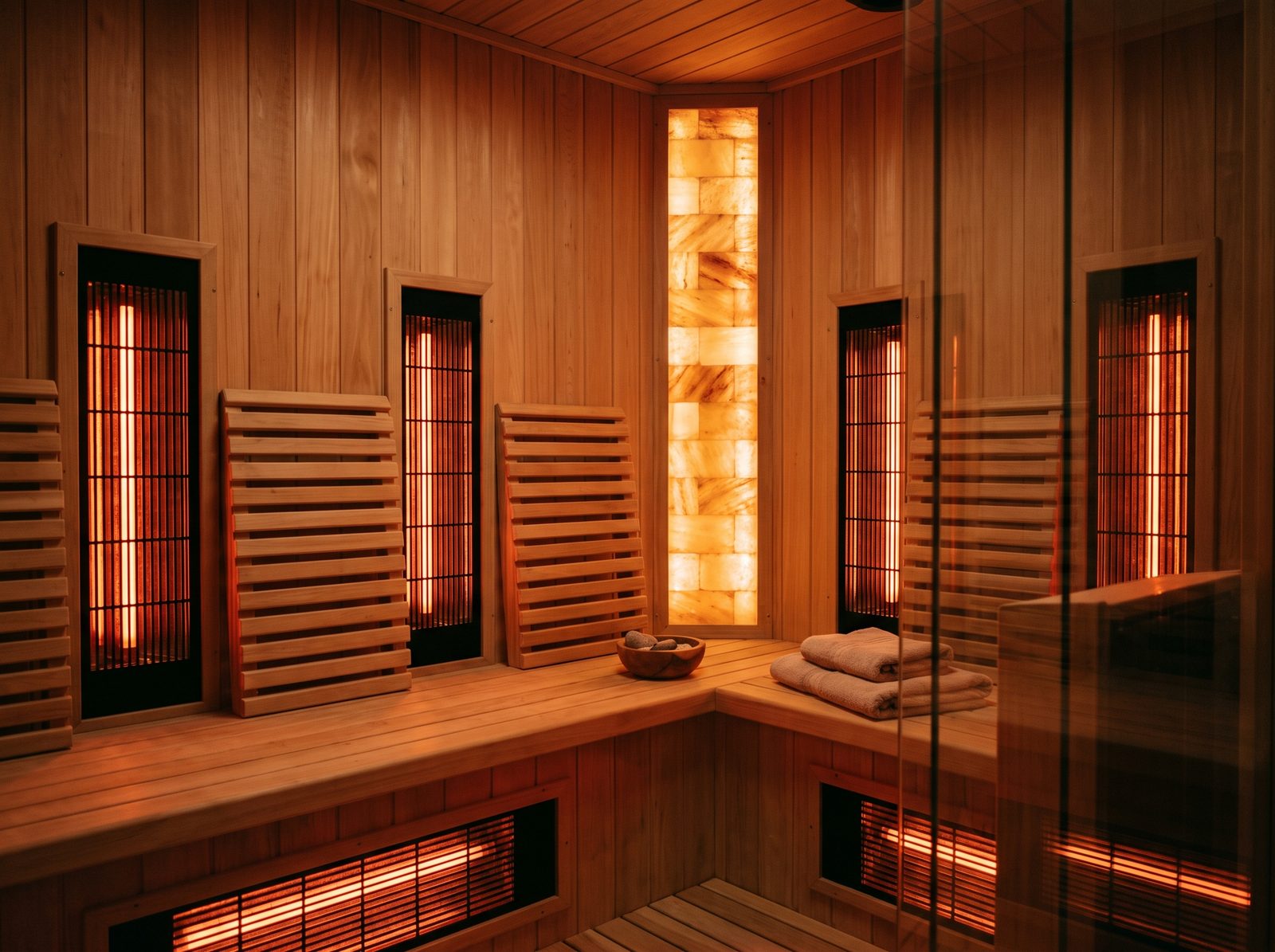
An infrared vs traditional sauna comparison is really a comparison between two different machines built to do different jobs, not a better-or-worse contest. A traditional sauna heats the air to 80–100°C and lets that hot, dry air warm you by convection and radiant heat off hot stones. An infrared cabin runs at 45–60°C and heats your body directly with radiant panels, barely warming the air around it at all.
Neither is a better sauna in the abstract. The honest question is which job you need done, and — on Lombok specifically — what your electrical supply can actually carry without an upgrade.
A traditional sauna works by heating the air and the stones on top of the heater, then largely by convection: hot air moves across your skin and transfers heat, with additional radiant heat coming off the stones and heated walls. A traditional heater in a well-insulated room is sized at roughly 1 kW per m³ of enclosed air, because it is the air itself doing much of the work.
An infrared cabin skips heating the air almost entirely. Radiant panels emit infrared wavelengths absorbed directly by skin and near-surface tissue, the same way sunlight warms you even on a cool, breezy day. The air in the cabin stays far cooler than a traditional room, which is why an infrared cabin feels different to sit in even when people compare it to a traditional room at a similar-sounding number.
The heater hardware reflects that difference. A traditional heater sits inside a heat-resistant guard rail with a stone tray on top, needs clearance from combustible surfaces on every side, and radiates enough heat that surrounding wall and bench material choice matters — never resinous pine on a traditional bench, since resin can weep and scorch at these temperatures. Infrared panels mount flat against the wall, run cool enough to touch briefly, and need far less clearance, which is part of why an infrared cabin can be smaller for the same seating count.
Reference figures worth planning around: a traditional sauna runs 80–100°C air at 10–20% relative humidity, with roughly a 10°C difference between upper and lower bench height. Sessions tend to run in shorter rounds — commonly 10 to 20 minutes — because the air temperature alone is intense enough that most people do not want to stay much longer without a cooling break.
An infrared cabin runs 45–60°C, cool enough that sessions commonly stretch to 30–45 minutes in one sitting, since there is no hot-air ceiling forcing an early exit. That is a genuine advantage for anyone who finds intense heat uncomfortable, or who wants one long, low-intensity session rather than several short, intense ones.
This is where the comparison stops being about comfort and starts being about infrastructure. A traditional heater sized for a modest 5–6 m³ room commonly needs 5–6 kW, and anything above about 6 kW usually pushes a villa's single-phase PLN supply into needing a 3-phase connection or a dedicated upgraded feed. An infrared cabin of similar seating capacity typically draws only 1.5–3 kW in total across its panels — well within what an untouched single-phase supply can carry alongside everything else already running at the villa.
That difference alone is often the deciding factor for a property with an already-stretched meter, a rental villa where an electrical upgrade is not practical, or a retrofit into an existing bathroom or covered deck. Choosing infrared can mean installing this month instead of waiting on a PLN upgrade application first.
Run the numbers over a full build and the gap compounds. Avoiding a 3-phase upgrade does not just save the upgrade cost itself — it can also simplify permitting and shorten the overall installation timeline, since PLN paperwork is frequently the slowest part of a traditional sauna project. Our full sauna cost breakdown for Lombok itemises what an electrical upgrade typically adds, if you want to see the two paths priced side by side.
A traditional sauna's stones let you add water for löyly — a burst of steam that spikes humidity for a few seconds and sharpens the sensation of heat against the skin. It is a core part of the traditional sauna ritual and one of the main reasons people describe traditional heat as more intense than the number on the thermostat suggests.
An infrared cabin cannot do this, structurally. There are no stones, and no heating element that tolerates water contact — pouring water on an infrared panel risks damaging it rather than producing steam. Anyone choosing infrared should go in understanding they are choosing a dry, radiant, no-steam session by design, not a lower-powered version of a traditional one. If löyly and humidity are the point for you, infrared will not deliver it at any setting.
Traditional saunas need deliberate ventilation design: a fresh-air inlet near the heater and an exhaust point positioned to pull hot, humid air out without stripping the room of heat too quickly. Get this wrong in a humid tropical climate and the room never quite dries out between sessions — uncomfortable, and hard on timber over time. Our guide to sauna ventilation in the tropics covers the detail most builds get wrong.
An infrared cabin's lower heat and lack of steam make it more forgiving to install into a tighter footprint or an existing covered space, since the structure is not managing the same thermal and moisture extremes. It is still an outdoor-rated build on Lombok — salt air and humidity do not care how hot the cabin runs — but the ventilation and structural demands are genuinely lighter.
Footprint reflects the same logic. A traditional two-person cabin needs enough internal volume to make the 1 kW per m³ heater rule work sensibly, which usually means a minimum floor area even before bench depth is added. An infrared two-person cabin can run noticeably smaller, since the panels heat occupants directly rather than needing a minimum air volume to feel effective — useful on a tight deck or a balcony retrofit where a full traditional cabin will not fit.
Both styles of heat are commonly associated with, or reported to help, recovery, sleep quality and perceived stress, though neither should be described as treating or preventing any medical condition. The intensity differs: a traditional sauna's higher air temperature and optional steam produce a stronger, faster sweat response over a shorter session, while an infrared cabin's lower temperature produces a gentler, more gradual response over a longer one. Some people simply find 90°C dry heat unpleasant and get on far better with 50°C infrared for twice as long.
Anyone with a cardiovascular condition, blood-pressure issues, or who is pregnant should speak to a doctor before using either type regularly. Neither a traditional sauna nor an infrared cabin should be used alone, and never after drinking alcohol — the lower temperature of infrared does not remove that rule, since dehydration and overheating are still possible over a long session.
The table below sets the two side by side on the factors that actually change your build, your power bill and your session.
| Factor | Traditional sauna | Infrared cabin |
|---|---|---|
| Typical air temperature | 80–100°C | 45–60°C |
| Relative humidity | 10–20%, plus optional steam bursts | Low, no steam capability |
| Typical session length | 10–20 min per round | 30–45 min |
| Heater power, small cabin | ~5–6 kW+ | ~1.5–3 kW |
| Typical electrical impact | Often needs a supply upgrade above 6 kW | Usually fits an existing single-phase supply |
| Ventilation demand | Deliberate inlet/exhaust design required | Lighter — lower heat and no steam |
| Indicative price | from IDR 125,000,000 (≈ USD 7,700) | from IDR 52,000,000 (≈ USD 3,200) |
Choose traditional heat if the ritual matters to you — the intensity, the optional steam, the shorter, sharper session — and your property's electrical supply already handles it or can be upgraded within budget. This is also usually the right choice for a custom built-in sauna designed as a statement feature.
Choose infrared if your electrical supply is genuinely constrained, if you prefer a longer, gentler session, or if the site favours a smaller footprint. Plenty of properties end up specifying both as part of a single wellness zone — a traditional cabin for the ritual, an infrared unit for a lower-commitment daily option — rather than treating the choice as exclusive.
For a private villa retrofit especially, start with the electrical question rather than the temperature question. A property with 3-phase already installed loses nothing by choosing traditional. A property without it pays for that choice twice — once for the sauna, once for the upgrade.
If you are unsure which fits your site and your power supply, tell us the room size and what is already on the meter, and we can usually rule one option in or out before you spend more time comparing. Get in touch and we will talk through both.
Common questions
Neither is objectively better — they do different jobs. A traditional sauna gives intense dry heat, optional steam and a shorter session; an infrared cabin gives gentler radiant heat and a longer session on a fraction of the power. The right choice depends on what you want from a session and what your electrical supply can carry.
A traditional sauna heats the whole volume of air plus a stack of stones to 80–100°C, which takes real power — commonly 5–6 kW or more. An infrared cabin heats your body directly with radiant panels and barely warms the air, so a similar-sized unit typically draws only 1.5–3 kW in total.
No. Infrared cabins have no stones and no heating element rated for water contact — pouring water onto a panel risks damaging it rather than producing steam. An infrared session is dry and radiant by design. If steam and löyly matter to you, a traditional sauna is the correct choice, not infrared at a different setting.
Usually not. Most infrared cabins draw 1.5–3 kW in total, which an existing single-phase PLN supply at a villa can typically carry alongside normal household load. This is one of the main reasons infrared suits properties where a 3-phase upgrade is impractical or where the meter is already close to capacity.
Most people use an infrared cabin for 30 to 45 minutes at 45–60°C, longer than a typical traditional round because the lower temperature is easier to sit in. Even so, do not use it alone or after drinking alcohol, and speak to a doctor first if you have a cardiovascular or blood-pressure condition, or are pregnant.
Keep reading
More from the journal on heat, cold and the specific ways this climate breaks things.
All 19 guidesBuying7 min
Sauna cost Lombok, honestly broken down: heater, electrical upgrade, foundation, drainage, glass and freight,…
Cold8 min
Ice bath temperature isn't a race to the lowest number. The 8–12°C working range, a 15°C beginner entry, and…
Technical8 min
Sauna electrical requirements in Lombok: PLN supply tiers, single vs three-phase, cable sizing, RCD earthing,…
Next step
Send a photo of the spot and rough dimensions. You get a layout, a heat-load calculation and a fixed price — usually within two working days.