Buying7 min
Sauna cost Lombok: the real price guide
Sauna cost Lombok, honestly broken down: heater, electrical upgrade, foundation, drainage, glass and freight,…
Buying
Barrel sauna vs cabin sauna, compared honestly: heat-up time, bench layout, monsoon drainage, insulation and price, so you know which fits your site.
In a barrel sauna vs cabin sauna comparison, the short version is this: a barrel heats faster and costs less, but its curved wall makes bench layout and headroom harder to get right. A cabin sauna costs more and takes longer to reach temperature, but it delivers proper headroom, a full glass front if you want one, and simpler insulation. Neither is a better sauna in the abstract — they suit different sites and different priorities.
This comparison sets the two shapes against each other on what actually matters in Lombok: how fast they heat, how they shed monsoon rain, how many people they seat comfortably, and what they cost delivered and installed.
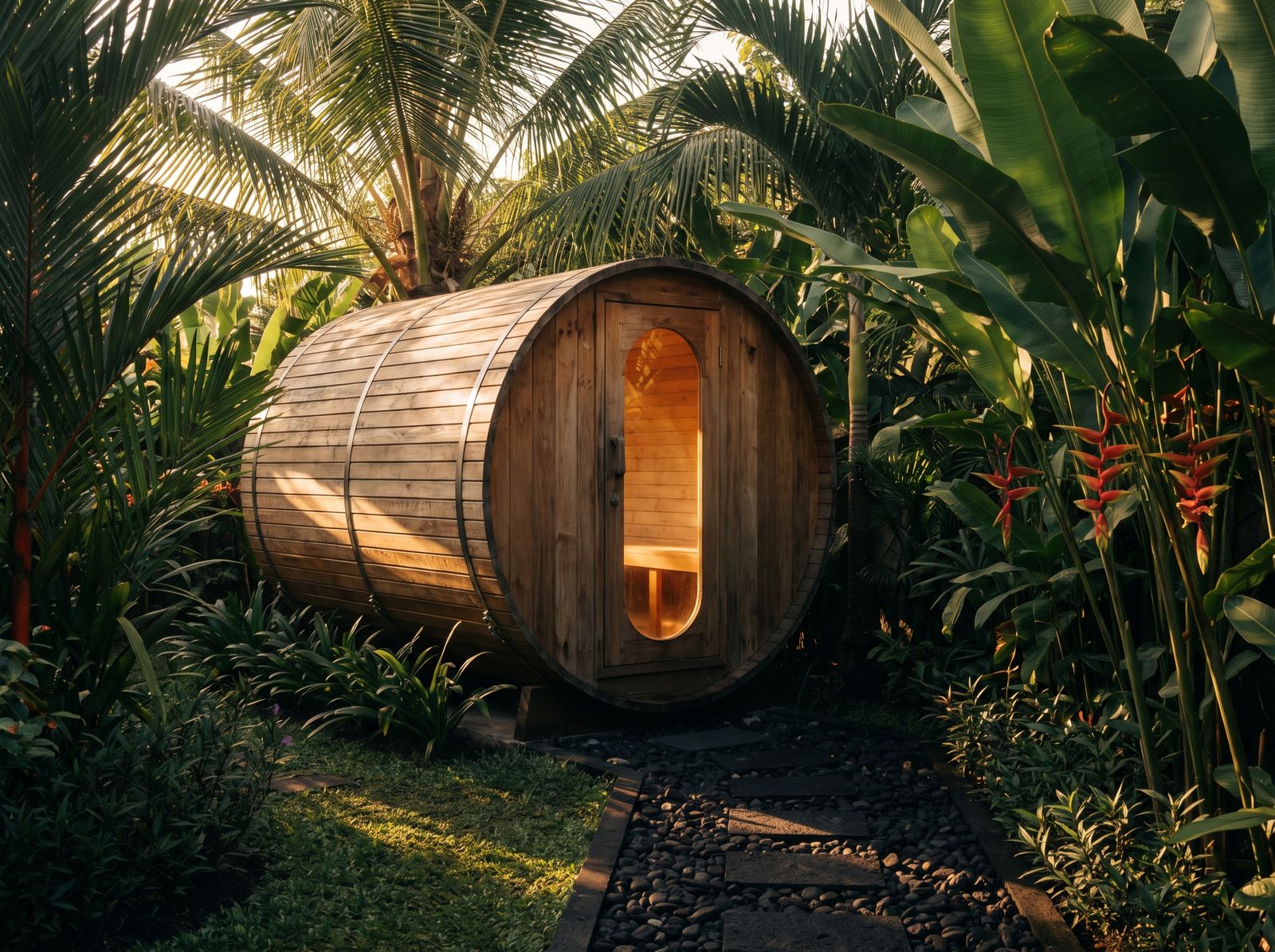
A barrel sauna is built from curved timber staves bound into a cylinder and set on cradles — the same joinery logic as a wine barrel, scaled up. An outdoor cabin sauna is a framed rectangular structure — stud walls, insulation, and a flat or pitched roof — closer to a small timber building than a vessel. That structural difference is the root of almost every other difference between them.
The barrel's curve is structurally efficient. A cylinder under thermal load resists distortion better than a flat panel, and staves under compression need less bracing than a framed wall. It is also why a barrel needs no separate roof: the same curve that forms the wall closes over the top. A cabin's flat walls and separate roof mean more framing, more insulation area, and more joints to detail correctly — but also a shape that can be built to any size and any layout.
Barrels are typically banded with stainless steel hoops rather than the timber hoops you might picture from a wine barrel, since stainless resists salt-air corrosion far better over years spent outside. The cradle beneath a barrel also needs to let it breathe and drain on both sides — a barrel sitting flat on a slab traps moisture along its lowest stave in a way a cabin's flat, vented sub-floor does not.
A barrel's smaller enclosed air volume and thinner curved wall reach working temperature faster than a cabin of similar footprint, for a given heater-to-volume ratio. Following the roughly 1 kW per m³ sizing rule, a small barrel sauna might carry a heater sized to 4–5 m³ of air and get to 80°C comfortably inside 30–40 minutes. A cabin of similar seating capacity typically encloses more air once headroom and a rectangular footprint are added, so expect nearer 45–60 minutes to the same temperature with a correctly sized heater — not because the cabin's heater is weaker, but because there is more air to heat.
Running cost between the two is closer than heat-up time suggests. Once a room is at temperature, holding it there costs roughly the same per hour for equivalent insulation quality, since the heater is simply replacing heat lost through the walls. A well-insulated cabin with a thicker wall build can hold heat slightly longer once the heater cycles off, which matters if you run back-to-back sessions for a family or a small group of guests.
A barrel's curved wall is the hardest thing about it to furnish. Benches have to follow the curve or sit inboard of it, which limits how many people can sit at a comfortable back-rest angle and how much genuine headroom exists away from the centre line. Most barrel layouts seat two to four people on facing benches, with full standing headroom only along the centre axis where the roofline is highest.
A cabin's flat walls and square corners make bench layout straightforward: an upper and lower tier along one or two walls, a clear aisle, and headroom that is consistent across the whole room. That upper-lower split matters more than it sounds — expect roughly a 10°C difference between upper and lower bench height, so a cabin's internal height and tier spacing is a genuine design lever for how hot a session feels. A barrel's single-curve geometry gives you far less freedom to place that second tier.
Door height is a quieter difference worth planning around. A barrel's door is cut into the curve near one end, so clearance is generally lower than a cabin's square door frame — a detail that matters for taller guests entering and exiting repeatedly during a longer session.
A barrel's continuous curve is close to self-draining: rain hits the roof at an angle and runs straight off, with no flat plane, parapet or roof junction where it can pool. In a Lombok downpour that matters — monsoon rain arrives hard and often sideways, and a barrel simply sheds it.
We see more warranty calls from flat-roofed structures with a single mis-sloped gutter than from any other detail on the island. A barrel's curved roof avoids that failure mode by not having a gutter at all.
A cabin's roof needs proper detailing to do the same job: correct fall, flashing at every junction, and guttering sized for tropical rainfall intensity rather than a temperate-climate spec. Done properly, a cabin sheds water just as reliably, but it is a design decision that has to be made correctly rather than a shape that does it by default. Both still need a drained, raised deck underneath — see our guide on maintaining a sauna in salt air for what happens when drainage and ventilation are an afterthought.
Insulating a curved wall evenly is harder than insulating a flat one — the stave thickness is fixed by the barrel's structural design, and there is no cavity to fill the way a framed cabin wall has one. Barrels perform well in practice because solid timber itself has reasonable thermal resistance, but a cabin's insulated stud wall gives more control over R-value, especially where budget allows a thicker wall build.
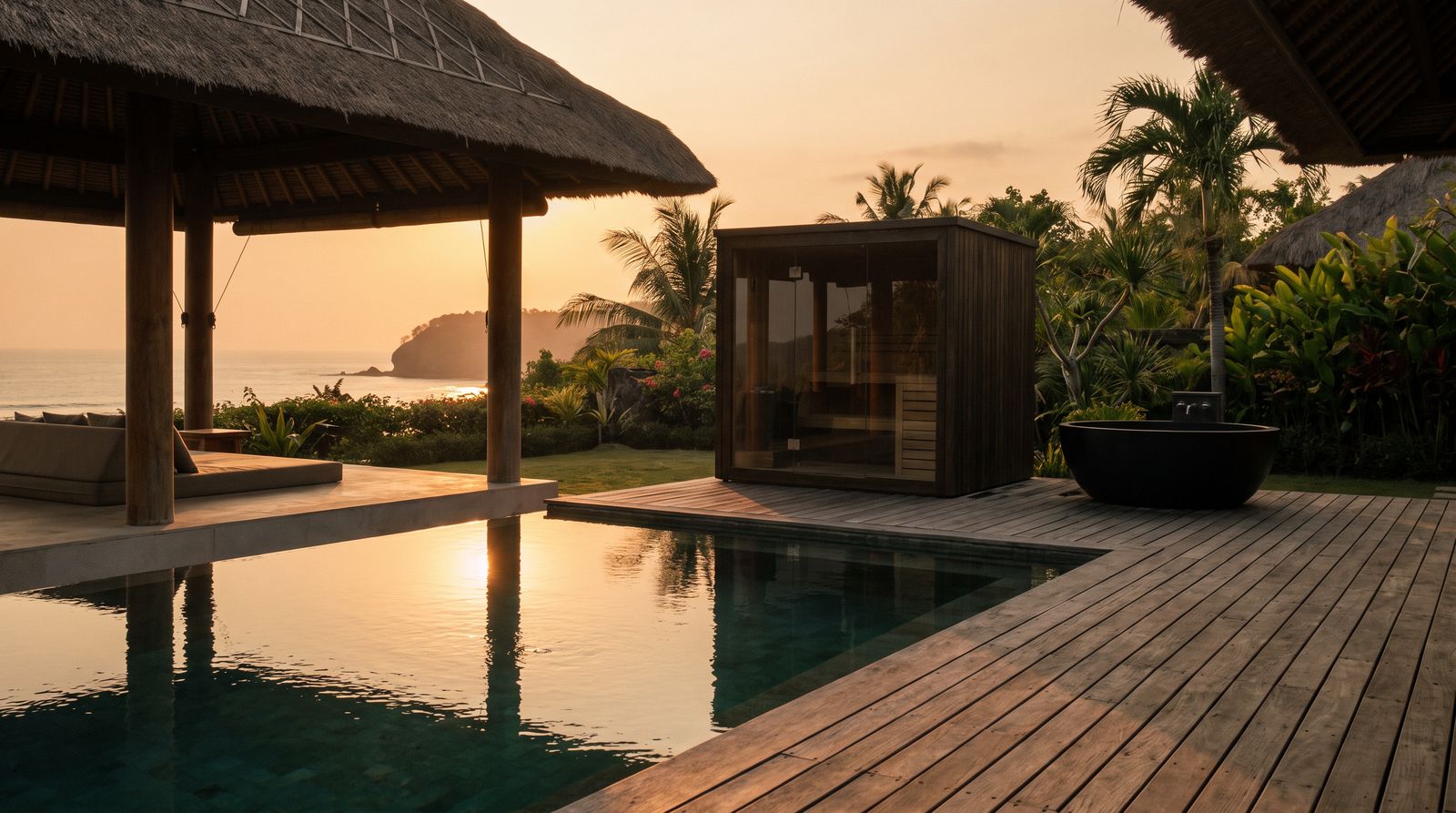
Glass is where the two shapes diverge most. A cabin can carry a full-height glazed front — genuinely popular for an ocean-view build in Sire or Tanjung — because a flat wall accepts a square or rectangular window frame without difficulty. A barrel is usually limited to a small round or oval window let into the end cap, since a curved wall does not accept a large flat pane without extensive extra framing. Remember that every square metre of uninsulated glass adds roughly 1.5 kW of heater capacity to hold temperature, in either shape.
None of this makes one shape draughtier than the other in practice. Both rely on a well-fitted door and correctly sealed joints far more than on wall thickness alone, and both hold heat perfectly well once that basic joinery is done properly.
Barrel saunas cost less to build than cabins of similar seating capacity, largely because there is less internal joinery and no separate roof structure to frame. The table below sets the two shapes side by side on the points covered above; treat every figure as indicative, with a final number confirmed after a site survey.
| Factor | Barrel sauna | Cabin sauna |
|---|---|---|
| Indicative price | from IDR 78,000,000 (≈ USD 4,800) | from IDR 125,000,000 (≈ USD 7,700) |
| Typical heat-up time | ~30–40 min | ~45–60 min |
| Headroom | Best along the centre line only | Consistent across the room |
| Bench layout | Limited — 2 to 4 seated | Flexible — tiered upper and lower |
| Water shedding | Self-draining curved roof | Needs correct fall and flashing |
| Glass or view | Small end window only | Full-height glass front possible |
| Best suited to | Compact sites, distinctive look | Group use, ocean-view sites |
The two shapes suit different sites and different priorities more than they suit different budgets alone. Choose a barrel where the brief looks like this:
Choose a cabin instead when the site or brief calls for:
Both shapes are built on the island, both take standard electric heaters sized the same way, and both can be finished in the same decking timber regardless of which one sits on top of it. The decision is rarely about which sauna is objectively better — it is about which shape matches the site, the headcount, and the view.
Maintenance load is close to identical once either is built: the same annual timber check, the same attention to hardware in salt air, and the same drainage inspection ahead of each wet season. Shape does not change that part of ownership — only the joinery and the roofline do.
If you already know your headcount, your site's footprint, and whether a view matters, you likely already know which shape you want. If you are still deciding, describe the site and the use case on WhatsApp and we will recommend a shape before we ever talk heater specs.
Common questions
A barrel sauna is cheaper, starting from IDR 78,000,000 (≈ USD 4,800) against IDR 125,000,000 (≈ USD 7,700) for a standard outdoor cabin sauna. The gap comes from less internal joinery and no separate roof structure on the barrel, not from a difference in build quality. Both prices are indicative and confirmed after a site survey.
Yes, typically. A barrel encloses less air for a given footprint and has a thinner curved wall, so with a correctly sized heater it commonly reaches 80°C in around 30–40 minutes, against roughly 45–60 minutes for a cabin of similar seating capacity. The cabin's heater is not weaker — there is simply more air to bring up to temperature.
Not practically. A barrel's curved wall does not accept a large flat pane without extensive extra framing, so glazing is usually limited to a small round or oval window in the end cap. A cabin sauna's flat wall accepts a full-height glazed front, which is why cabins are the usual choice for a view-facing build.
Most barrel layouts seat two to four people on facing benches. The curved wall limits how many people can sit at a comfortable back-rest angle, and full standing headroom exists only along the centre axis. A cabin sauna seats more people comfortably because its flat walls and square corners give consistent headroom throughout.
A barrel's continuous curved roof is close to self-draining, since there is no flat plane or roof junction for rain to pool against. A cabin can shed monsoon rain just as reliably, but only if the roof fall, flashing and guttering are detailed correctly for tropical rainfall — it is a design decision rather than a default.
Keep reading
More from the journal on heat, cold and the specific ways this climate breaks things.
All 20 guidesBuying7 min
Sauna cost Lombok, honestly broken down: heater, electrical upgrade, foundation, drainage, glass and freight,…
Buying8 min
Infrared vs traditional sauna, compared honestly: how each heats you, what each draws from Lombok's weak…
Cold8 min
Ice bath temperature isn't a race to the lowest number. The 8–12°C working range, a 15°C beginner entry, and…
Next step
Send a photo of the spot and rough dimensions. You get a layout, a heat-load calculation and a fixed price — usually within two working days.