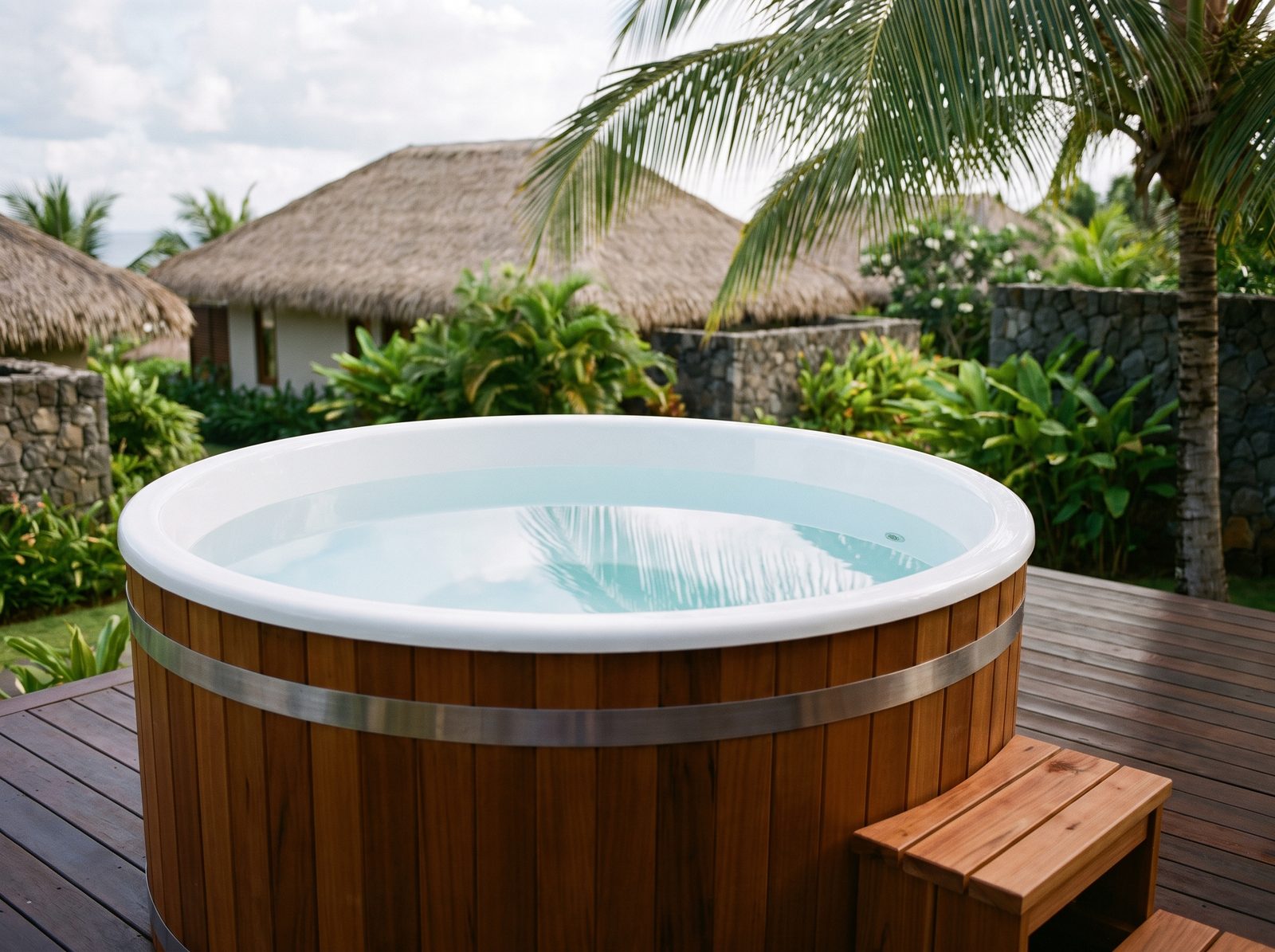
Cold8 min
Ice bath temperature: why colder is not better
Ice bath temperature isn't a race to the lowest number. The 8–12°C working range, a 15°C beginner entry, and…
Care
Sauna maintenance on the Lombok coast: fight salt and humidity separately — A4 fixings, cladding oil, stone swaps, bench care and wet-season habits.

A sauna on the Lombok coast is fighting two different attackers at once, and most maintenance problems trace back to treating them as one. Salt is the first: the onshore breeze at Kuta, Selong Belanak or Senggigi lays a film over everything it reaches — well inland of the beachfront, not just on it — that corrodes fixings, hinges and heater parts and holds a damp layer against the timber. Humidity is the second, and it attacks everything else: wood, seals, stone, and the electrics behind the panel, whether or not there is a grain of salt anywhere nearby.
A sensible sauna maintenance routine treats these as separate jobs with separate schedules, not one generic "clean the sauna" task. This guide sets out what to check weekly, monthly, and annually, when to replace stones, how to care for a bench — sand it, never varnish it — how to keep exterior cladding defended with oil and a rinse, and what actually happens to a cabin left shut for the wet season.
Salt air travels further inland than most owners assume, riding on wind rather than needing direct sea spray to do damage. Grade matters more than brand here: A2 stainless — the default in most imported kits — can pit and streak within a year or two on an exposed site, while A4/316 shrugs the same exposure off, and the two are indistinguishable on the counter. This is why we spec A4/316 for hinges, screws, bands and heater guards on any coastal build, and why a sauna bought as a generic kit with unspecified "stainless" hardware is the one that needs its fixings replaced early.
Timber takes the double attack. UV breaks down the surface of an unprotected board while the salt film holds moisture against it, which is why unoiled coastal cladding goes grey and then soft years ahead of the same board inland. Humidity then works on everything else regardless of location — Lombok's 80–90% ambient affects an inland villa almost as much as a beachfront one, and timber that is not allowed to dry fully between sessions is what eventually greys, softens or moulds at joints and corners, not the sauna's own heat cycle.
The two problems show up in different places, which is a useful diagnostic. Corroded screws and a rusting heater guard mean salt; grey, soft timber at a corner or a musty smell mean humidity. Treating a salt problem with more ventilation, or a humidity problem with better fixings, misses the actual cause.
Most of what keeps a coastal sauna running well is routine rather than skilled — the schedule below is what we give owners at handover, and it holds for a wood-fired or electric outdoor cabin, an infrared cabin, or a custom build alike.
| Frequency | Task |
|---|---|
| Weekly | Wipe down benches, sweep floor, check door seal for grit or debris, leave door open after last use to dry the room. |
| Monthly | Inspect visible fixings and hinges for early corrosion, rinse the salt film off seaward cladding with fresh water, check heater guard and element for salt residue, look at stones for cracking or dust. |
| Every 3 months | Light sand of bench surfaces if grain is raised, check door seal compression and latch alignment, clear debris from external vents. |
| Every 6–12 months | Replace sauna stones, inspect all fixings and replace any showing corrosion, check timber cladding and structural posts for termite activity. |
| Annually | Full electrical check of heater and wiring, reseal or replace door gasket as needed, deep-inspect roofline and cladding joints for water ingress. |
None of these intervals are rigid. A sauna used daily by a hotel needs the weekly and monthly columns taken more seriously than a private villa sauna used a few times a month, and a site directly on the waterfront should tighten the fixings checks regardless of use frequency.
The annual electrical check is also the point to confirm the property's supply still matches what the heater actually draws — worth reviewing against our sauna electrical requirements guide if the connection hasn't been checked since installation, particularly on an older villa running close to its PLN limit.
Sauna stones crack and eventually break down from repeated heat-and-water-splash cycling, and dust or small fragments at the base of the heater are the clearest sign a batch is due for replacement. Cracked stones hold less useful thermal mass and produce a sharper, less even löyly when water hits them, which is usually the first thing a regular user notices before anyone's actually inspected the heater.
Six to twelve months is a reasonable replacement interval for a sauna in regular use, tightened toward six months for a hotel or villa sauna running most days and stretched toward twelve for a lightly used private one. Check monthly rather than waiting for the full interval — a handful of small, sharp fragments is easy to miss until they've been sitting in the heater for weeks.
This is also the point to check the heater element itself for salt residue and corrosion while the stones are out, since the two checks take almost no extra time done together and the heater is fully exposed for a proper look either way.
Bench timber gets sanded, never varnished, and this is one of the few absolute rules in sauna maintenance rather than a judgment call. Varnish and other sealed finishes trap moisture against the wood and, at bench height in a room running 80–100°C, can soften or release compounds against bare skin — the opposite of what a sealant is supposed to do in a normal outdoor timber application.
A light sand every few months, following the grain, removes the raised or roughened surface that builds up from repeated sweat and humidity exposure, and restores the smooth, bare-timber feel a bench should have. This is a simple job with fine-grit sandpaper and no finish applied afterward — the wood is meant to stay bare, breathing, and replaceable rather than sealed.
We spec Western red cedar or thermally-modified aspen and alder for interior surfaces specifically because they handle this cycle of heat, humidity, and periodic sanding well over years of use, unlike resinous softwoods that can weep at bench temperature regardless of finish. Never use resinous pine on a bench in a hot room — it's a recurring mistake we see on kit-built saunas sourced without local climate in mind. Our guide to choosing wood for a tropical sauna covers the full timber comparison.
Exterior timber on a salt coast needs a renewable finish, which rules out every film-forming product. Varnish, lacquer and paint systems fail under tropical UV by blistering and peeling, and once they fail they hold salt and moisture against the wood — the opposite of protection, and expensive to strip. A penetrating oil soaks into the surface instead of sitting on it, weathers by fading rather than peeling, and can be reapplied indefinitely without any stripping at all.
Read the timber rather than the calendar for timing: when rain stops beading on the surface and the colour has flattened, the oil is due. How often that happens depends on exposure — a south-coast elevation taking the full onshore breeze can want oil twice a year, while a sheltered garden site is often fine with an annual coat. Between coats, a freshwater rinse of the seaward faces — a hose and ten minutes, on the monthly round — takes the salt film off before it can hold moisture against the boards through a run of humid nights.
Charred cladding is the low-maintenance exception: the carbonised skin is itself the defence and wants a refresh oil far less often. Bengkirai left completely bare simply goes silver-grey without losing strength, which is a legitimate choice as long as everyone agrees it was a choice. What no exterior ever gets, on any of our builds, is varnish.
Door seals take a specific kind of coastal punishment: salt-laden air degrades rubber and silicone gaskets faster than the same materials last in a temperate climate, and a compressed seal that's lost its spring lets both heat and humidity leak in the wrong directions. A gap you can see daylight through is losing heater efficiency continuously, not just on the days someone notices.
Fixings are the other half of this section, and the rule is simple: anything holding the door, hinges, or heater guard together should be A4/316 stainless, checked for early corrosion monthly and replaced at the first sign of pitting rather than waiting for failure. A single corroded hinge screw is a minor fix; the same screw failing and letting a heavy door sag is a much bigger one.
Latch alignment drifts as a door settles and seals compress over months of use, and a quarterly check of whether the door still closes flush and locks solidly is worth doing alongside the seal inspection, since a misaligned latch is often what wears a seal unevenly in the first place. Sites directly exposed to onshore wind, such as those near Senggigi, need these checks taken more seriously than an inland villa a few kilometres from the coast.
Termites are a genuine structural risk for any timber building on Lombok, sauna included, and the heat inside the cabin does not deter them from the structural posts and cladding outside the heated zone. A termite check belongs in the same six-to-twelve month cycle as stone replacement — looking specifically at ground-contact posts, the base of external cladding, and any timber-to-concrete junctions where moisture and shade combine.
Bengkirai and teak, which we use for decking and external cladding, resist termites considerably better than untreated softwoods, but "resistant" is not "immune," and a structure sitting on a site with a known termite history needs checking more often than the default interval. Early signs are subtle — small mud tunnels along a post base, or timber that sounds hollow when tapped rather than solid.
A termite problem caught early is a localised timber replacement. Caught late, on a structural post, it can mean rebuilding a wall section. The six-to-twelve month check is cheap insurance against the second outcome.
Shutting a sauna down completely for the wet season, intending to leave it be until dry season returns, is a common instinct and usually a mistake. A closed, unheated, unventilated cabin sitting through months of 80–90% humidity and heavy rain is exactly the environment that lets moisture take hold in timber joints, seals, and any exposed fixings.
A sauna's own heat cycle, run periodically, is part of what keeps the cabin dry through the year — shutting it down completely for the wet season trades a heating bill for a moisture problem.
A sauna that sits cold and shut for an entire wet season commonly needs more work at the start of the next dry season than one run every week or two through the rains specifically to purge moisture. Ventilation left blocked "to keep rain out" during a long shutdown tends to trap humidity inside rather than exclude it.
If a genuine extended shutdown is unavoidable — an owner away for months, a hotel between seasons — propping the door slightly open on dry days and running a short heat cycle every few weeks is a far better outcome than sealing the cabin shut and hoping.
Most of the maintenance above is straightforward once it's on a calendar, and the failures we get called out for are almost always a missed schedule rather than a design fault — a corroded fixing that was never checked, stones nobody replaced, a seal that degraded unnoticed over a wet season. Building to the right spec in the first place, with marine-grade hardware and the right interior timber, is what makes the routine light rather than constant.
This applies whether the structure is an outdoor cabin, an infrared cabin, or a fully custom build — the schedule scales with use and exposure, not with which structure you chose.
If your sauna is coming up on its first annual service, or you're specifying a new build and want the maintenance load designed down from the start, contact our team to arrange a visit.
Common questions
Weekly wipe-downs and seal checks, monthly fixings and heater inspection, and a full stone replacement and structural check every 6–12 months. Coastal sites exposed to onshore wind need the fixings and seal checks taken more seriously than an inland villa, since salt air corrodes hardware faster than humidity alone.
Every 6–12 months for a sauna in regular use, tightened toward six months for a hotel or daily-use villa sauna and stretched toward twelve for light private use. Check monthly for dust or small fragments at the heater base, which is the clearest early sign a batch needs replacing.
No. Bench timber should be sanded, never varnished. A sealed finish traps moisture against the wood and can soften or release compounds against bare skin at bench-height heat. A light sand every few months, following the grain, is the correct way to keep a bench surface smooth.
Read the timber rather than the calendar: when rain stops beading on the surface and the colour has flattened, the oil is due. An exposed south-coast elevation can want oil twice a year; a sheltered garden site is often fine with an annual coat. Use a penetrating oil, never varnish — film finishes peel under tropical UV and then trap salt and moisture against the wood. A monthly freshwater rinse of seaward faces slows the whole cycle down.
A cold, unheated, unventilated cabin sitting through months of high humidity and rain lets moisture take hold in joints, seals, and fixings faster than regular use would. Running a short heat cycle every week or two through the wet season, with the door open afterward, keeps the cabin drier than shutting it completely.
Yes. Timber structures on Lombok carry a genuine termite risk regardless of the heat inside the cabin, since termites target structural posts and cladding outside the heated zone. A check every 6–12 months, alongside stone replacement, covering ground-contact posts and timber-to-concrete junctions is a sensible interval.
Keep reading
More from the journal on heat, cold and the specific ways this climate breaks things.
All 19 guidesCold8 min
Ice bath temperature isn't a race to the lowest number. The 8–12°C working range, a 15°C beginner entry, and…
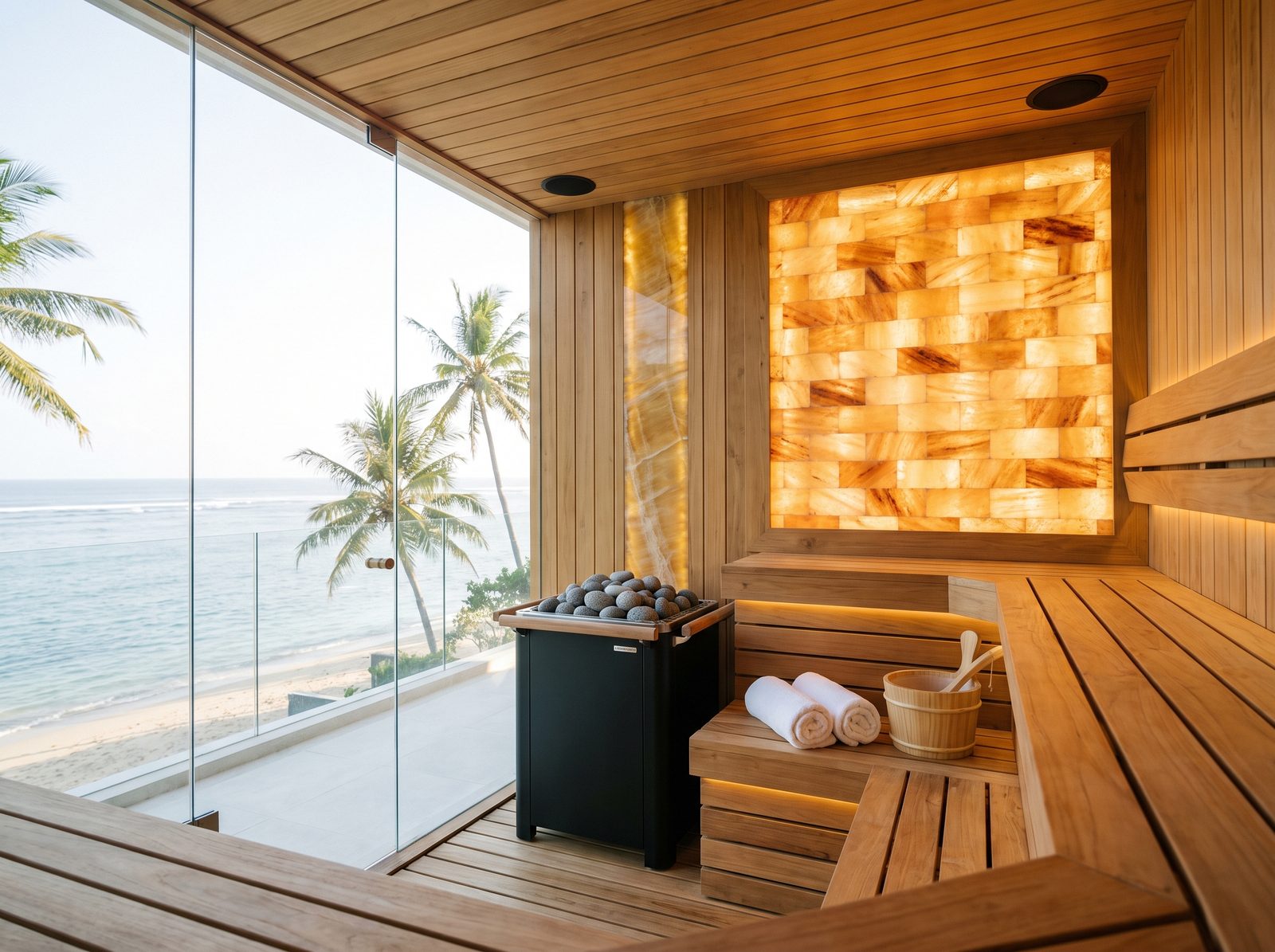
Technical8 min
Sauna electrical requirements in Lombok: PLN supply tiers, single vs three-phase, cable sizing, RCD earthing,…

Wellness Zones8 min
Wellness zone design is a circulation problem: the order of hot room, plunge and rest, the distances between…
Next step
Send a photo of the spot and rough dimensions. You get a layout, a heat-load calculation and a fixed price — usually within two working days.