Cold7 min
Ice bath chiller sizing for a tropical climate
An ice bath chiller rated for Europe runs far harder in Lombok's heat. The real sizing math — heat load, HP per litre,…
Power
PLN cuts out, diesel is loud, and the sun is free eleven months a year. What it actually takes to run a heater and a chiller on panels — and where solar stops making sense.
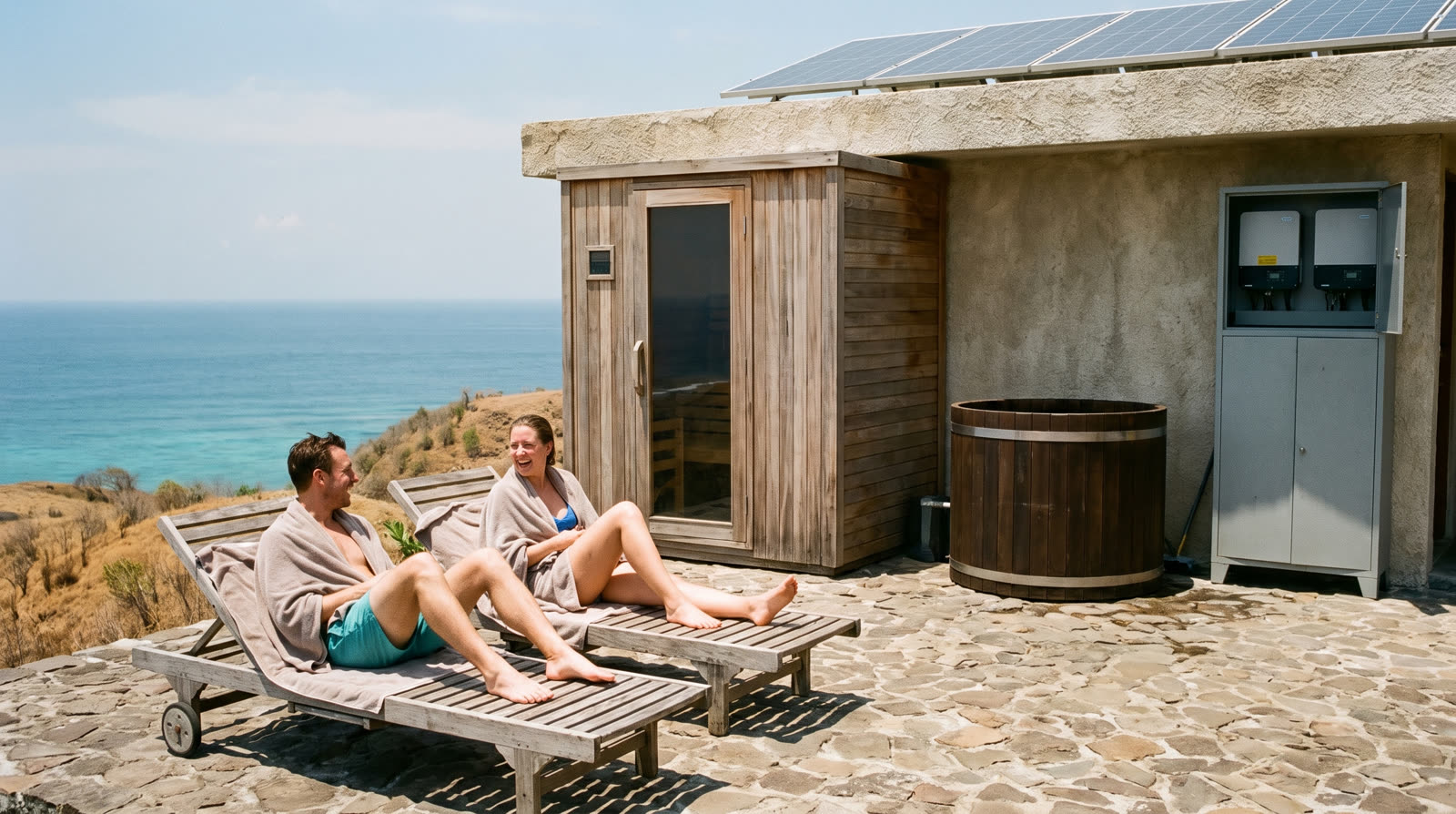
Solar carries an ice-bath chiller in Lombok comfortably and a sauna heater only with help. A 1 HP chiller draws 0.4–0.9 kW and runs hardest exactly when the sun is highest, so a 3–5 kWp rooftop array covers it with margin. A 6–9 kW heater running for 60–90 minutes a day is a different animal: it needs either the grid behind the panels (a grid-tied hybrid), a battery bank sized around 10–15 kWh, or a sauna session timed to the middle of the day. For most villas the right answer is a hybrid system of 5–10 kWp with PLN as the backstop, costing IDR 90–180 million, which also covers the rest of the house. Fully off-grid saunas are possible; they are rarely sensible.
The question comes up on almost every villa brief we take as Sauna Lombok, for two reasons that are both real: PLN reliability on the south coast and the Gilis, and owners who want the wellness zone to read as low-impact. Here is the honest arithmetic.
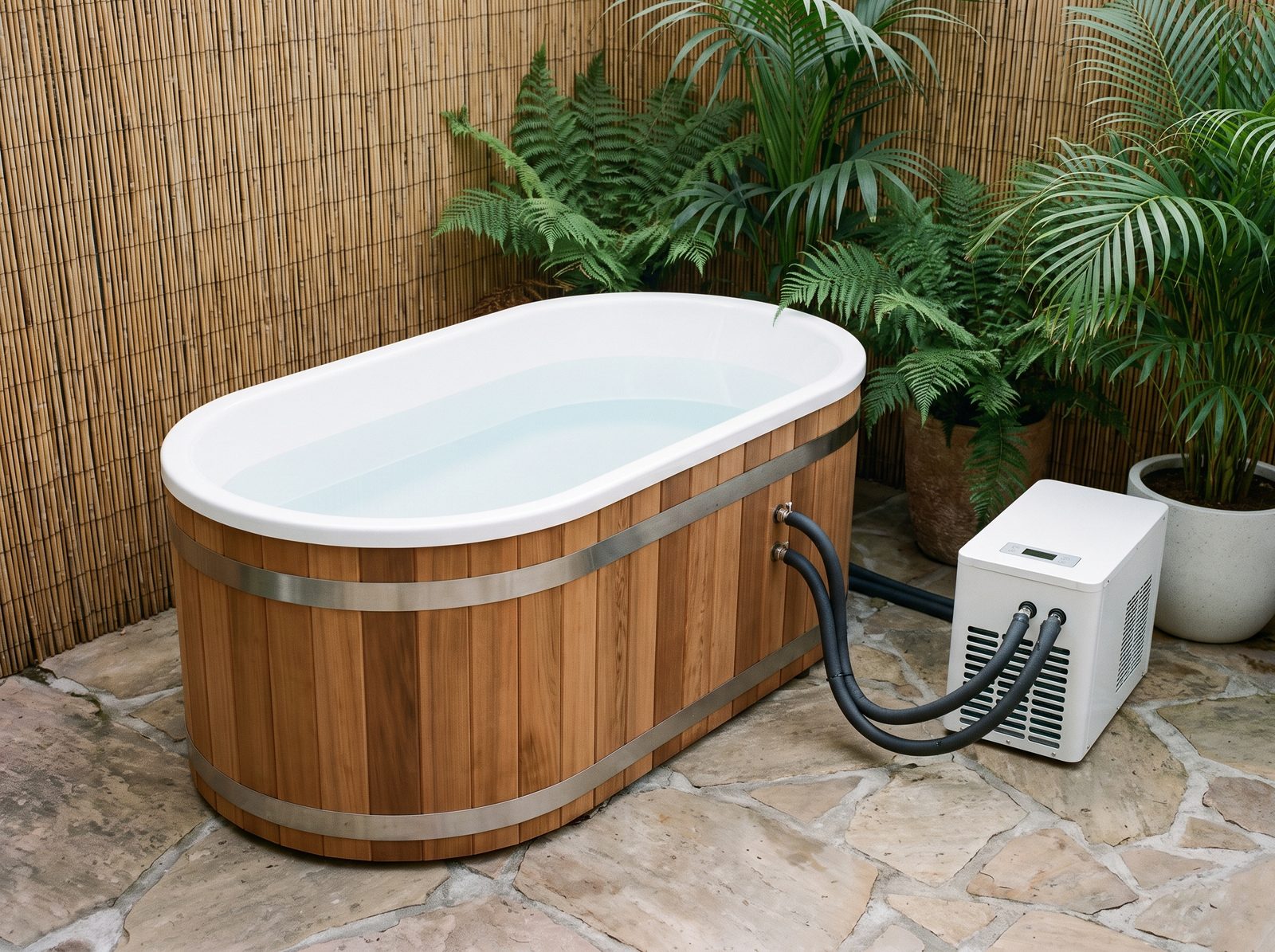
An ice-bath chiller is a refrigeration compressor. It cycles on and off to hold 8–12°C, averaging perhaps 300–600 W across a hot afternoon and less at night. Its work peaks with the sun — the water warms fastest at 2 pm — which is the ideal shape for a solar load. Sizing is covered in our chiller guide for the tropics; for power, treat it like a large fridge.
A sauna heater is a resistive load with no subtlety: 6 kW for a compact cabin, 8–9 kW for a four-to-six-seat room, drawing flat out for 40–60 minutes of warm-up and then in bursts to hold 80–90°C. A one-hour session consumes 6–9 kWh — roughly what a typical Lombok villa's fridge, pumps and lights use in a whole day. Solar can supply that power instantaneously only from a large array in full sun; otherwise the energy has to come from the grid or a battery. Our electrical requirements guide covers the wiring side; this article is about where the electrons come from.
Panels on the roof, a hybrid inverter, PLN connection kept. Daytime, the array runs the chiller, pumps and house; surplus offsets the meter under PLN's export rules. When the sauna heater kicks in, the inverter draws the shortfall from PLN without anyone noticing. Add a modest battery (5–10 kWh) and the villa rides through the evening outages that make guests reach for the WhatsApp complaint. For a villa in Selong Belanak or the Kuta hills, a 5–8 kWp array with a 5 kWh battery typically covers the chiller entirely, most of the house, and about a third of the sauna's energy over a month.
No PLN, or a connection too weak to trust. To run an 8 kW heater for an hour after sunset you need an inverter rated 10–12 kW continuous and a battery bank that can deliver 8–9 kWh with headroom — call it 12–15 kWh of lithium storage — plus an array of 8–12 kWp to refill it the next day alongside the house. That system lands at IDR 250–400 million before the sauna itself. It works, and we have specified it for one remote north-coast site, but the same money buys a very good hybrid system plus a decade of PLN bills. Off-grid is a decision about the site, not about the sauna.
The cheapest fix is behavioural. Run the sauna at 1–3 pm, when a 6 kWp array is producing 4–5 kW, and the grid or a small battery only tops up the remainder. For surf retreats this fits the day anyway — morning session, lunch, sauna and plunge, evening free — and it turns solar from a partial contribution into the main supply. For a private villa used at dusk, it does not fit, and Option A is the honest recommendation.
| Setup | Array | Battery | Inverter | Indicative cost (system only) |
|---|---|---|---|---|
| Chiller only, grid-tied | 3–5 kWp | none | 5 kW hybrid | IDR 55–90M |
| Chiller + house + partial sauna, hybrid | 5–10 kWp | 5–10 kWh | 8–10 kW hybrid | IDR 90–180M |
| Full off-grid with evening sauna | 8–12 kWp | 12–15 kWh | 10–12 kW | IDR 250–400M |
| Infrared cabin (2–3 kW) instead of a heater | 3–5 kWp | 3–5 kWh | 5 kW hybrid | IDR 60–110M |
Solar figures are indicative Lombok installer prices in 2026 and sit outside our quote; we coordinate the electrical interface with your solar installer and size the sauna side accordingly. Sauna and ice-bath pricing is on the pricing page.
If solar independence matters more than löyly, an infrared cabin at 2–3 kW turns the heater problem into a chiller-sized problem. A 5 kWp array with a 5 kWh battery runs an infrared session at any hour. The experience is different — 50–60°C radiant heat rather than 85°C air and steam — but for villas where guests use the sauna for twenty minutes after a surf, it is a legitimate trade that also removes the PLN power-upgrade conversation entirely.
The same air that corrodes sauna hardware (our salt-air maintenance guide covers that side) attacks solar mounting. Specify anodised aluminium rails and A4 stainless fixings, keep inverters and batteries in a ventilated, shaded, salt-screened room rather than an open wall on the sea side, and budget a rinse of the panels after the dry-season dust. Panels lose output as they heat; a 35°C Lombok afternoon costs roughly 10–15% against the nameplate rating, which is why we size arrays with that margin rather than to the brochure number.
Three things: your current PLN capacity (the VA on the meter), when you actually want to use the sauna (afternoon or dusk), and whether the site is grid-connected at all. With those, we can tell you in one reply whether the chiller alone goes on solar, whether the heater joins it, and which of the three options is worth paying for. Send them with a photo of the roof and the intended sauna spot on WhatsApp, and we will include the solar interface in the site survey.
Common questions
Yes, with qualifications. A 6–9 kW heater running for an hour needs either the grid behind the panels (a grid-tied hybrid system of 5–10 kWp), a battery bank of 12–15 kWh for evening sessions off-grid, or sessions timed to midday when the array produces most. A 2–3 kW infrared cabin runs on a 5 kWp array with a small battery at any hour.
Easily. A 1 HP chiller averages 300–600 W and works hardest in the afternoon when the array produces most, so a 3–5 kWp rooftop system covers it with margin, grid-tied or with a small battery for night-time cycling.
Indicative Lombok installer prices in 2026: IDR 55–90 million for a chiller-only grid-tied array, IDR 90–180 million for a 5–10 kWp hybrid with 5–10 kWh of battery that covers the house, chiller and part of the sauna, and IDR 250–400 million for a full off-grid system that runs an evening sauna. Solar is quoted by the installer, separately from the sauna.
Rarely for the sauna alone. The battery and inverter needed for an 8 kW evening load cost as much as a good hybrid system plus a decade of PLN bills. Off-grid makes sense when the site has no usable grid connection at all — a decision about the site, not the sauna.
Keep reading
More from the journal on heat, cold and the specific ways this climate breaks things.
All 20 guidesCold7 min
An ice bath chiller rated for Europe runs far harder in Lombok's heat. The real sizing math — heat load, HP per litre,…

Cold8 min
Cold plunge water treatment matters even though the water is cold. Filtration, ozone, UV, chlorine at 10°C,…
Cold8 min
Ice bath temperature isn't a race to the lowest number. The 8–12°C working range, a 15°C beginner entry, and…
Next step
Send a photo of the spot and rough dimensions. You get a layout, a heat-load calculation and a fixed price — usually within two working days.