Cold8 min
Ice bath temperature: why colder is not better
Ice bath temperature isn't a race to the lowest number. The 8–12°C working range, a 15°C beginner entry, and…
Commercial
A framework for hotel and surf-resort sauna ROI in Lombok: capex, running cost, staffing, the after-surf peak and a worked illustrative example.
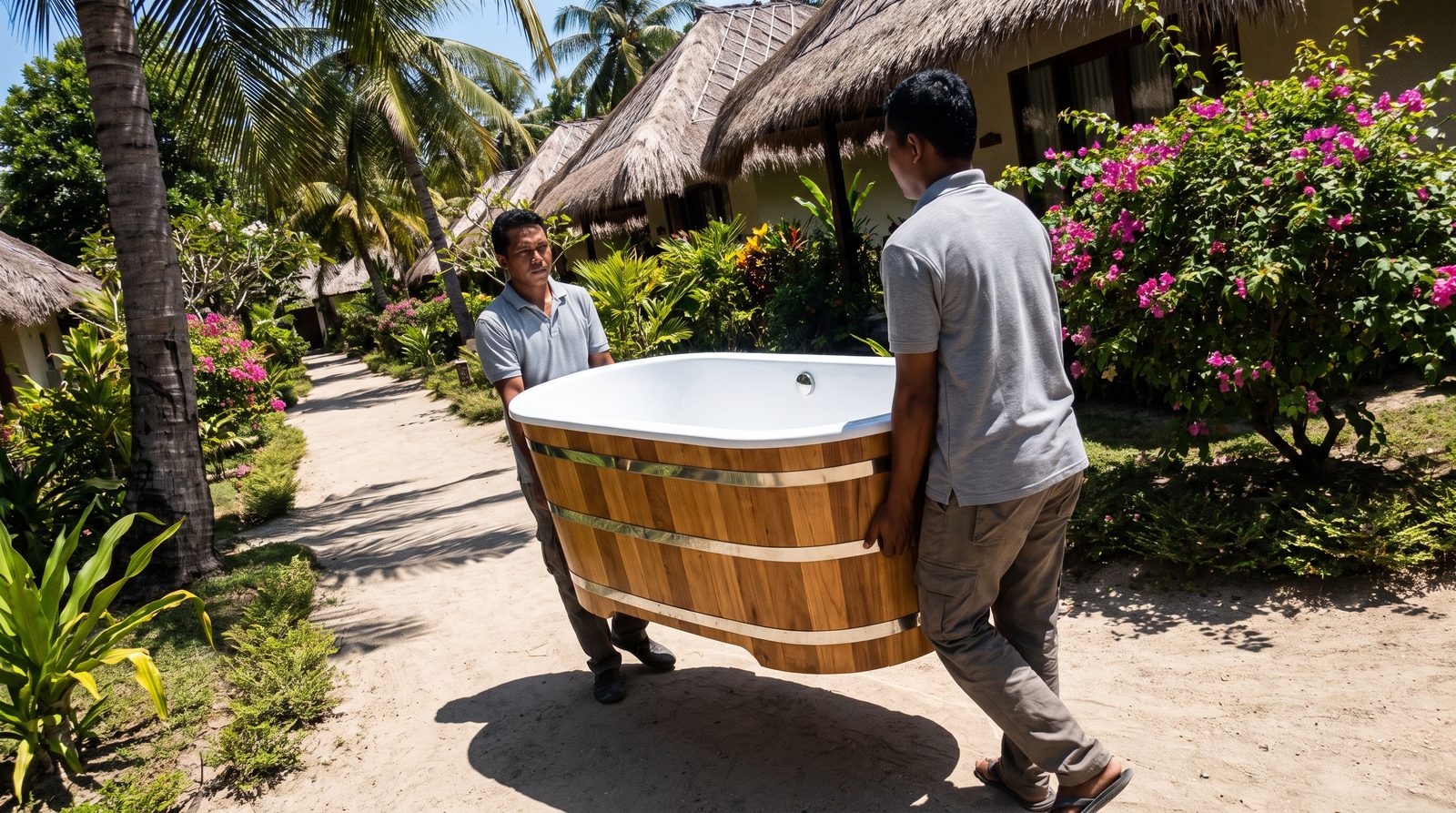
A wellness zone at a boutique hotel is best modelled as a rate-and-occupancy lever, not as a cost centre to be minimised. A well-run sauna and cold-plunge area gives guests a reason to book a higher-rated room, extends dwell time on property, and shows up in the review language other guests read before they book. None of that appears as its own line item — it appears inside the rate you can charge and the occupancy you can hold, which is why a hotel sauna should be evaluated against the revenue it supports, not just its running cost.
This article is a framework for thinking about that return, not a set of market statistics — nobody outside your own booking system knows your occupancy, your rate premium, or your guest mix. The worked numbers later on are illustrative arithmetic, not benchmarks. Run your own figures through the same structure and it will tell you something real about your property.
Treat a wellness zone the way you would treat an ocean-view upgrade or a private pool: a capital asset that supports pricing, not an amenity whose value is measured only in what it costs to run. Guests researching a boutique stay in Selong Belanak, Kuta Lombok or the wider Mandalika area increasingly filter listings by wellness features, and a genuine heat-and-cold offering is still uncommon enough on the island to function as a real differentiator rather than a checkbox.
The commercial case rests on three effects, all indirect: a defensible rate premium on rooms or packages tied to the wellness offer, a tie-breaker effect in the booking decision itself when a guest is comparing two similar properties, and small incremental revenue from treating it as a bookable — sometimes paid — experience for day guests. None of these show up as their own line in a P&L. They show up inside room revenue and package revenue, which is exactly why a wellness zone gets undervalued when it is judged only on capex and running cost.
A full wellness zone — sauna, cold plunge, and the surrounding deck and landscaping — starts from IDR 240,000,000 (≈ USD 14,800) as an indicative package. For a commercial property, budget beyond that baseline for a higher duty-cycle specification: a heater and chiller sized for multiple sessions a day rather than occasional evening use, and often two cabins, or a larger cabin, so guests are not queuing at peak hours.
Componentised, an outdoor cabin sauna starts from IDR 125,000,000 (≈ USD 7,700) and a chilled cold plunge from IDR 68,000,000 (≈ USD 4,200), which lets a phased build start with one and add the other once it is proven with guests. Either path still carries the site-specific extras covered in our sauna cost breakdown — electrical supply, foundation, drainage and freight — and a commercial build usually sits at the upper end of those ranges, since duty cycle and guest-proofing both push specification up.
Running cost has three components: electricity for the heater and any chiller, water for the cold plunge and washdown, and the more general upkeep of a structure exposed to daily guest traffic rather than occasional private use. Electricity is the largest and the most predictable, since it scales directly with hours run per day and the kW rating of the equipment — a heater run for six guest sessions a day costs a multiple of one run twice a week, but it is also spread across far more sessions, which is the arithmetic worth doing properly rather than guessing at.
Chiller sizing deserves particular attention commercially. Lombok's ambient temperature means a chiller works far harder than its nameplate rating suggests — budget roughly double the nameplate you would use in a temperate climate, with about 1 HP per 1,000 L as a starting point for holding a cold plunge near 10°C. A commercial plunge used by multiple guests through the day carries more heat load, from bodies and ambient exposure, than a private one, so this is not a place to under-specify to save on the initial quote.
Most boutique properties do not need a dedicated wellness attendant. The realistic model folds daily checks into an existing role, such as a pool or maintenance team member's morning round. That round should cover water treatment for the cold plunge — see our cold plunge water treatment guide — a visual check of the heater and timber, and resetting signage between sessions.
Scheduling matters more than staffing cost. A bookable slot system, even a simple one built into existing reservation software, avoids the two failure modes that sink guest satisfaction fastest: overcrowding at peak times — at a surf property, the two hours after the afternoon session — and an empty, cold facility at other times because nobody knew it was available. Clear posted safety rules at an unsupervised guest facility are not optional — they are what makes an unstaffed model workable at all.
An unsupervised wellness facility with no posted temperature guidance, no session-length recommendation and no visible emergency contact is the single most common gap we find auditing existing hotel installations — cheap to fix, and the first thing a cautious guest or an insurer will ask about.
Throughput is simple arithmetic once you fix two numbers: how many guests a session seats, and how many sessions fit in the hours you choose to operate. A cabin sized for four typically supports a session length of 20–30 minutes for traditional heat, or 30–45 minutes for infrared, plus a turnover gap for airing and a quick check between groups. Over an eight-hour operating window that is roughly 10–14 sessions a day, seating somewhere between 40 and 55 guest-visits, before accounting for any slots you deliberately hold open.
Compare that number to your room count and typical occupancy, not to an industry benchmark — and then map it against when demand actually arrives. At a surf camp or surf resort the day has a shape: the property empties for dawn patrol, then everyone wants heat in the same window after the afternoon session, with a second wave after dinner. Flat-capacity arithmetic overstates what one cabin delivers into a peak like that, which is exactly the point at which a second cabin, staggered rounds or a longer evening window earns its keep rather than being a discretionary upsell.
Commercial guest traffic wears a wellness zone faster than private use, and salt air accelerates the parts of that wear that are electrical and metal rather than timber. Hinges, door hardware, heater contactors and any exposed fixings need a more frequent inspection cycle than a private villa would budget for — typically quarterly rather than annual, given daily use.
Timber holds up well if the species choice was right from the start — bengkirai or teak decking, thermally-modified interiors — but higher guest turnover means benches and door hardware see more cycles of swelling and drying than a private sauna sees in years. Budget a proper maintenance line as an operating cost from day one, rather than discovering it as a surprise capex request in year two.
The arithmetic below uses invented, round numbers purely to illustrate the structure of the calculation. Replace every input with your own figures — your rate strategy, your occupancy, your own booking data — before treating any output as a real projection.
| Input (illustrative) | Example value |
|---|---|
| Capex, full wellness zone | IDR 240,000,000 (≈ USD 14,800) |
| Rooms at the property (example) | 20 |
| Illustrative rate uplift attributed to wellness, per occupied night | IDR 40,000 (≈ USD 2.50) |
| Illustrative occupied room-nights per year | 5,000 |
| Resulting illustrative annual attributed revenue | IDR 200,000,000 (≈ USD 12,300) |
| Illustrative annual running cost (power, water, upkeep, staffing share) | IDR 45,000,000 (≈ USD 2,800) |
| Illustrative net annual return | IDR 155,000,000 (≈ USD 9,500) |
| Illustrative simple payback | ~1.5–1.6 years |
Every number in that table except the capex figure is invented for this illustration — plausible in shape, not sourced from any market data, and not a promise about what your property will see. The structure is the useful part: a capex figure you can get from a survey, an assumption about attributed rate uplift that only you can estimate from your own rate strategy, and your own occupied-night count from your property management system. Run your real numbers through that same structure and you get a real payback estimate, not our invented one.
Sensitivity matters more than the headline number. Halve the assumed uplift and the payback roughly doubles; halve the occupied-night count and it does the same. Before committing capital, it is worth running the calculation at a deliberately conservative uplift assumption — half of whatever you first guess — and checking the payback still makes sense at that lower bar.
Before this framework becomes a real number for your property, gather four things:
The first two are yours to model. We can help directly with the last two. A commercial wellness zone is engineered differently from a private one from the first conversation — heavier duty cycle, guest-proofing, and a maintenance plan built in rather than added later. Talk to us about a wellness zone sized and specified for your property's actual guest throughput, and we will help you build the real version of the table above.
Common questions
It can be, when modelled as a rate-and-occupancy lever rather than a standalone cost. A wellness zone supports pricing and booking decisions the same way a view or a pool does, but the return depends entirely on your own rate strategy and occupancy — not on a general statistic. Use the framework in this guide with your own figures before deciding.
A full wellness zone starts from IDR 240,000,000 (≈ USD 14,800) as an indicative package. Componentised, an outdoor cabin sauna starts from IDR 125,000,000 (≈ USD 7,700) and a chilled cold plunge from IDR 68,000,000 (≈ USD 4,200). Commercial builds usually sit toward the upper end of these ranges because of higher duty-cycle specification.
Usually not. Most boutique properties fold daily checks — water treatment, a visual equipment check, resetting signage — into an existing pool or maintenance role. What matters more is a bookable slot system to prevent overcrowding, and clearly posted safety rules, since many hotel wellness facilities run unsupervised for most of the day.
Start from four inputs: the capex from a site survey, your own occupied-night count, an assumed rate uplift attributed to the wellness offer, and a realistic commercial running cost. Multiply uplift by occupied nights for attributed revenue, subtract running cost, and divide capex by that net figure for a simple payback. Use your own numbers, not generic ones.
Budget quarterly inspection rather than the annual check that suits a private villa sauna. Daily guest traffic and Lombok's salt air both accelerate wear on hinges, door hardware and heater contactors specifically, and higher guest turnover puts more swelling-and-drying cycles through timber benches than a private sauna sees in years.
Keep reading
More from the journal on heat, cold and the specific ways this climate breaks things.
All 19 guidesCold8 min
Ice bath temperature isn't a race to the lowest number. The 8–12°C working range, a 15°C beginner entry, and…
Technical8 min
Sauna electrical requirements in Lombok: PLN supply tiers, single vs three-phase, cable sizing, RCD earthing,…
Wellness Zones8 min
Wellness zone design is a circulation problem: the order of hot room, plunge and rest, the distances between…
Next step
Send a photo of the spot and rough dimensions. You get a layout, a heat-load calculation and a fixed price — usually within two working days.